
Catalogue Search | MBRL


Are you sure you want to remove the book from the shelf?

{{itemTitle}}
99
result(s) for
"Folklore Egypt."
Sort by:

The mouse who saved Egypt
In ancient times, a young Egyptian prince rescues a mouse and many years later, when the boy has become Pharoah, the mouse hears his prayer to the Sun God and finds a way to repay the debt.
Book
Les Contes populaires de l'Égypte ancienne
Extrait: \"La découverte en 1852 d'une sorte de nouvelle égyptienne, analogue aux récits des Mille et une nuits, fut une surprise réelle pour la plupart des savants de l'Europe. On s'attendait bien à trouver dans les papyrus des hymnes à la divinité, des poèmes historiques, des écrits de magie ou de science, des lettres d'affaire, une littérature sérieuse et solennelle, mais des contes?\" À PROPOS DES ÉDITIONS LIGARAN: Les éditions LIGARAN proposent des versions numériques de grands classiques de la littérature ainsi que des livres rares, dans les domaines suivants: • Fiction: roman, poésie, théâtre, jeunesse, policier, libertin.
• Non fiction: histoire, essais, biographies, pratiques.
eBook

Walls of the prince : Egyptian interactions with Southwest Asia in antiquity : essays in honour of John S. Holladay, Jr
Walls of the Prince offers a series of articles that explore Egyptian interactions with Southwest Asia during the second and first millennium BCE, including long-distance trade in the Middle Kingdom, the itinerary of Thutmose III's great Syrian campaign, the Amman Airport structure, anthropoid coffins at Tell el-Yahudiya, Egypt's relations with Israel in the age of Solomon, Nile perch and other trade with the southern Levant and Transjordan in the Iron Age, Saite strategy at Mezad Hashavyahu, and the concept of resident alien in Late Period Egypt. These are complemented by methodological and typological studies of data from the archaeological investigations at Tell al-Maskhuta, the Wadi Tumilat, and Mendes in the eastern Nile delta. Together, they reflect the diverse range of Professor Holladay's long and distinguished scholarly career.
eBook


Veiled sentiments : honor and poetry in a Bedouin society
\"First published in 1986, Lila Abu-Lughod's Veiled Sentiments has become a classic ethnography in the field of anthropology. During the late 1970s and early 1980s, Abu-Lughod lived with a community of Bedouins in the Western Desert of Egypt for nearly two years, studying gender relations, morality, and the oral lyric poetry through which women and young men express personal feelings. The poems are haunting, the evocation of emotional life vivid. But Abu-Lughod's analysis also reveals how deeply implicated poetry and sentiment are in the play of power and the maintenance of social hierarchy. What begins as a puzzle about a single poetic genre becomes a reflection on the politics of sentiment and the complexity of culture. This thirtieth anniversary edition includes a new afterword that reflects on developments both in anthropology and in the lives of this community of Awlad 'Ali Bedouins, who find themselves increasingly enmeshed in national political and social formations. The afterword ends with a personal meditation on the meaning-for all involved-of the radical experience of anthropological fieldwork and the responsibilities it entails for ethnographers.\"--Publisher's description.
Book
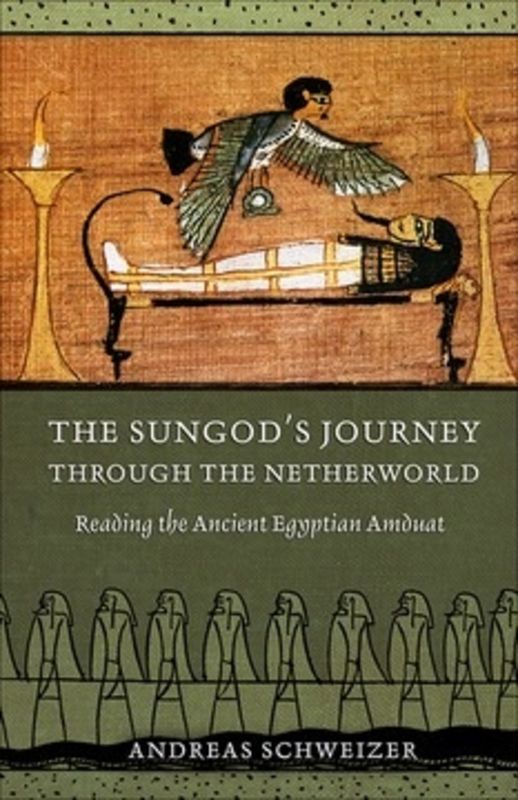
The Sungod's Journey Through the Netherworld
\"The ancient Egyptian sources come alive, speaking to us without seeming alien to our modern ways of thinking. Andreas Schweizer invites us to join the nocturnal voyage of the solar barque and to immerse ourselves, with the 'Great Soul' of the sun, into the darkness surrounding us. Here in the illustrations and texts of theAmduat, threats hidden in the depths of our soul become visible as concrete images, an analysis of which remains ever worthwhile: even in the guise of the evil, ominous, or dark side of godhead with which Schweizer concerns himself. The netherworld into which we descend underlies our own world. Creative energies of dreadful intensity are active there, and only death, to which all must surrender, makes us truly alive by offering us regeneration from the depths.\"-Erik Hornung, from the Foreword
TheAmduat(literally \"that which is in the netherworld\") tells the story of the nocturnal journey of Re, the Egyptian Sungod, through the netherworld from the time when the sun dies, after setting in the west, to its rebirth at sunrise in the east. In the middle of the night, in the profoundest depths of the netherworld, this resurrection is made possible by a mystical union of the sun with the mummified body of Osiris, god of the dead. This great mystery of the union between the freely moving soul of the Sungod, longing for the bright and boundless sky, with Osiris's corpse, which is irrevocably bound to the subterranean realm of the dead, evokes the renewal of all life and the restoration of totality.
In the Egyptian belief system, the pharaohs and in later times all blessed dead embarked on this same \"night-sea journey\" after death, ultimately becoming one with Re and living forever. The vision of the afterlife elaborated in theAmduat, dating from around 1500 B.C.E., has been influential for millennia, providing the model for an entire genre of Egyptian literature, the Books of the Afterlife, which in turn endured into the Greco-Roman era. Its themes and images persisted into gnostic and alchemical texts and made their way into early Christian portrayals of the beyond.
InThe Sungod's Journey through the Netherworld, Andreas Schweizer guides the reader through the Amduat, offering a psychological interpretation of its principal textual and iconographic elements. He is concerned with themes that run deep and wide in human experience, drawing on Jungian archetypes to find similar expression in many cultures worldwide: sleep as death; resurrection as reawakening or rebirth; and salvation or redemption, whether from original sin (as for Christians) or from the total annihilation of death (as for the ancient Egyptians).
eBook

Tales of ancient egypt
Retells twenty stories of magic, adventure, and mythology first told in ancient Egypt.
Book

Kaygusuz Abdal: Founder of Two Edges of Mediterranean – Entourage, Intention and Entity
The historical information about the biography of Kaygusuz Abdal; is inversely proportional to his recognition in the tradition and history of literature. As much as Kaygusuz's poetry and ideas are concerned, precise information about his biography is less explored. Although Kaygusuz is the most frequently cited name in almost every Bektashi poetry collection, and all recent histories of Turkish literature mention him as an important person in the literary history of the Turks however the biographical information that should be available about him is insufficient. There is almost a consensus that he lived in the second half of the 14th century and the first half of the 15th century. There is no consensus on where and when he died and where he was buried. The issue that Kaygusuz is the founder of Alawi and Bektashi literature is also discussed in two stages, historically and literary. Some state that Kaygusuz's founding feature carries both a literary and a historical notion, as his views are based on the interpretation of many issues in Bektashism. Here, Kaygusuz Abdal's life is discussed as a part of constituent phenomena. The one who gave birth to the reality of Kaygusuz spread it and kept it alive; the connection of the entourage, purpose, and essence has been construed. In most of the traces of Turkish literature and as a part of Turkish historiography, Kaygusuz has been referred to as the founder of Alawi and Bektashi literature. He is especially mentioned as the founder of Bektashism in Egypt. How it is mentioned is also important. There will be a discussion on the tension line here. An approach has been developed on Kaygusuz's history and his entourage, as well as the part of his legendary life that is thought to belong to him. To define a personality like Kaygusuz, to reveal the phenomenon of Kaygusuz, it is essential to turn to the common perception and to focus on the issues that make up the common way of understanding a historical and legendary poet, Sufi. Then Kaygusuz's intention; as a notion that grounds or defines intentions, the place of travel in the history of culture will be tried to be understood through the position of Egypt in the Turkic World and the Islamic world. In the last part, Kaygusuz's personality and qualities that determine his place in Alawi and Bektashi literature and the history of Turkish literature, in general, will be defined through the Mediterranean, the beginnings problem, and the paradigms of founding. Mahlası olan Kaygusuz ile nam salmış olan Alâeddin, Gaybî veya Alâaddin Gaybî’nin biyografisi hakkında mevsuk bilgiler gelenekte ve edebiyat tarihindeki tanınmasıyla ters orantılıdır. Kaygusuz’un şiiri ve fikirleri ne kadar biliniyorsa bir o kadar biyografisi konusunda kesin bilgiler verilememektedir. Kaygusuz Abdal’ın Türk folklorunda önemli bir şahsiyet olması,hemen her Bektaşî şiir derlemesinde en sık yer verilen isim olması, diğer yandan Türk edebiyatı tarihçelerinin neredeyse hepsinde Kaygusuz’dan Türklerin edebiyat tarihinde önemli bir kişi olarak söz etmesinin sonucunda mevcut olması gereken biyografik bilgi beklentisi karşılığını bulamamaktadır. XIV.yüzyılın ikinci yarısı ve XV.yüzyılın ilk yarısında yaşamış olduğu konusunda neredeyse bir fikir birliği bulunmaktadır. Alâiye beyinin oğlu olduğu başından geçen olağanüstü bir olaydan sonra Abdal Musa’ya mürit olmak istediği; uzun yıllar Abdal Musa tekkesinde hizmet ettiği ve sonrasında yollara düştüğü ve vefat ettiği rivayet edilir. Nerede ve ne zaman öldüğü, nerde medfun olduğu konusunda fikir birliği bulunmamaktadır. Nice eseri bugüne ulaşabilmiş, kendi devri sonrasında da ismi ve mirası yaşatılmış olan Kaygusuz’un ne zaman vefat ettiği bir kenara, nerede öldüğü konusundaki tarihi uzlaşmazlık da Kaygusuz gibi öncü bir isim için olması gerekendir. Diğer yandan ve doğal olarak Yeniçağın başındaki böylesi bir şahsiyet için kesin bilgiler verebilmek onu tarihin literal bir unsuru olmasına sebep de olabilirdi. Edebi şahsiyetin asırlar öncesi ve onu aşan boyutunu örtmesi tehlikesi de söz konusudur. Kaygusuz’un Alevi ve Bektaşî edebiyatının kurucusu olduğu meselesi de tarihi ve edebi olarak iki aşamada tartışılmaktadır. Kimi Alevi ve Bektaşî edebiyatının hem şiirde hem nesirde Kaygusuz’la başladığını kimi Bektaşîlikteki birçok meselenin yorumlanmasında onun görüşlerinin temel alınması dolayısıyla kuruculuğun hem edebi hem de tarihi bir nosyonu olduğunu tartışır. Bu çalışmada Kaygusuz Abdal’ın hayatına kurucu fenomenler çerçevesinde yaklaşılacaktır. Kaygusuz Abdal gerçekliğini doğuran, yayan, yaşatan; çevre, gaye ve öz ilişkilerinin bağlantısı çözümlenmeye çalışılacaktır. Türk tarih yazımı ve onun bir parçası olarak Türk Edebiyatı tarihçelerinin çoğunda Kaygusuz’un Alevi ve Bektaşî edebiyatının kurucusu olarak anılması; özellikle Mısır’da Bektaşiliğin kurucusu olarak zikredilmesi veya nasıl zikredildiğinin ihtiva ettiği gerilim hattında bir tartışma yürütülecektir. Kaygusuz’un tarihi ve menkıbevi hayatının şahsına ait olduğu düşünülen kısmı kadar maiyeti üzerinden bir yaklaşım geliştirilmiştir. Onun gibi bir şahsiyeti tanımlayabilmek, Kaygusuz görüngüsünü ortaya koyabilmek için hiss-i müştereği; dolaylı ama ortak yoldan anlamayı oluşturan hususlara eğilmek elzemdir. Ardından Kaygusuz’un niyeti; niyetleri temellendiren veya niyetleri tanımlayan bir nosyon olarak seyahatin kültür tarihindeki yeri ve Mısır’ın Türk Dünyası ve İslam alemindeki konumu üzerinden anlaşılmaya çalışılacaktır. Son bölümde Kaygusuz’un şahsiyetini ve Alevi ve Bektaşî Edebiyatı ve genel olarak Türk Edebiyatı Tarihi’ndeki yerini belirleyen nitelikleri; Akdeniz, başlangıç sorunu ve kuruculuk paradigmaları üzerinden tanımlanacaktır.
Journal Article