
Catalogue Search | MBRL


Are you sure you want to remove the book from the shelf?

{{itemTitle}}
17
result(s) for
"Folklore Russie."
Sort by:


Flying Tiger
Storytelling bridges culture, history, and spirituality. In The Flying Tiger Kira Van Deusen takes us into the world of the female shamans of the Amur, presenting over fifty traditional stories she recorded in the 1990s from the people of the taiga forest in the Russian Far East. More than a collection of tales, the reader learns about the lives of the story-tellers and their history, their spiritual traditions, adaptation to the environment, relationships with animals, and sense of humour.
eBook

Soul Hunters
This is an insightful, highly original ethnographic interpretation of the hunting life of the Yukaghirs, a little-known group of indigenous people in the Upper Kolyma region of northeastern Siberia. Basing his study on firsthand experience with Yukaghir hunters, Rane Willerslev focuses on the practical implications of living in a \"hall-of-mirrors\" world—one inhabited by humans, animals, and spirits, all of whom are understood to be endless mimetic doubles of one another. In this world human beings inhabit a betwixt-and-between state in which their souls are both substance and nonsubstance, both body and soul, both their own individual selves and reincarnated others. Hunters are thus both human and the animals they imitate, which forces them to steer a complicated course between the ability to transcend difference and the necessity of maintaining identity.
eBook

Singing Story, Healing Drum
\"Singing Story, Healing Drum\" explores the shamanic practices, oral traditions, and music of the Turkic Republics of Tuva and Khakassia in south Siberia. Based on extensive field-work, it includes folktales, legends, and shamanic poems that illuminate spiritual traditions, as well as description of rituals practised by the people of this region. Kira Van Deusen's travels and her acquaintance with scholars, shamans, and storytellers who have been active in reviving traditional culture give her a unique perspective that allows her to present views from inside and outside the culture.;Lively personal accounts are combined with scholarly research to show the importance of oral literature and music in connection with shamanism. \"Singing Story, Healing Drum\" helps the reader find a way through the often confusing phenomena of the \"shamanic revival\", both in Russia and abroad.
eBook

The Cossack Myth
In the years following the Napoleonic Wars, a mysterious manuscript began to circulate among the dissatisfied noble elite of the Russian Empire. Entitled The History of the Rus', it became one of the most influential historical texts of the modern era. Attributed to an eighteenth-century Orthodox archbishop, it described the heroic struggles of the Ukrainian Cossacks. Alexander Pushkin read the book as a manifestation of Russian national spirit, but Taras Shevchenko interpreted it as a quest for Ukrainian national liberation, and it would inspire thousands of Ukrainians to fight for the freedom of their homeland. Serhii Plokhy tells the fascinating story of the text's discovery and dissemination, unravelling the mystery of its authorship and tracing its subsequent impact on Russian and Ukrainian historical and literary imagination. In so doing he brilliantly illuminates the relationship between history, myth, empire and nationhood from Napoleonic times to the fall of the Soviet Union.
eBook
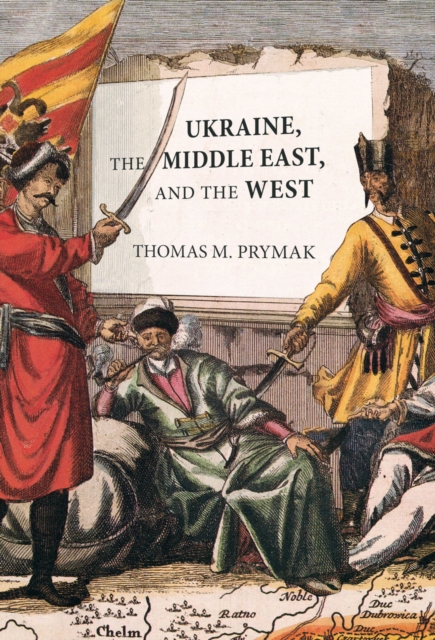
Ukraine, the Middle East, and the West
For decades, Ukrainian contacts with the outside world were
minimal, impeded by politics, ideology, and geography. But prior to
the Soviet period the country enjoyed diverse exchanges with, on
the one hand, its Islamic neighbours, the Crimean Khanate and the
Ottoman Empire, and, on the other, its central and western European
neighbours, especially Poland and France. Thomas Prymak addresses
geographical knowledge, international travel, political conflicts,
historical relations with religiously diverse neighbours, artistic
developments, and literary and language contacts to smash old
stereotypes about Ukrainian isolation and tell a vivid and original
story. The book treats a wide range of subjects, including
Ukrainian travellers in the Middle East, from pilgrims to the Holy
Land to political exiles in Turkey and Iran; Tatar slave raiding in
Ukraine; the poetry of Taras Shevchenko and the Russian war against
Imam Shamil in the High Caucasus; Ukrainian themes and the French
writers Honoré de Balzac and Prosper Mérimée; Rembrandt's
mysterious painting today titled The Polish Rider ; and
Ilya Repin's legendary painting of the Zaporozhian Cossacks writing
their satirical letter mocking the Turkish sultan. Drawing together
political and cultural history, languages and etymology, and
folklore and art history, Ukraine, the Middle East, and the
West is an original interdisciplinary study that reintroduces
Ukraine's long-overlooked connections beyond Eastern Europe.
eBook

Building Fortress Europe
What happens when a region accustomed to violent shifts in borders is subjected to a new, peaceful partitioning? Has the European Union spent the last decade creating a new Iron Curtain at its fringes?Building Fortress Europe: The Polish-Ukrainian Frontierexamines these questions from the perspective of the EU's new eastern external boundary. Since the Schengen Agreement in 1985, European states have worked together to create a territory free of internal borders and with heavily policed external boundaries. In 2004 those boundaries shifted east as the EU expanded to include eight postsocialist countries-including Poland but excluding neighboring Ukraine. Through an analysis of their shared frontier,Building Fortress Europeprovides an ethnographic examination of the human, social, and political consequences of developing a specialized, targeted, and legally advanced border regime in the enlarged EU. Based on fieldwork conducted with border guards, officials, and migrants shuttling between Poland and Ukraine as well as extensive archival research,Building Fortress Europeshows how people in the two countries are adjusting to living on opposite sides of a new divide. Anthropologist Karolina S. Follis argues that the policing of economic migrants and asylum seekers is caught between the contradictory imperatives of the European Union's border security, economic needs of member states, and their declared commitment to human rights. The ethnography explores the lives of migrants, and their patterns of mobility, as framed by these contradictions. It suggests that only a political effort to address these tensions will lead to the creation of fairer and more humane border policies.
eBook

Ukraine and Europe
Ukraine and Europe challenges the popular perception of Ukraine as a country torn between Europe and the east. Twenty-two scholars from Europe, North America, and Australia explore the complexities of Ukraine's relationship with Europe and its role the continent's historical and cultural development.
eBook