
Catalogue Search | MBRL


Are you sure you want to remove the book from the shelf?

{{itemTitle}}
9
result(s) for
"Folly Religious aspects Christianity."
Sort by:

The praise of folly
\"Desiderius Erasmus (1466-1536) was a Dutch humanist, scholar, and social critic, and one of the most important figures of the Renaissance. The Praise of Folly is perhaps his best-known work. Originally written to amuse his friend Sir Thomas More, this satiric celebration of pleasure, youth, and intoxication irreverently pokes fun at the pieties of theologians and the foibles that make us all human, while ultimately reaffirming the value of Christian ideals. No other book displays quite so completely the transition from the medieval to the modern world, and Erasmus's wit, wisdom, and critical spirit have lost none of their timeliness today.\"--Publisher's description.
Book

The praise of folly
Desiderius Erasmus (1466-1536) was a Dutch humanist, scholar, and social critic, and one of the most important figures of the Renaissance.The Praise of Follyis perhaps his best-known work. Originally written to amuse his friend Sir Thomas More, this satiric celebration of pleasure, youth, and intoxication irreverently pokes fun at the pieties of theologians and the foibles that make us all human, while ultimately reaffirming the value of Christian ideals. No other book displays quite so completely the transition from the medieval to the modern world, and Erasmus's wit, wisdom, and critical spirit have lost none of their timeliness today.
This Princeton Classics edition ofThe Praise of Follyfeatures a new foreword by Anthony Grafton that provides an essential introduction to this iridescent and enduring masterpiece.
eBook
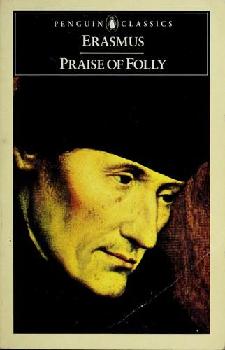
Praise of folly ; and, Letter to Martin Dorp, 1515
The classic work of the Renaissance humanist satirizes the organized Christian Church of the sixteenth century.

The Praise of Folly
Desiderius Erasmus (1466–1536) was a Dutch humanist, scholar, and social critic, and one of the most important figures of the Renaissance. The Praise of Folly is perhaps his best-known work. Originally written to amuse his friend Sir Thomas More, this satiric celebration of pleasure, youth, and intoxication irreverently pokes fun at the pieties of theologians and the foibles that make us all human, while ultimately reaffirming the value of Christian ideals. No other book displays quite so completely the transition from the medieval to the modern world, and Erasmus's wit, wisdom, and critical spirit have lost none of their timeliness today.
This Princeton Classics edition of The Praise of Folly features a new foreword by Anthony Grafton that provides an essential introduction to this iridescent and enduring masterpiece.
eBook


Preaching Fools
Across national and cultural borders, the archetype of the fool has played a significant role in how communities interpret and ascribe identity. As Charles Campbell and Johan Cilliers remind us, the Christian preacher, tasked with delivering a paradoxical gospel, is a fool. In a delicate exploration with enlightening results, Preaching Fools uses a diverse representation of fools and foolish actions to show how modern preaching is inseparable from the folly of the cross. Campbell and Cilliers walk the fine line between the ugliness and beauty of the gospel and challenge readers toward a deeper engagement with its unsettling message.
eBook

Jest in Time: The Problems and Promises of the Holy Fool in Francesco, giullare di Dio, Ordet, and Ikiru
This paper is a study of Roberto Rossellini's Francesco, giullare di Dio (The Flowers of St. Francis, 1950), Akira Kurosawa's Ikiru (1952), and Carl Dreyer's Ordet (1955) through the theoretical lens of the religious figure of the holy fool. First, I assert that each film employs a foolish character in order to critique the contemporary culture, particularly resisting modern attempts to soften or ignore extreme elements of Christian teaching, such as sacrificial self-giving for others or the hope of bodily resurrection. Second, I argue that the content of a fool character affects the film's form, creating a subversive style which in turn aims to produce a \"conversion\" or change in the viewer, making the film itself an instantiation of holy folly. A typology of the holy fool within the Christian tradition, its major features and functions, is first discussed followed by detailed analyses of each film.
Journal Article

Pride : the seven deadly sins
Dyson, named by Ebony magazine one of the 100 most influential African Americans, here looks at the many dimensions of pride. Ranging from Augustine and Aquinas, MacIntyre and Hauerwas, to Niebuhr and King, Dyson offers a thoughtful, multifaceted look at this \"virtuous vice.\" He probes the philosophical and theological roots of pride in examining its transformation in Western culture. Dyson discusses how black pride keeps blacks from being degraded and excluded by white pride, which can be invisible, unspoken, but nonetheless very powerful. Dyson also offers a moving glimpse into the teachers and books that shaped his personal pride and vocation and also looks at less savory aspects of national pride.
eBook

In Praise of Folly: A cursory review and appreciation five centuries later/'Lof der Zotheid': 'n oorsig en evaluering vyf eeue later
Desiderius Erasmus was a humanist reformer concerned with reforming the civil and ecclesiastical structures of his society. In reformed circles, much attention is paid to his role in the Lutheran controversy. Despite this, his powerful influence continues to this day. Erasmus’ particular fool’s literature, Moriae Encomium (1509), revealed his humanist concerns for civil and ecclesial society as a whole. He employed folly as a rhetorical instrument in satirical manner, evoking readers’ amusement from numerous charges against the perceived multilayered social reality of the day. Five hundred years later the person of Folly may still perform this same task in Christian society. That was Erasmus’ point – the church is not to be seen as an island, it shares in the structures of society and is therefore still subject to its share of critical comments.‘Lof der Zotheid’: ‘n oorsig en evaluering vyf eeue later. Desiderius Erasmus was ’n humanis wat gepoog het om hom te beywer vir die hervorming van die burgerlike en kerklike strukture van sy tyd. In gereformeerde kringe word sy rol in die Lutherse twisgeskil beklemtoon. Sy verreikende invloed word steeds vandag gevoel. Erasmus se gekke-literatuur, Moriae Encomium (1509), het sy besorgdheid rakende die burgerlike en ekklesiastiese samelewing vanuit ’n humanistiese standpunt openbaar. Hy gebruik dwaasheid as retoriek en met behulp van satire vermaak hy die leser terwyl hy die veelvuldige lae van die sosiale realiteit van die dag ontbloot. Die personifikasie van die ‘gek’ of ‘dwaas’ is 500 jaar later steeds relevant vir hierdie rol in die Christelike samelewing. Erasmus was van mening dat die kerk nie as ’neiland beskou moet word nie. Dit maak deel uit van die samelewingstrukture en is daarom steeds aan kritiek onderworpe.
Journal Article