
Catalogue Search | MBRL


Are you sure you want to remove the book from the shelf?

{{itemTitle}}
1,329
result(s) for
"Food New York (State) New York History."
Sort by:


The Italian American Table
Looking at the historic Italian American community of East Harlem in the 1920s and 30s, Simone Cinotto recreates the bustling world of Italian life in New York City and demonstrates how food was at the center of the lives of immigrants and their children. Drawing on a vast array of resources including fascinating, rarely explored primary documents and fresh approaches in the study of consumer culture, Cinotto argues that Italian immigrants created a distinctive culture of food as a symbolic response to the needs of immigrant life, from the struggle for personal and group identity to the pursuit of social and economic power. Adding a transnational dimension to the study of Italian American foodways, Cinotto recasts Italian American food culture as an American \"invention\" resonant with traces of tradition.
eBook


From Farm to Canal Street
On the sidewalks of Manhattan's Chinatown, you can find street vendors and greengrocers selling bright red litchis in the summer and mustard greens and bok choy no matter the season. The neighborhood supplies more than two hundred distinct varieties of fruits and vegetables that find their way onto the tables of immigrants and other New Yorkers from many walks of life. Chinatown may seem to be a unique ethnic enclave, but it is by no means isolated. It has been shaped by free trade and by American immigration policies that characterize global economic integration. InFrom Farm to Canal Street, Valerie Imbruce tells the story of how Chinatown's food network operates amid-and against the grain of-the global trend to consolidate food production and distribution. Manhattan's Chinatown demonstrates how a local market can influence agricultural practices, food distribution, and consumer decisions on a very broad scale.
Imbruce recounts the development of Chinatown's food network to include farmers from multimillion-dollar farms near the Everglades Agricultural Area and tropical \"homegardens\" south of Miami in Florida and small farms in Honduras. Although hunger and nutrition are key drivers of food politics, so are jobs, culture, neighborhood quality, and the environment. Imbruce focuses on these four dimensions and proposes policy prescriptions for the decentralization of food distribution, the support of ethnic food clusters, the encouragement of crop diversity in agriculture, and the cultivation of equity and diversity among agents in food supply chains. Imbruce features farmers and brokers whose life histories illuminate the desires and practices of people working in a niche of the global marketplace.
On the sidewalks of Manhattan's Chinatown, you can find street vendors and greengrocers selling bright red litchis in the summer and mustard greens and bok choy no matter the season. The neighborhood supplies more than two hundred distinct varieties of fruits and vegetables that find their way onto the tables of immigrants and other New Yorkers from many walks of life. Chinatown may seem to be a unique ethnic enclave, but it is by no means isolated. It has been shaped by free trade and by American immigration policies that characterize global economic integration. InFrom Farm to Canal Street, Valerie Imbruce tells the story of how Chinatown's food network operates amid-and against the grain of-the global trend to consolidate food production and distribution. Manhattan's Chinatown demonstrates how a local market can influence agricultural practices, food distribution, and consumer decisions on a very broad scale.Imbruce recounts the development of Chinatown's food network to include farmers from multimillion-dollar farms near the Everglades Agricultural Area and tropical \"homegardens\" south of Miami in Florida and small farms in Honduras. Although hunger and nutrition are key drivers of food politics, so are jobs, culture, neighborhood quality, and the environment. Imbruce focuses on these four dimensions and proposes policy prescriptions for the decentralization of food distribution, the support of ethnic food clusters, the encouragement of crop diversity in agriculture, and the cultivation of equity and diversity among agents in food supply chains. Imbruce features farmers and brokers whose life histories illuminate the desires and practices of people working in a niche of the global marketplace.
eBook


Disparities in Neighborhood Food Environments: Implications of Measurement Strategies
Public health researchers have begun to map the neighborhood \"food environment\" and examine its association with the risk of overweight and obesity. Some argue that \"food deserts\"-areas with little or no provision of fresh produce and other healthy food-may contribute to disparities in obesity, diabetes, and related health problems. While research on neighborhood food environments has taken advantage of more technically sophisticated ways to assess distance and density, in general, it has not considered how individual or neighborhood conditions might modify physical distance and thereby affect patterns of spatial accessibility. This study carried out a series of sensitivity analyses to illustrate the effects on the measurement of disparities in food environments of adjusting for cross-neighborhood variation in vehicle ownership rates, public transit access, and impediments to pedestrian travel, such as crime and poor traffic safety. The analysis used geographic information systems data for New York City supermarkets, fruit and vegetable markets, and farmers' markets and employed both kernel density and distance measures. We found that adjusting for vehicle ownership and crime tended to increase measured disparities in access to supermarkets by neighborhood race/ethnicity and income, while adjusting for public transit and traffic safety tended to narrow these disparities. Further, considering fruit and vegetable markets and farmers' markets, as well as supermarkets, increased the density of healthy food outlets, especially in neighborhoods with high concentrations of Hispanics, Asians, and foreign-born residents and in high-poverty neighborhoods.
Journal Article


SNAP, campus food insecurity, and the politics of deservingness
Many low-income college students are barred from food assistance for no reason other than the fact that they are pursuing a college education. Based on 22 interviews that capture the experiences of food insecure college students as they attempt to navigate SNAP, this study shows how low enrollment in the program and food insecurity are the predictable outcomes of policy decisions intended to restrict access to both free public higher education and public assistance in the 1980’s and 1990’s and were shaped by the racialized politics of deservingness. By documenting the barriers students encounter attempting to access food assistance, this study shows how these policies play out in the lives of students at the City University of New York (CUNY) today. Ultimately, the politics of deservingness create significant direct and indirect barriers to SNAP enrollment for students and limit policy makers’ and advocates’ attempts to expand SNAP and address food insecurity on college campuses.
Journal Article

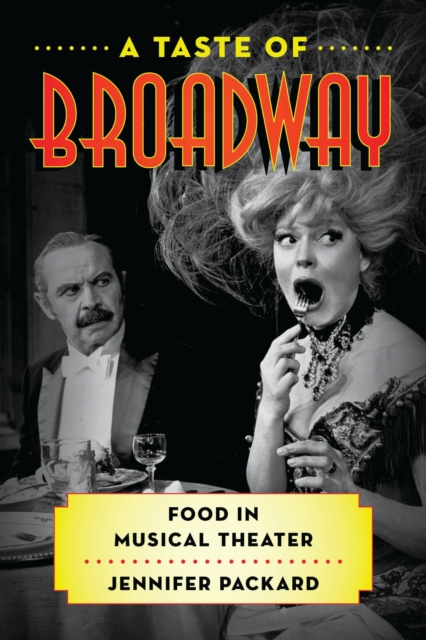
A Taste of Broadway
Food carries symbolic importance used to define individuals, situations, and places, making it an ideal communication tool. In musical theater, food can be used as a shortcut to reveal more about a setting, character, or situation. This book looks at the role of food in popular theater musicals illustrating how food relates to the broader world.
eBook