
Catalogue Search | MBRL


Are you sure you want to remove the book from the shelf?

{{itemTitle}}
2,537
result(s) for
"Food consumption History."
Sort by:

The archaeology of food : identity, politics, and ideology in the prehistoric and historic past
The Archaeology of Food explains how archaeologists reconstruct what people ate, and how such reconstructions reveal ancient political struggles, religious practices, ethnic identities, gender norms, and more. Balancing deep research with accessible writing, Katheryn Twiss familiarizes readers with archaeological data, methods, and intellectual approaches as they explore topics ranging from urban commerce to military provisioning to ritual feasting. Along the way, Twiss examines a range of primary evidence, including Roman bars, Aztec statues, Philistine pig remains, Nubian cooking pots, Mississippian squash seeds, and the bones of a medieval king. Her book introduces both archaeologists and non-archaeologists to the study of prehistoric and historic foodways, and illuminates how those foodways shaped and were shaped by past cultures.
Book
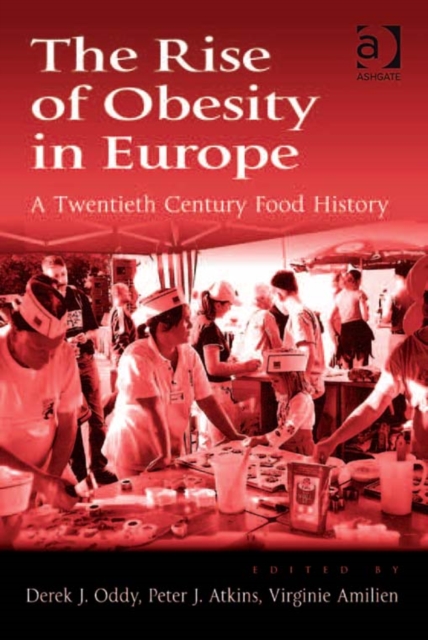
The Rise of Obesity in Europe
Twentieth century Europe went through a dramatic transition from low income populations experiencing hunger and nutritionally inadequate diets, to the recent era of over-consumption and growing numbers of overweight and obese people. By examining the trends in food history from case studies across Europe, this book offers a historical context to explain how and why this transition has occurred and what we can learn in order to try and address the vitally important issues arising from obesity in contemporary Europe.
eBook

Food, energy and the creation of industriousness : work and material culture in agrarian England, 1550-1780
\"Until the widespread harnessing of machine energy, food was the energy which fuelled the economy. In this groundbreaking study of agricultural labourers' diet and material standard of living Craig Muldrew uses new empirical research to present a much fuller account of the interrelationship between consumption, living standards and work in the early modern English economy than has previously existed. The book integrates labourers into a study of the wider economy and engages with the history of food as an energy source and its importance to working life, the social complexity of family earnings and the concept of the 'industrious revolution'. It argues that 'industriousness' was as much the result of ideology and labour markets as labourers' household consumption. Linking this with ideas about the social order of early modern England the author demonstrates that bread, beer and meat were the petrol of this world and a springboard for economic change\"-- Provided by publisher.
Book

Hog Meat and Hoecake
When historical geographer Sam B. Hilliard's bookHog Meat and Hoecakewas published in 1972, it was ahead of its time. It was one of the first scholarly examinations of the important role food played in a region's history, culture, and politics, and it has since become a landmark of foodways scholarship.
In the book Hilliard examines the food supply, dietary habits, and agricultural choices of the antebellum American South, including Arkansas, Louisiana, Mississippi, Tennessee, Alabama, Georgia, North Carolina, and South Carolina. He explores the major southern food sources at the time, the regional production of commodity crops, and the role of those products in the subsistence economy.
Far from being primarily a plantation system concentrating on cash crops such as cotton and tobacco, Hilliard demonstrates that the South produced huge amounts of foodstuffs for regional consumption. In fact, the South produced so abundantly that, except for wines and cordials, southern tables were not only stocked with the essentials but amply laden with veritable delicacies as well. (Though contrary to popular opinion, neither grits nor hominy ever came close to being universally used in the South prior to the Civil War.)
Hilliard's focus on food habits, culture, and consumption was revolutionary-as was his discovery that malnutrition was not a major cause of the South's defeat in the Civil War. His book established the methods and vocabulary for studying a region's cuisine in the context of its culture that foodways scholars still employ today. This reissue is an excellent and timely reminder of that.
eBook

Spoiled : the myth of milk as a superfood
\"Can any other food product be as staggeringly difficult and expensive as milk to get from source (in this case, a cow) to destination (milk glass on table) in something loosely approximating its original condition? Cow and goat milk was consumed only in fermented form for centuries (e.g., cheese, yogurt) until modern times. The rise of fresh milk drinking is unnecessary, expensive, bad for the environment, and nonsensical, and has grown into a huge industry only because in the early 20th century advertising campaigns convinced doctors and the rest of us that milk was an essential food. Mendelson's book is a history of the food she describes as \"drinking-milk,\" referring to dairy animals' milk that is consumed in fluid form rather than as some kind of fermented sour milk or cheese. Contrary to popular belief, it never figured prominently in human diets until very recently. Mendelson argues that milk's rise to the status of nutritional mainstay - the first scientifically anointed superfood of the modern industrialized world - was one of the great flukes of food history. The founders of Western medicine had no way of understanding the genetic anomaly that allowed them, unlike most of the world's peoples, to digest lactose from babyhood to old age. In other words, today's mega-industry stemmed from a lack of scientific perspective. Mendelson further argues that in the case of drinking-milk's merits or demerits, early modern medical authorities' unquestioning faith in their own advanced knowledge lured them into misguided teachings destined to form the flawed basis of a huge - and soon troubled - industry that is now on the thin edge of unsustainability. From the Enlightenment era on, the seeds of many future dairy-industry crises lurked in an unavoidable bit of historical mistiming: Medical authorities arrived at a supposedly up-to-the-minute belief that \"sweet\" (unfermented, and thus full-lactose) drinking-milk was purer and more healthful than sour milk, well before crucial scientific advances that might have triggered some doubts. The purpose of this book is not to portray drinking-milk from dairy animals as a dangerous poison but to explain how milk is produced, and to debunk the idea that milk in unfermented fluid form is a food of unique virtues whose use goes back to remote prehistory. Along the way, she provides an interesting look at the history of the raw-versus-pasteurized milk debate, and how it has developed into not only a public health debate but also a 'personal choice' question adopted by those on opposite sides of the political spectrum\"-- Provided by publisher.
BOOK

Consumption in the age of affluence: the world of food
With growing affluence in the developed world, food has become an increasing focus for attention. Here, the authors argue that in order to understand the extensive and dramatic developments in the world of food, a new interdisciplinary approach is necessary. The Age of Affluence successfully addresses food consumption in this way. The volume:
argues the importance of socioeconomic and cultural factors over diet, in influencing the production, marketing and consumption of different groups of foods;
places food systems theory on sound analytical foundations;
draws critically upon food systems literature;
includes case studies from the sugar, dairy and meat systems;
employs novel statistical techniques to identify and explain distinct patterns of food consumption;
The book will help to revitalize the discipline of food studies and points the way forward for the continuing study of food consumption. As such, it will be invaluable to students, researchers and policymakers engaged in the world of food.
eBook

Food consumption in global perspective : essays in the anthropology of food in honour of Jack Goody
\"The globalization of food consumption has often been equated with the loss of culinary traditions and the homogenization of cuisines. By contrast, the anthropologists, historians and sociologists contributing to this collection reveal both rapid changes and also profound and sometimes surprising continuities in local food consumption practices in the nineteenth, twentieth and twenty-first centuries, and use these to shed light on shifting social boundaries and cultural identities. The volume combines ethnographic, historical and comparative analyses, situating local practices of eating, cooking and sharing food within transnational processes and contexts. In so doing, the volume celebrates and furthers approaches developed in Jack Goody's seminal 1982 book, Cooking, Cuisine and Class: A Study in Comparative Sociology. With studies of China, India, West Africa, South America and Europe, the book provides a truly global perspective on the social dynamics of food consumption in the modern world\"-- Provided by publisher.
Book


