
Catalogue Search | MBRL


Are you sure you want to remove the book from the shelf?

{{itemTitle}}
515
result(s) for
"Food industry and trade Environmental aspects"
Sort by:

Food fight : from plunder and profit to people and planet
Food is life but our food system is killing us. Designed in a different century for a different purpose - to mass-produce cheap calories to prevent famine - it's now generating obesity, ill-health and driving the climate crisis. We need to transform it into a system that can nourish all eight billion of us and the planet we live on. In 'Food Fight', Stuart Gillespie reveals how the system we once relied upon for global nutrition has warped into the very thing making us sick.
BOOK
Food Practices in Transition
This edited volume presents and reflects upon empirical evidence of 'sustainability'-induced and -related transition in food practices. The material collected in the various chapters contributes to our understanding of the ways in which ideas and preferences, sociotechnological developments and changes in the governance of food interact and become visible in practices of consumption, retail and production.
eBook

Sustainability in the Agrofood Sector
Intro -- Title Page -- Copyright Page -- Contents -- List of Contributors -- Foreword -- Preface -- Introductory Note: Future of Agrofood Sustainability -- Chapter 1 Food Sustainability Challenges in the Developing World -- 1.1 Introduction -- 1.2 Agriculture and the Food Sustainability Sector -- 1.2.1 Biodiversity and Agriculture -- 1.2.2 Agricultural Development -- 1.2.3 Agriculture: Pests and Rodents -- 1.2.4 Agriculture and Organic Farming -- 1.2.5 Livestock, Poultry and Aquaculture -- 1.3 Food Security and the Developing World -- 1.3.1 Poverty, Hidden Hunger and Diseases -- 1.3.2 Emerging Diseases -- 1.3.3 Stability of Food Supply and Access to Safe, High-quality Foods -- 1.3.4 Food Diversification -- 1.3.5 Health (dietary) Supplements -- 1.3.6 Food Wastage -- 1.3.7 Food Safety -- 1.3.8 Sustainability Challenges in the Food Industry -- 1.4 Conclusions and Future Outlook -- References -- Chapter 2 The Role of Small-scale Farms and Food Security -- 2.1 Introduction -- 2.2 The Elusive Search for Sustainability -- 2.3 Food Security, the Bio-economy and Sustainable Intensification -- 2.4 Global Land Grabs or Agricultural Investment? -- 2.5 Farm Succession -- 2.6 Conclusions and Future Outlook -- References -- Chapter 3 Sustainability Challenges, Human Diet and Environmental Concerns -- 3.1 Introduction -- 3.2 The Current State of the World Food System -- 3.3 Health and Diet -- 3.4 What is Stopping People from Consuming 'Healthy' Food -- 3.5 The Relationship between Diet and Environmental Impacts -- 3.6 Animal Protein Consumption -- 3.7 Methods of Environmental Impact Assessment -- 3.8 Metrics of Environmental Impact Assessments -- 3.9 Consumers' Understanding of Diet and the Environmental Impacts -- 3.10 Interventions in Diet -- 3.11 Conclusions and Future Outlook -- Acknowledgements -- References.
Book

Making our food sustainable
\"All over the world, people are working to protect our planet in new and exciting ways. Read on to discover how growing everyday foods can help to save the world\"--Back cover.
BOOK

Carbon footprints and food systems
This report addresses carbon labeling schemes, a high-profile issue and one that has important economic implications for developing countries. Carbon accounting and labeling instruments are designed to present information on greenhouse gas emissions (GHG) from supply chains. These instruments have become an important awareness-raising channel for governments, producers, retailers and consumers to bring about the reduction of GHGs. At the same time, they have emerged as a crucial element of supply chain management, trade logistics and, potentially, trade regulations between countries. But the underlying science of GHG emissions is only partially developed. Many of these schemes are based on rudimentary knowledge of GHG emissions and have mainly been designed by industrialized countries. There is a concern that these systems do not accurately reflect production processes in developing countries, and that they may even shift consumer preferences away from developing country exports. The report includes an analysis of current and emerging carbon labeling schemes and an assessment of available data, emissions factors and knowledge gaps of carbon footprinting methodologies. The report also analyzes carbon accounting methodologies for sugar and pineapple products from Zambia and Mauritius according to PAS 2050 guidelines, to illustrate whether these schemes accurately represent the production systems in developing countries. The report concludes with a series of recommendations on how carbon footprint labeling can be made more development-friendly
eBook

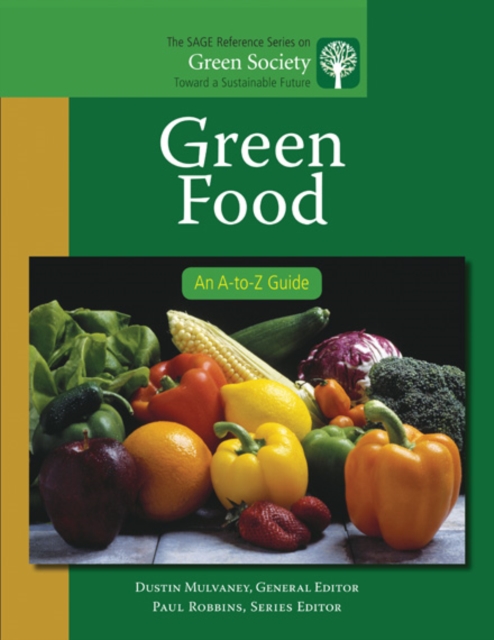
Green food : an A-to-Z guide
Laying out the contours of the field of agri-food studies, this book draws on scholars of political ecology, rural sociology, geography, and environmental studies to paint a picture of agriculture and food, and provides readers with an understanding of the institutions, practices, and concepts to identify what is \"green\" food.
eBook

Ravenous : how to get ourselves and our planet into shape
You may not be aware of this - not consciously, at least - but you do not control what you eat. Every mouthful you take is informed by the subtle tweaking and nudging of a vast, complex, global system: one so intimately woven into everyday life that you hardly even know it's there. The food system is no longer simply a means of sustenance. It is one of the most successful, most innovative and most destructive industries on earth. It sustains us, but it is also killing us. Diet-related disease is now the biggest cause of preventable illness and death in the developed world - far worse than smoking. The environmental damage done by the food system is also changing climate patterns and degrading the earth, risking our food security. Few people know the workings of the food system better than Henry Dimbleby, founder of the Leon restaurant chain, government adviser and author of the radical National Food Strategy. In Ravenous, he takes us behind the scenes to reveal the mechanisms that act together to shape the modern diet - and therefore the world. He explains not just why the food system is leading us into disaster, but what can be done about it. -- Provided by publisher.
Book
Sustainability Challenges in the Agrofood Sector
Sustainability Challenges in the Agrofood Sector covers a wide range of agrofood-related concerns, including urban and rural agriculture and livelihoods, water-energy management, food and environmental policies, diet and human health. Significant and relevant research topics highlighting the most recent updates will be covered, with contributions from leading experts currently based in academia, government bodies and NGOs (see list of contributors below). Chapters will address the realities of sustainable agrofood, the issues and challenges at stake, and will propose and discuss novel approaches to these issues. This book will be the most up-to-date and complete work yet published on the topic, with new and hot topics covered as well as the core aspects and challenges of agrofood sustainability.
eBook