
Catalogue Search | MBRL


Are you sure you want to remove the book from the shelf?

{{itemTitle}}
7,040,777
result(s) for
"Food."
Sort by:


Food politics
We all witness, in advertising and on supermarket shelves, the fierce competition for our food dollars. In this engrossing exposé, Marion Nestle goes behind the scenes to reveal how the competition really works and how it affects our health. The abundance of food in the United States--enough calories to meet the needs of every man, woman, and child twice over--has a downside. Our over-efficient food industry must do everything possible to persuade people to eat more--more food, more often, and in larger portions--no matter what it does to waistlines or well-being. Like manufacturing cigarettes or building weapons, making food is big business. Food companies in 2000 generated nearly
eBook

Never out of season : how having the food we want when we want it threatens our food supply and our future
The bananas we eat today aren't our parents' bananas: We eat a recognizable, consistent fruit that was standardized in the 1960s from dozens into one basic banana. But because of that, the banana we love is dangerously susceptible to a pathogen that might wipe them out. That's the story of our food today: Modern science has brought us produce in perpetual abundance--once-rare fruits are seemingly never out of season, and we breed and clone the hardiest, best-tasting varieties of the crops we rely on most. As a result, a smaller proportion of people on earth go hungry today than at any other moment in the last thousand years, and the streamlining of our food supply guarantees that the food we buy, from bananas to coffee to wheat, tastes the same every single time. Our corporate food system has nearly perfected the process of turning sunlight, water and nutrients into food. But our crops themselves remain susceptible to nature's fury. And nature always wins.-- Source other than the Library of Congress
Book
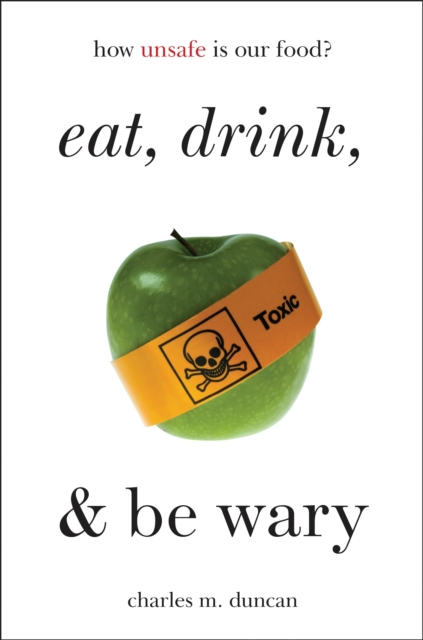
Eat, drink, and be wary
Food safety has fast become one of the nation's top issues. Three thousand people die each year in the U.S. from foodborne illnesses. Another 48 million are sickened annually and our government fails to protect us. Many foods and additives that we eat every day have been banned for years in other countries. Our government food safety agencies move in reverse--cutting back on inspections, allowing food producers to inspect themselves, and permitting the vast majority of potentially adulterated foods to enter this country without benefit of any testing or inspection. How, in a country so advanced in most areas, could we have descended to this alarming state of food safety? One answer: Budget cuts and bureaucrats. Eat, Drink, and Be Wary examines the multitude of dangers in food production, transportation, storing, and preparation that result in this shocking number of preventable illnesses and deaths. It takes a broad and detailed look, in all food groups, at the problems and potential solutions in food safety practices, inspections, and enforcements. This book answers the questions and concerns of millions of Americans who have reached new levels of serious doubts about the safety of our food. Charles Duncan points readers to the dangers to look for in deli foods, raw milk, seafood, poultry, eggs, beef, and others. For consumers who care about the food they eat, this book details the dangers, offers direction for choosing safe foods, and provides a critique of our current system that suggests ways it can be fixed, or at least improved.
eBook


Barons
Best Books of 2024: \"Frerick's prose throughout is both direct and masterfully controlled, with every point supported by extensive references and notes.This is no alarmist screed but rather a careful, systematic, and utterly damning demolition job--an exquisitely informed exposé.
eBook

Lost feast : culinary extinction and the future of food
\"A rollicking exploration of the history and future of our favorite foods When we humans love foods, we love them a lot. In fact, we have often eaten them into extinction, whether it is the megafauna of the Paleolithic world or the passenger pigeon of the last century. In Lost Feast, food expert Lenore Newman sets out to look at the history of the foods we have loved to death and what that means for the culinary paths we choose for the future. Whether it's chasing down the luscious butter of local Icelandic cattle or looking at the impacts of modern industrialized agriculture on the range of food varieties we can put in our shopping carts, Newman's bright, intelligent gaze finds insight and humor at every turn. Bracketing the chapters that look at the history of our relationship to specific foods, Lenore enlists her ecologist friend and fellow cook, Dan, in a series of \"extinction dinners\" designed to recreate meals of the past or to illustrate how we might be eating in the future. Part culinary romp, part environmental wake-up call, Lost Feast makes a critical contribution to our understanding of food security today. You will never look at what's on your plate in quite the same way again.\"-- Provided by publisher.
Book

The food environment in Latin America: a systematic review with a focus on environments relevant to obesity and related chronic diseases
Food environments may be contributing to the rapid increase in obesity occurring in most Latin American (LA) countries. The present study reviews literature from LA that (i) describes the food environment and policies targeting the food environment (FEP); and (ii) analytic studies that investigate associations between the FEP and dietary behaviours, overweight/obesity and obesity related chronic diseases. We focus on six dimensions of the FEP: food retail, provision, labelling, marketing, price and composition.
Systematic literature review. Three databases (Web of Science, SciELO, LILACS) were searched, from 1 January 1999 up to July 2017. Two authors independently selected the studies. A narrative synthesis was used to summarize, integrate and interpret findings.
Studies conducted in LA countries.
The search yielded 2695 articles of which eighty-four met inclusion criteria.
Most studies were descriptive and came from Brazil (61 %), followed by Mexico (18 %) and Guatemala (6 %). Studies were focused primarily on retail/provision (n 27), marketing (n 16) and labelling (n 15). Consistent associations between availability of fruit and vegetable markets and higher consumption of fruits and vegetables were found in cross-sectional studies. Health claims in food packaging were prevalent and mostly misleading. There was widespread use of marketing strategies for unhealthy foods aimed at children. Food prices were lower for processed relative to fresh foods. Some studies documented high sodium in industrially processed foods.
Gaps in knowledge remain regarding policy evaluations, longitudinal food retail studies, impacts of food price on diet and effects of digital marketing on diet/health.
Journal Article


Handbook of Food Powders - Processes and Properties
Many food ingredients are supplied in powdered form, as reducing water content increases shelf life and aids ease of storage, handling and transport. Powder technology is therefore of great importance to the food industry. This book explores a variety of processes that are involved in the production of food powders, the further processing of these powders and their functional properties. Part one introduces processing and handling technologies for food powders and includes chapters on spray, freeze and drum drying, powder mixing in the production of food powders and safety issues around food powder production processes. Part two focusses on powder properties including surface composition, rehydration and techniques to analyse the particle size of food powders. Finally, part three highlights speciality food powders and includes chapters on dairy powders, fruit and vegetable powders and coating foods with powders. This book is a standard reference for professionals in the food powder production and handling industries, development and quality control professionals in the food industry using powders in foods, and researchers, scientists and academics interested in the field.
eBook