
Catalogue Search | MBRL


Are you sure you want to remove the book from the shelf?

{{itemTitle}}
781
result(s) for
"Forced migration History."
Sort by:

Moved by the state : forced relocation and making a good life in postwar Canada
\"'Why don't they just move?' This reductive question is asked whenever reports surface of the all-too-common lack of social services and economic opportunities in Canada's rural and urban communities. But why are certain people and places vulnerable? And who is responsible for a remedy? From the 1950s to the 1970s, the Canadian government relocated people, often against their will, in order to improve their lives. Moved by the State offers a completely new interpretation of this undertaking, seeing it as part of a larger project of development and focusing on the bureaucrats and academics who designed, implemented, and monitored the relocations rather than on those who were uprooted. In this finely crafted history, Tina Loo explores the contradiction between intention and consequence as diverse communities across Canada were resettled. In the process, she reveals the optimistic belief underpinning postwar relocations: the power of the interventionist state to do good\"-- Provided by publisher.
Book

Debating the highland clearances
Storm clouds always gather over the story of the Highland Clearances. The eviction of the Highlanders from the glens and straths of the Highlands and Islands of the north of Scotland still causes great historical dispute more than a century after the events. The Highland Clearances also generated a great deal of contemporary controversy and documentation. The record comes in diverse forms and with radically different provenances, offering excellent material for exercises in historical analysis and selection. Debating the Highland Clearances introduces the Highland Clearances as a classic historical problem. Eric Richards reviews the historical debate and examines the methods and sources employed by the combatants past and present. The debates among historians, novelists, politicians and economists are no less passionate today and raise major questions about interpretation and the appropriate frame of reference for the noisy and continuing public debate about the Highland Clearances.This book presents a representative anthology of documents illustrating the historical foundations on which the debate is built. The debate is set in context and the author explains why it is not only important for Scottish patriots but for history in general.Key Features:• Organised into two parts; the first considers debates surrounding the Clearances, the second examines a selection of the sources which inform these debates• Presents and analyses an anthology of source material compiled to introduce the debates surrounding the Highland Clearances to audiences learning about historical analysis• Asks why passionate debate about the Clearances has been sustained and provides a modern introduction to its main issues
eBook


Democracy and Displacement in Colombia's Civil War
Democracy and Displacement in Colombia's Civil War is
one of few books available in English to provide an overview of the
Colombian civil war and drug war. Abbey Steele draws on her own
original field research as well as on Colombian scholars' work in
Spanish to provide an expansive view of the country's political
conflicts. Steele shows how political reforms in the context of
Colombia's ongoing civil war produced unexpected, dramatic
consequences: democratic elections revealed Colombian citizens'
political loyalties and allowed counterinsurgent armed groups to
implement political cleansing against civilians perceived as loyal
to insurgents.
Combining evidence collected from remote archives, more than two
hundred interviews, and quantitative data from the government's
displacement registry, Steele connects Colombia's political
development and the course of its civil war to purposeful
displacement. By introducing the concepts of collective targeting
and political cleansing, Steele extends what we already know about
patterns of ethnic cleansing to cases where expulsion of civilians
from their communities is based on nonethnic traits.
eBook

We are not refugees : true stories of the displaced
Never in history have so many people been displaced by political and military conflicts at home--more than 65 million globally ... [This book] tells the stories of many of these displaced, who have not been given asylum. For over a decade, human rights journalist Agus Morales has journeyed to the sites of the world's most brutal conflicts and spoken to the victims of violence and displacement. To Syria, Afghanistan, Pakistan, and the Central African Republic. To Central America, the Congo, and the refugee camps of Jordan. To the Tibetan Parliament in exile in northern India.
BOOK

Migration and Mobility in the Early Roman Empire
In Migration and Mobility in the Early Roman Empire seventeen specialists in the fields of Roman social history, Roman demography and Roman economic history offer fresh perspectives on voluntary, state-organised and forced mobility during the first to early third centuries CE.
eBook


Uprooted
With the stroke of a pen at the Potsdam Conference following the Allied victory in 1945, Breslau, the largest German city east of Berlin, became the Polish city of Wroclaw. Its more than six hundred thousand inhabitants--almost all of them ethnic Germans--were expelled and replaced by Polish settlers from all parts of prewar Poland.Uprootedexamines the long-term psychological and cultural consequences of forced migration in twentieth-century Europe through the experiences of Wroclaw's Polish inhabitants.
In this pioneering work, Gregor Thum tells the story of how the city's new Polish settlers found themselves in a place that was not only unfamiliar to them but outright repellent given Wroclaw's Prussian-German appearance and the enormous scope of wartime destruction. The immediate consequences were an unstable society, an extremely high crime rate, rapid dilapidation of the building stock, and economic stagnation. This changed only after the city's authorities and a new intellectual elite provided Wroclaw with a Polish founding myth and reshaped the city's appearance to fit the postwar legend that it was an age-old Polish city. Thum also shows how the end of the Cold War and Poland's democratization triggered a public debate about Wroclaw's \"amputated memory.\" Rediscovering the German past, Wroclaw's Poles reinvented their city for the second time since World War II.
Uprootedtraces the complex historical process by which Wroclaw's new inhabitants revitalized their city and made it their own.
eBook

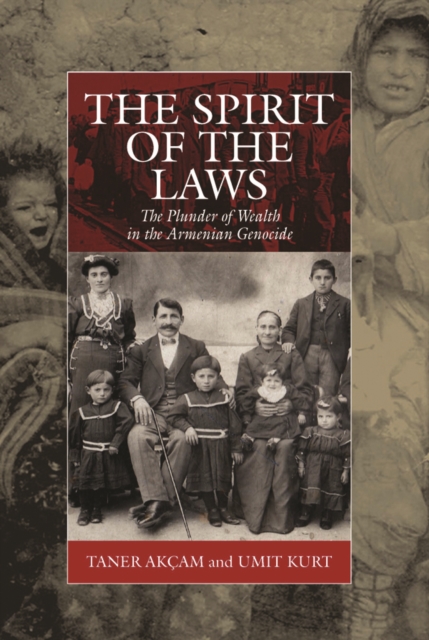
The spirit of the laws
Pertinent to contemporary demands for reparations from Turkey is the relationship between law and property in connection with the Armenian Genocide. This book examines the confiscation of Armenian properties during the genocide and subsequent attempts to retain seized Armenian wealth. Through the close analysis of laws and treaties, it reveals that decrees issued during the genocide constitute central pillars of the Turkish system of property rights, retaining their legal validity, and although Turkey has acceded through international agreements to return Armenian properties, it continues to refuse to do so. The book demonstrates that genocides do not depend on the abolition of the legal system and elimination of rights, but that, on the contrary, the perpetrators of genocide manipulate the legal system to facilitate their plans.
eBook