
Catalogue Search | MBRL


Are you sure you want to remove the book from the shelf?

{{itemTitle}}
838,413
result(s) for
"Foreign policy"
Sort by:


How New and Assertive Is China's New Assertiveness?
There has been a rapidly spreading meme in U.S. pundit and academic circles since 2010 that describes China's recent diplomacy as \"newly assertive.\" This \"new assertiveness\" meme suffers from two problems. First, it underestimates the complexity of key episodes in Chinese diplomacy in 2010 and overestimates the amount of change. Second, the explanations for the new assertiveness claim suffer from unclear causal mechanisms and lack comparative rigor that would better contextualize China's diplomacy in 2010. An examination of seven cases in Chinese diplomacy at the heart of the new assertiveness meme finds that, in some instances, China's policy has not changed; in others, it is actually more moderate; and in still others, it is a predictable reaction to changed external conditions. In only one case—maritime disputes–does one see more assertive Chinese rhetoric and behavior. The speed and extent with which the newly assertive meme has emerged point to an understudied issue in international relations—namely, the role that online media and the blogosphere play in the creation of conventional wisdoms that might, in turn, constrain policy debates. The assertive China discourse may be a harbinger of this effect as a Sino-U.S. security dilemma emerges.
Journal Article

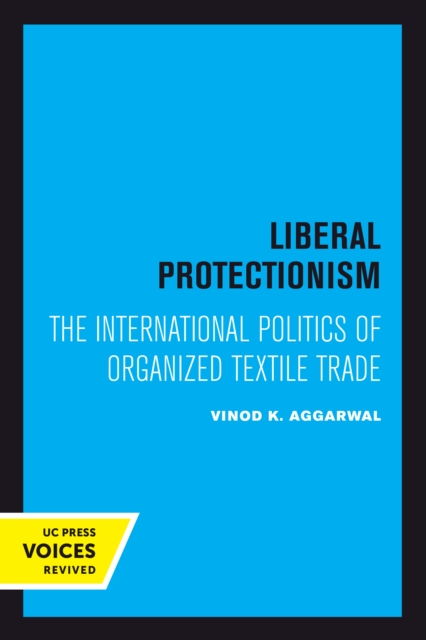
Liberal Protectionism
What does organized trade portend for the future of the post-World
War II trading order? Are we seeing a transition from liberalism to
protectionism? These questions are central to Vinod K. Aggarwal's
penetrating analysis of conflict and cooperation in trade among
developed and less developed countries. In his examination of the
evolution of organized trade, Aggarwal specifically analyses
international regimes in textile and apparel trade. The author uses
an original theoretical approach to investigate international
regimes. Why are regimes desirable? Aggarwal shows how such accords
can protect broader arrangements, allow countries to control one
another's behavior, and minimize information and organization costs
in negotiations. Several factors account for the form of regimes.
The strength of regimes is enhanced by an asymmetry of
international power. A hegemon is more willing and able to maintain
a regime. Both the nature and scope of regimes are determined by
the relative degree of trade competition and cognitive consensus
among actors. As trade competition increases, and actors decide to
link related issues, regimes become more protectionist in their
goals and wider in their coverage. Aggarwal's theory successfully
accounts for the transformation of international regimes in textile
trade, demonstrating the importance of systematically incorporating
international level factors into our theories. His empirical work
is based on extensive archival research and interviews with key
negotiators. Aggarwal concludes that the pattern of international
cooperation which evolved in textile trade provides a portrait of
the future for trade in other industrial sectors. He finds the
trend of arrangements in textile trade disturbing and argues that
organized trade will not prevent-and may in fact promote a slide
from liberalism to protectionism. Regimes originally developed to
counter protectionism may evolve into systems of organized
protection that encourage neither efficiency nor equity. A lucid
analysis of recent historical developments in textile trade, this
study sheds light on the movement toward increasing protection in
other sectors of trade as well. It is a significant work that will
prove valuable to those who study international trade and regimes.
This title is part of UC Press's Voices Revived program,
which commemorates University of California Press's mission to seek
out and cultivate the brightest minds and give them voice, reach,
and impact. Drawing on a backlist dating to 1893, Voices
Revived makes high-quality, peer-reviewed scholarship
accessible once again using print-on-demand technology. This title
was originally published in 1986.
eBook


The Concept of “Hedging” Revisited
This article argues that the concept of “hedging” should be understood in the context of the “balancing-bandwagoning” spectrum within the “balance of power” theory, in which hedging is located between balancing and bandwagoning as the state’s third strategic choice. Although polarity—unipolar, bipolar, and multipolar—largely determines the likelihood of hedging behavior, during a period of power shift, strategic uncertainty emerges. States, particularly secondary powers, attempt to calculate the risk of balancing, bandwagoning, and hedging, adopting an optimal strategy. To identify states’ strategic behavior, it is important to first examine their economic and military capabilities, and if these indicators are not decisive enough to identify balancing, bandwagoning, or hedging behavior, diplomatic factors should be taken into account, although those are a relatively weaker indicator.
The use of this conceptual framework reveals that Japan’s foreign policy behavior has not involved “hedging” vis-à-vis China; instead, Japan’s behavior is consistently associated with “balancing” against the risks of China’s rise. In addition, while Japan’s behavior vis-à-vis the United States is considered to be bandwagoning, Japan made political efforts to strengthen its own military capabilities—internal balancing—which began in the 2010s when Japan relaxed its political constraints on use of its military. This behavior also aimed both to illustrate Japan’s efforts related to alliance burden-sharing and to enhance its external balancing with the United States. Yet, the periods from 1997 to 2005 and from 2010 on represent an aberration because Japan engaged one type of hedging—security hedging—vis-à-vis the risk of US commitment reduction to East Asia. In this sense, while concurring with the realists’ argument that Japan’s current behavior is characterized as balancing, the argument differs from that of realists who believe that Japan’s policy shift to balancing toward China only began with China’s rise in the late 2000s or 2010s.
Journal Article


Great Delusion
A major theoretical statement by a distinguished political scholar explains why a policy of liberal hegemony is doomed to failIn this major statement, the renowned international-relations scholar John Mearsheimer argues that liberal hegemony, the foreign policy pursued by the United States since the Cold War ended, is doomed to fail. It makes far more sense, he maintains, for Washington to adopt a more restrained foreign policy based on a sound understanding of how nationalism and realism constrain great powers abroad.It is widely believed in the West that the United States should spread liberal democracy across the world, foster an open international economy, and build institutions. This policy of remaking the world in America's image is supposed to protect human rights, promote peace, and make the world safe for democracy. But this is not what has happened. Instead, the United States has ended up as a highly militarized state fighting wars that undermine peace, harm human rights, and threaten liberal values at home. Mearsheimer tells us why this has happened.
eBook


Media, Public Opinion, and Foreign Policy in the Age of Social Media
Democratic publics have always struggled to constrain their elected leaders’ foreign policy actions. By its nature, foreign policy creates information asymmetries that disadvantage citizens in favor of leaders. But has this disadvantage deepened with the advent of the Internet and the resulting fundamental changes in the media and politics? We argue that it has. The current information and political environments erode constraint by inclining constituents to reflexively and durably back “their” leaders and disapprove of opposition. These changes make it harder for citizens to informationally “catch up” with and constrain leaders because views that contradict citizens’ beliefs are less likely to break through when media are fragmented and siloed. These changes have important implications for theories concerning the democratic peace, audience costs, rally effects, and diversionary war. They may also contribute to instability in foreign policy by contributing to sudden and destabilizing changes in public opinion that undercut commitments abroad.
Journal Article