
Catalogue Search | MBRL


Are you sure you want to remove the book from the shelf?

{{itemTitle}}
201
result(s) for
"Forensic pathologists."
Sort by:

Genesis
\"New York Times-bestselling author Robin Cook takes on the ripped-from-the-headlines topic of harnessing DNA from ancestry websites to catch a killer in this timely and explosive new medical thriller\"-- Provided by publisher.
Book

Artificial intelligence in the practice of forensic medicine: a scoping review
Forensic medicine is a thriving application field for artificial intelligence (AI). Indeed, AI applications intended to forensic pathologists or forensic physicians have emerged since the last decade. For example, AI models were developed to help estimate the biological age of migrants or human remains. However, the uses of AI applications by forensic pathologists or physicians and their levels of integration in medicolegal practices are not well described yet. Therefore, a scoping review was conducted on PubMed, ScienceDirect, and Scopus databases. This review included articles that mention any AI application used by forensic pathologists or physicians in practice or any AI model applied in one expertise field of the forensic pathologist or physician. Articles in other languages than English or French or dealing mainly with complementary analyses handled by experts who are not forensic pathologists or physicians or with AI to analyze data for research purposes in forensic medicine were excluded from this review. All the relevant information was retrieved in each article from a grid analysis derived and adapted from the TRIPOD checklist. This review included 35 articles and revealed that AI applications are developed in thanatology and in clinical forensic medicine. However, those applications seem to mainly remain in research and development stages. Indeed, the use of AI applications by forensic pathologists or physicians is not actual due to issues discussed in this article. Finally, the integration of AI in daily medicolegal practice involves not only forensic pathologists or physicians but also legal professionals.
Journal Article

Skeleton justice : a novel
The New York crimefighting team of medical examiner Jake Rosen and attorney Philomena \"Manny\" Manfreda take on the bizarre case of a stalker and thief who sedates his victims and then steals vials of their blood.
Book

Burnout and Stress in Forensic Science Jobs: A Systematic Review
Background/Objectives. Burnout and occupational stress are significant issues among forensic professionals, impacting their well-being and job performance. This systematic review aims to provide an up-to-date overview of the occupational stress and burnout experienced by forensic personnel, exploring the profound and multifaceted impact on their physical, mental, professional, and interpersonal well-being. Methods. A systematic review was conducted following PRISMA guidelines using Scopus and WOS databases to search for articles published from 1 January 2000 to 31 August 2024. The search used keywords related to burnout and forensic professions. Inclusion criteria were original articles in English and French, while reviews, book chapters, editorials, and notes were excluded. A total of 10 studies were included after eliminating duplicates and excluding irrelevant articles. Results. The review identified seven key findings. (1) High levels of occupational stress and burnout among forensic personnel necessitate effective stress management strategies and resilience training; (2) autopsy technicians in Romania experience burnout and alexithymia, particularly related to traumatic events involving children, highlighting the need for specialized support systems; (3) disparities in burnout and post-traumatic stress disorder (PTSD) symptoms were observed in autopsy technicians and resident doctors, suggesting tailored mental health resources; (4) organizational factors, such as peer support and compensation satisfaction, significantly impact burnout and secondary traumatic stress (STS) among sexual assault nurse examiners; (5) burnout among forensic physicians, both in Romania and Egypt, is linked to personality traits, job satisfaction, and socio-demographic factors; (6) pathologists face a range of health issues, including musculoskeletal problems and psychological disorders, underscoring the need for industry-specific health measures; and (7) the lack of wellness resources for forensic professionals calls for improved mental health support and training. Conclusions. The findings highlight the pervasive issue of burnout and stress among forensic professionals globally. Addressing these challenges requires comprehensive stress management programs, tailored mental health resources, and organizational support. Future research should focus on developing and implementing effective interventions to enhance resilience and job satisfaction within this high-stress field.
Journal Article
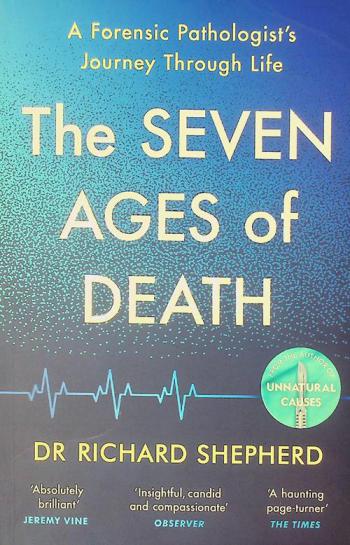
The seven ages of death : a forensic pathologist's journey through life
\"Forensic pathologist and bestselling author of Unnatural Causes, Dr Richard Shepherd, brings his unparalleled honesty and insight to a new book about life and death. What can death teach us about life? In his career conducting thousands of post-mortems, Dr Richard Shepherd has examined death at every stage of life. From old to young, murder to misadventure, and from illness to accidental death, each autopsy is its own unique investigation, revealing secrets about life, mortality, and even about himself. From the author of Unnatural Causes comes a powerful, endlessly fascinating and above all reassuring new book about death - how to understand it, postpone it, and, when our time comes (as it must come), how to embrace it, as our last and greatest adventure\"--Publisher's description.

Interpretation of post-mortem interval by analyzing the histological attributes of gingival mucosa — an observational study
Background
Forensic odontology has been one of the most rapidly advancing fields within forensic science for decades. It goes beyond simply determining age and gender, playing a crucial role in estimating the post-mortem interval (PMI), which remains a vital element of forensic investigations. By analyzing post-mortem tissue changes histologically, it offers deep understanding of the time elapsed since death. Although traditional methods for estimating PMI are available, there are limited approaches that specifically utilize histological analysis of gingiva. This study explores the utility of histopathological changes in unfixed antemortem gingival tissues as a means to estimate PMI, leveraging the durability and protection offered by oral mucosa. The research examines autolytic alterations in gingival tissues preserved with formalin over different time intervals, up to 15 days, and analyzes the corresponding histological features to assess their relevance in PMI determination.
Results
Gingival samples were collected from individuals in a tropical climate and subjected to varying PMIs up to 15 days. Histopathological processing and evaluation were performed to categorize changes into immediate, early, and late stages based on cellular, nuclear, and tissue alterations in the epithelium and connective tissue. Results reveal a progressive degeneration over time, including cytoplasmic vacuolation, pyknotic nuclei, and acantholysis in the epithelium along with connective tissue changes. Endothelial lining disintegration, fibroblast degeneration, and nuclear breakdown were also observed. Epithelium-connective tissue junction integrity is lost, and complete homogenization of tissue occurs beyond 15 days.
Conclusion
The findings suggest that histopathological analysis of gingival tissue can serve as an additional and potentially reliable method for estimating PMI. It also offer insights into the progression of post-mortem alterations, presenting a feasible, cost-effective, and potentially valuable adjunct method for PMI estimation in certain forensic contexts.
Journal Article

A lady in shadows : a Madeleine Karno mystery
\"On June 2nd, 1894, in the wake of President Marie Francois Sadi Carnots assassination, France descends into chaos and riots in the streets of Varbourg. Many lives are lost in the mayhem, but when one lady of the night is found murdered with brutal incisions and no sign of a struggle, it is clear something is amiss. Madeleine Karno must ask herself the terrifying question: Do they have their very own Jack the Ripper in France?\"--Amazon.com.
Book

Legal pathology: Evaluating the High Court on expert evidence
This article explains why the application of admissibility rules to the opinion of a forensic pathologist in 'Lang v The Queen' ('Lang') (and forensic pathologists in 'Velevski v The Queen', and indirectly an anatomist in 'Honeysett v The Queen') seems insufficiently attentive to the expressed need for specialised knowledge and, inextricably, the actual abilities of those recognised as expert witnesses. The article explains why legal practitioners and judges should carefully attend to 'specialised knowledge', and treat independent evidence supporting specific abilities (in Lang, being able to discriminate between self-inflicted stab wounds and stab wounds inflicted by others) as a form of 'specialised knowledge'. Notwithstanding obiter in 'Dasreef Pty Ltd v Hawchar', it cautions against placing too much reliance on training, formal qualifications, general experience, and past legal practice. Courts, in particular, should be more sceptical about opinion evidence adduced by parties (especially prosecutors in criminal proceedings), the abilities of trial lawyers, judges and other fact-finders, as well as the effectiveness of trial safeguards and appeals.
Journal Article

Exploring Burnout at the Morgue During the COVID-19 Pandemic: A Three-Phase Analysis of Forensic and Pathology Personnel
Background/Objectives: Burnout is a critical concern among healthcare professionals, particularly during crises such as the COVID-19 pandemic. This study investigated burnout levels among forensic medicine and pathology personnel at three distinct phases: the early pandemic period (Phase 1—September 2020), the peak of the pandemic (Phase 2—October 2021), and the post-pandemic period (Phase 3—October 2024). Methods: A total of 37 participants employed in forensic medicine and pathology departments completed the Maslach Burnout Inventory (MBI). A one-way repeated measures ANOVA was conducted to assess within-subject differences over time. Normality and sphericity were tested using the Shapiro–Wilk test and Mauchly’s test, with the Greenhouse-Geisser correction. Post hoc Bonferroni-adjusted comparisons identified significant differences, and partial eta squared (η2) was reported for effect sizes. Results: Results showed significant fluctuations in burnout levels across the three phases. Emotional exhaustion and low personal accomplishment peaked during Phase 2, with slight reductions observed in Phase 3. Gender differences were evident, with females reporting higher EE levels and males exhibiting higher depersonalization across all phases. Marital and parental status also influenced burnout levels, with unmarried individuals and those without children showing higher burnout scores. Medical doctors experienced the highest burnout levels among professional roles, while auxiliary staff showed significant challenges in the PA subscale. Conclusions: The COVID-19 pandemic was pivotal in exacerbating burnout levels due to increased workload, crisis decision-making, and emotional toll. Although the sample size is limited, these findings underscore the importance of implementing targeted interventions to mitigate burnout among forensic and pathology personnel, especially during healthcare emergencies. Gender-based differences in burnout suggest the necessity of specific workplace well-being strategies, while the protective role of family status demonstrates the importance of work-life balance policies. The persistence of psychological distress after a medical crisis calls for long-term monitoring and support programs. There is a need for improved workload distribution, peer support networks, and mental health training to build resilience among forensic and pathology personnel.
Journal Article