
Catalogue Search | MBRL


Are you sure you want to remove the book from the shelf?

{{itemTitle}}
76,180
result(s) for
"Forest ecosystems."
Sort by:

Biodiversity of woodlands
This book examines the variety of living things in a woodland ecosystem.
Book

Disturbance-mediated heterogeneity drives pollinator diversity in boreal managed forest ecosystems
Intensive forest management, together with fire suppression, have decreased structural complexity and altered dynamics of boreal forests profoundly. Such management threatens forest biodiversity and can reduce the provision of ecosystem services. Although the importance of ecosystem services is widely acknowledged, conservation strategies are hindered by poor knowledge about diversity patterns of service provider species as well as on mechanisms affecting these assemblages at different spatial and temporal scales. In this study, we assessed the effect of disturbance management on forest pollinator communities. To do so, we used a large-scale ecological experiment conducted in the year 2000, where forest complexity was manipulated with different harvest regimes and prescribed fire. Results were consistent with a positive response of pollinators to increasing habitat heterogeneity driven by past disturbances. Harvested sites harbored a diverse pollinator community, and showed higher spatial and temporal turnover in species richness. Conversely, old-growth forest communities were a nested subset of harvested sites and contained half of their total diversity. Variation in community composition (β diversity) was primarily affected by species temporal turnover. Throughout the season, β diversity was controlled by fire and harvesting legacies, which provide environmental heterogeneity in the form of flowering and nesting resources over space and time. Conservation strategies may undervalue ecosystem services in dynamic, naturally disturbancedriven, landscapes when relying solely on undisturbed forests areas. However, maintaining natural dynamics in early successional forests, by emulating natural disturbances at harvesting, hold promise for the conservation of both biodiversity and ecosystem services in boreal forests.
Journal Article


Socio-Economic Drivers of Ecosystem Service Recognition in Kakamega Forest, Kenya
Forest ecosystems deliver ecosystem services (ESs) that are essential for the well-being of local communities. These services necessitate a clear understanding of their perception among community members in order to facilitate informed and sustainable forest management decisions. This study aimed to explore the relationship between forest ESs and local communities by identifying community preferences for key ESs and examining how socio-economic factors influence this perception. Data was collected through participatory methods, including focus group discussions, key informant interviews, and a household survey involving 453 respondents. The data was analyzed using descriptive statistics and binary logistic regression. We identified firewood, rainfall attraction, air quality, and wildlife habitat as the most acknowledged services in their respective ES categories. Land ownership, education level, Community Forest Association membership, and labor migration significantly influenced service recognition. These findings highlight critical areas for intervention, including livelihood enhancement, cultural heritage preservation, and improved community outreach programs. The outcomes of this research are expected to contribute to the sustainable management of forest ecosystems.
Journal Article

Conservation : protecting our plant resources
This volume discusses the use of natural resources, and the issue of forest and plant conservation.
Book
High Ecosystem Stability Under Drought Events in National Nature Reserves in China’s Forest Ecosystem
Forest-type national nature reserves and their surrounding areas have experienced a series of drought events, which have influenced forest ecosystem stability. Assuming that drought events do not cause a shift in the ecosystem’s stable state, we quantified the stability of forest ecosystems in China’s national nature reserves and their surrounding areas in response to drought events from 2000 to 2018, using satellite-observed Enhanced Vegetation Index (EVI) and Standardized Precipitation Index (SPI) data. We further examined differences in ecosystem stability across regions and forest types, and identified the impacts of environmental factors using correlation analysis, analysis of variance (ANOVA), and random forest models. The results show that both national nature reserves and their surrounding areas primarily experienced single, moderate-intensity drought events, most of which occurred in spring and summer. Compared with surrounding areas, national nature reserves exhibited higher ecosystem stability, with a mean drought resistance index of 31.45 ± 21.09. The difference in ecosystem stability between reserves and their surrounding areas was most pronounced in deciduous forests, which was attributed to their high hydraulic conductivity and distinctive leaf phenological traits. Additionally, climatic factors were the dominant drivers of both resistance and recovery rate, each contributing more than 30% to the overall explained variance. Our results provide valuable guidance for enhancing drought resilience and promoting the sustainable management of China’s national forest reserves.
Journal Article

Biodiversity of rain forests
This book examines the variety of living things in a rain forest ecosystem.
Book

Monitoring Changes in the Enhanced Vegetation Index to Inform the Management of Forests
In the absence of forest ecosystem time series data, monitoring proxies such as the enhanced vegetation index (EVI) can inform the capacity of forests to provide ecosystem services. We used MODIS-derived EVI at 250 m and 16-day resolution and Breaks for Additive and Seasonal Trend (BFAST) algorithms to monitor forest EVI changes (breaks and trends) in and around the Algonquin Provincial Park (Ontario, Canada) from 2003 to 2022. We found that relatively little change occurred in forest EVI pixels and that most of the change occurred in non-protected forest areas. Only 5.3% (12,348) of forest pixels experienced one or more EVI breaks and 27.8% showed detectable EVI trends. Most breaks were negative (11,969, 75.3%; positive breaks: 3935, 24.7%) with a median magnitude of change of −755.5 (median positive magnitude: 722.6). A peak of negative breaks (2487, 21%) occurred in the year 2013 while no clear peak was seen among positive breaks. Most breaks (negative and positive) and trends occurred in the eastern region of the study area. Boosted regression trees revealed that the most important predictors of the magnitude of change were forest age, summer droughts, and warm winters. These were among the most important variables that explained the magnitude of negative (R2 = 0.639) and positive breaks (R2 = 0.352). Forest composition and protection status were only marginally important. Future work should focus on assessing spatial clusters of EVI breaks and trends to understand local drivers of forest vegetation health and their potential relation to forest ecosystem services.
Journal Article
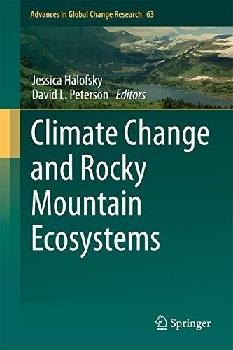
Climate change and Rocky Mountain ecosystems
\"This book is the result of a team of approximately 100 scientists and resource managers who worked together for two years to understand the effects of climatic variability and change on water resources, fisheries, forest vegetation, non-forest vegetation, wildlife, recreation, cultural resources and ecosystem services. Adaptation options, both strategic and tactical, were developed for each resource area. This information is now being applied in the northern rocky Mountains to ensure long-term sustainability in resource conditions. The volume chapters provide a technical assessment of the effects of climatic variability and change on natural and cultural resources, based on best available science, including new analyses obtained through modeling and synthesis of existing data. Each chapter also contains a summary of adaptation strategies (general) and tactics (on-the-ground actions) that have been developed by science-management teams\"--Back cover.
Book

Demand for forest ecosystem services: a comparison study in selected areas in the Czech Republic and China
Ecosystem services are investigated from many perspectives, but there are very few studies comparing the perception of forest and demand for forest ecosystem services (FES) in a cross-cultural analysis. This study aims to map the demand for FES and find out the forest perception of forest visitors in both Czech and Chinese societies. Data were collected by structured questionnaire among three different groups of respondents (n = 847) in six forest areas. The questions were focused on the demand for FES, expectations from the forest, preference for the visual form of the forest, and the willingness of forest visitors. Analysis demonstrates that the demand for some FES is related to geographical and cultural conditions. The results indicated that provisioning and regulation services are perceived as more important than cultural services. The differences by country were obvious in the cultural and provisioning services: Chinese demand more relaxing and meditation activities, whereas Czech demand mushroom picking. A significant outcome is a high demand of Chinese respondents for recreational facilities. Tree planting was rated as one of the most popular voluntary activity across the whole sample. Meanwhile, some findings point to an increasing pressure on forest ecosystems and their protection, which emerge due to the strong demand for recreational facilities. According to the findings, active involvement of forest visitors in various activities is recommended so that their appreciation of FES will constantly increase and to take into account the profile of visitors and incorporate them in forest management and planning in order to meet societal demand.
Journal Article