
Catalogue Search | MBRL


Are you sure you want to remove the book from the shelf?

{{itemTitle}}
125
result(s) for
"Forgery of antiquities"
Sort by:

Frauds, myths, and mysteries : science and pseudoscience in archaeology
\"A humorous yet informative and scientific text that helps students to critically debunk archaeological myths and understand how we know what we know\"-- Provided by publisher.
Book

Italian Forgers
Italian Forgers takes an
unorthodox approach to the fascinating topic of art forgery,
focusing not on art forgery per se, but on the major forgery
scandals that shifted the Italian art market in response to
constant, and often intense, demand for Italian objects.
By focusing on power dynamics that both precipitated forgery
scandals and forged Italian cultural identities, this book connects
the debates and discussions about three well-known Italian
forgers-Giovanni Bastianini, Icilio Joni, and Alceo Dossena-to
anchor and investigate the mechanics of the Italian art market from
unification through the fascist era.
Carol Helstosky examines foreign accounts of transactions and
Italian writings about the art market. The actions and words of
Italian dealers illustrate how the Italian art and antiquities
market was an undeniably modern industry, on par with tourism in
terms of its contribution to the Italian economy and to
understandings of Italian identity. These accounts also reveal how
dealers, artists, go-betweens, guides, and restorers worked to not
only meet the intense demand for Italian products but also to
develop highly sophisticated business practices to maintain
financial stability and respond to shifts in demand consciously
(but not always conscientiously).
Italian Forgers weaves a compelling narrative about the
history of Italian identity, forgery, and the value of the past. As
a result, Helstosky brings historical perspective to the study of
art forgery and art fraud. She reveals how historical circumstances
and structural imbalances of cultural power shaped the market for
art and antiquities and amplified incidents of art deception and
forgery scandals.
eBook


When Art isn't Real
How an initially valueless object becomes worth hundreds
of millions. And vice versa. The art world is a
multi-billion-dollar industry which captures world headlines on a
regular basis, for both good and bad reasons. This book deals with
one of the most-discussed areas of controversy: high-profile
objects that have experts arguing about their veracity. Some may
have been looted, others may be fakes, some may be heavily restored
or misattributed. Often, in these cases, analytical science is
called on to settle a dispute. The authors of this book have
decades of experience in this field, working on a range of objects
dating from prehistory to the twentieth century. They present seven
of the most famous cases from the Getty Kouros to the Turin Shroud
- some of which are still contested, and examine how a few words
from a connoisseur or scientist can make a virtually valueless
object worth hundreds of millions. And vice versa.
eBook

Archaeological oddities : a field guide to forty claims of lost civilizations, ancient visitors, and other strange sites in North America
\"This book is an offbeat field guide for sites in North America that reflect the rejection of the facts of prehistory and history. Though fake, the forty sites Feder highlights are fascinating and fun places to visit. Feder provides an entertaining summary of those forty sites along with the practical information you'll need to visit them\"--Provided by publisher.
Book

Scientific Investigation of Copies, Fakes and Forgeries
The faking and forgery of works of art and antiquities is probably now more extensive than ever before. The frauds are aided by new technologies, from ink jet printers to epoxy resins, and driven by the astronomic prices realised on the global market. This book aims to provide a comprehensive survey of the subject over a wide range of materials, emphasising how the fakes and forgeries are produced and how they may be detected by technical and scientific examination. The subject is exemplified by numerous case studies, some turning out not to be as conclusive as is sometimes believed. The book is aimed at those likely to have a serious interest in these investigations, be they curator, collector, conservator or scientist. Paul Craddock has recently retired from the Department of Conservation, Documentation and Science at the British Museum, where he was a materials scientist.
eBook
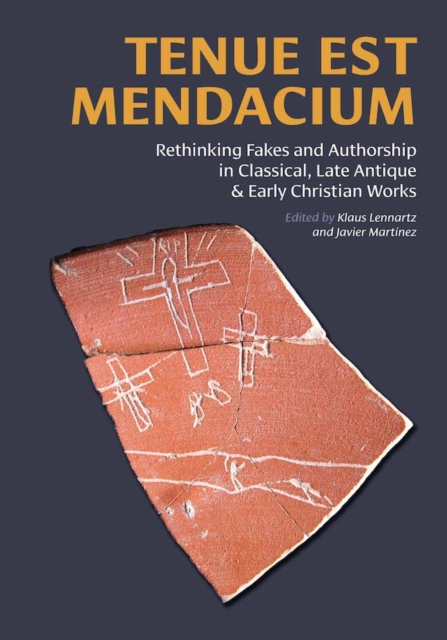
Tenue Est Mendacium
Many new and fruitful avenues of investigation open up when scholars consider forgery as a creative act rather than a crime. We invited authors to contribute work without imposing any restrictions beyond a willingness to consider new approaches to the subject of ancient fakes, forgeries, and questions of authenticity. The result is this volume, in which our aim is to display some of the many possibilities available to scholarship.The exposure of fraud and the pursuit of truth may still be valid scholarly goals, but they implicitly demand that we confront the status of any text as a focal point for matters of belief and conviction. Recent approaches to forgery have begun to ask new questions, some intended purely for the sake of debate: Ought we to consider any author to have some inherent authenticity that precludes the possibility of a forger's successful parody? If every fake text has a real context, what can be learned about the cultural circumstances which give rise to forgeries? If every real text can potentially engender a parallel history of fakes, what can this alternative narrative teach us? What epistemological prejudices can lead us to swear a fake is genuine, or dismiss the real thing as inauthentic?Following Splendide Mendax and Animo Decipiendi?, this is the latest installment of an ongoing inquiry, conducted by scholars in numerous countries, into how the ancient world - its literature and culture, its history and art - appears when viewed through the lens of fakes and forgeries, sincerities and authenticities, genuine signatures and pseudepigrapha. How does scholarship tell the truth if evidence doesn't? But fabula docet: The falsum does not simply make the great, annoying stone before the door of the truth (otherwise this here would really be a \"council of antiquarians and paleographers\"). The falsum makes a delicate, fine tissue. It allows the verum to shine through, in nuances and reliefs that were less noticeable without its counterpart, really tied at the head. And, treated differentiated, it becomes even itself perlucidum, shines out with \"hidden values.\"
eBook
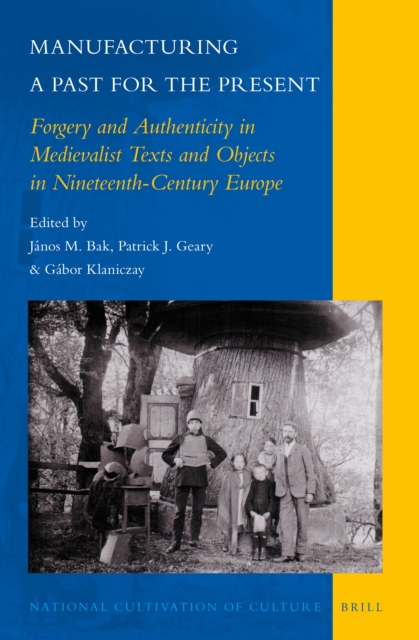
Manufacturing a past for the present : forgery and authenticity in medievalist texts and objects in nineteenth-century Europe
Manufacturing a Past for the Present contains a series of essays on forgeries and manipulated texts and objects mainly in the service of modern nations emerging during the long nineteenth century, and reflections on the related debates on authenticity.
eBook
Archaeology, Artifacts and Antiquities of the Ancient Near East
Archaeology, Artifacts and Antiquities of the Ancient Near East follows the evolution of Oscar White Muscarella's scholarly work and interests and is divided into several categories of interrelated fields.
eBook

Provenance vs. Authenticity: An Archaeological Perspective on the Post-2002 \Dead Sea Scrolls-Like\ Fragments
Abstract
This article adds an archaeological voice to the current debate surrounding the authenticity of recently acquired \"Dead Sea Scrolls-like\" fragments. In our opinion, since these fragments are above all archaeological artifacts, considerations of provenance should take priority over authenticity. We begin with a survey that contextualizes this debate in relation to other types of archaeological artifacts, and consider the importance of context as well as ethical, legal, moral, and economic issues relating to the acquisition and publication of unprovenanced artifacts. We conclude that any artifact that lacks verifiable documentation of its provenance-whether or not it is authentic-should not be studied or published by scholars. Finally, we urge professional organizations and publishers to establish or strengthen policies preventing the publication of such artifacts, even after primary publication or presentation elsewhere.
Journal Article