
Catalogue Search | MBRL


Are you sure you want to remove the book from the shelf?

{{itemTitle}}
3,669
result(s) for
"Forms and Records Control"
Sort by:

Automated anesthesia carts reduce drug recording errors in medication administrations — A single center study in the largest tertiary referral hospital in China
To clinically evaluate a type of patented automated anesthesia cart in medication administrations in anesthesia.
This was a prospectively randomized open label clinical trial. In 10 designated operating suits in the First Affiliated Hospital of Zhengzhou University, in China. 1066 cases originated from 10,812 medication administrations in anesthesia were randomized. 78 registered anesthesiologists managed the medication. The patients received medication administrations in anesthesia with either an automated or a conventional manual cart. American Society of Anesthesiologists (ASA) score, sex, duration of anesthesia and surgical specialty, errors in administration of medications (incorrect medication given (substitution), medication not given (omission) and drug recordings errors”), compliance and satisfaction were recorded.
The total error rate was 7.3% with the automated anesthesia carts (1 in 14 administrations) and 11.9% with conventional manual carts (1 in 8 administrations). Automated anesthesia carts significantly reduced the drug recording error rate compared to conventional manual carts (P<0.01). However, no significant difference of substitution or errors omission errors was found between groups of automated anesthesia carts and conventional manual carts. The anesthesiologists' compliance with the automated anesthesia carts was unsatisfactory, and all the errors in medication recordings with the automated anesthesia carts were due to the incorrect use of the carts. Most of the participating anesthesiologists preferred the automated anesthesia carts (P<0.05).
The utilization of automated anesthesia carts reduced the drug recording errors in medication administrations of anesthesia.
•Automated anesthesia carts reduced the error rate;•Anesthesiologists' compliance to the automated anesthesia carts was not satisfactory;•Most of the participating anesthesiologists preferred the automated anesthesia carts.
Journal Article

Multimodal system designed to reduce errors in recording and administration of drugs in anaesthesia: prospective randomised clinical evaluation
Objective To clinically evaluate a new patented multimodal system (SAFERSleep) designed to reduce errors in the recording and administration of drugs in anaesthesia. Design Prospective randomised open label clinical trial.Setting Five designated operating theatres in a major tertiary referral hospital. Participants Eighty nine consenting anaesthetists managing 1075 cases in which there were 10 764 drug administrations.Intervention Use of the new system (which includes customised drug trays and purpose designed drug trolley drawers to promote a well organised anaesthetic workspace and aseptic technique; pre-filled syringes for commonly used anaesthetic drugs; large legible colour coded drug labels; a barcode reader linked to a computer, speakers, and touch screen to provide automatic auditory and visual verification of selected drugs immediately before each administration; automatic compilation of an anaesthetic record; an on-screen and audible warning if an antibiotic has not been administered within 15 minutes of the start of anaesthesia; and certain procedural rules—notably, scanning the label before each drug administration) versus conventional practice in drug administration with a manually compiled anaesthetic record.Main outcome measures Primary: composite of errors in the recording and administration of intravenous drugs detected by direct observation and by detailed reconciliation of the contents of used drug vials against recorded administrations; and lapses in responding to an intermittent visual stimulus (vigilance latency task). Secondary: outcomes in patients; analyses of anaesthetists’ tasks and assessments of workload; evaluation of the legibility of anaesthetic records; evaluation of compliance with the procedural rules of the new system; and questionnaire based ratings of the respective systems by participants.Results The overall mean rate of drug errors per 100 administrations was 9.1 (95% confidence interval 6.9 to 11.4) with the new system (one in 11 administrations) and 11.6 (9.3 to 13.9) with conventional methods (one in nine administrations) (P=0.045 for difference). Most were recording errors, and, though fewer drug administration errors occurred with the new system, the comparison with conventional methods did not reach significance. Rates of errors in drug administration were lower when anaesthetists consistently applied two key principles of the new system (scanning the drug barcode before administering each drug and keeping the voice prompt active) than when they did not: mean 6.0 (3.1 to 8.8) errors per 100 administrations v 9.7 (8.4 to 11.1) respectively (P=0.004). Lapses in the vigilance latency task occurred in 12% (58/471) of cases with the new system and 9% (40/473) with conventional methods (P=0.052). The records generated by the new system were more legible, and anaesthetists preferred the new system, particularly in relation to long, complex, and emergency cases. There were no differences between new and conventional systems in respect of outcomes in patients or anaesthetists’ workload.Conclusions The new system was associated with a reduction in errors in the recording and administration of drugs in anaesthesia, attributable mainly to a reduction in recording errors. Automatic compilation of the anaesthetic record increased legibility but also increased lapses in a vigilance latency task and decreased time spent watching monitors.Trial registration Australian New Zealand Clinical Trials Registry No 12608000068369.
Journal Article

Early warnings and repayment plans: novel trial management methods for monitoring and managing data return rates in a multi-centre phase III randomised controlled trial with paper Case Report Forms
Background
Monitoring and managing data returns in multi-centre randomised controlled trials is an important aspect of trial management. Maintaining consistently high data return rates has various benefits for trials, including enhancing oversight, improving reliability of central monitoring techniques and helping prepare for database lock and trial analyses. Despite this, there is little evidence to support best practice, and current standard methods may not be optimal.
Methods
We report novel methods from the Trial of Imaging and Schedule in Seminoma Testis (TRISST), a UK-based, multi-centre, phase III trial using paper Case Report Forms to collect data over a 6-year follow-up period for 669 patients. Using an automated database report which summarises the data return rate overall and per centre, we developed a Microsoft Excel-based tool to allow observation of per-centre trends in data return rate over time. The tool allowed us to distinguish between forms that can and cannot be completed retrospectively, to inform understanding of issues at individual centres. We reviewed these statistics at regular trials unit team meetings. We notified centres whose data return rate appeared to be falling, even if they had not yet crossed the pre-defined acceptability threshold of an 80% data return rate. We developed a set method for agreeing targets for gradual improvement with centres having persistent data return problems. We formalised a detailed escalation policy to manage centres who failed to meet agreed targets. We conducted a post-hoc, descriptive analysis of the effectiveness of the new processes.
Results
The new processes were used from April 2015 to September 2016. By May 2016, data return rates were higher than they had been at any time previously, and there were no centres with return rates below 80%, which had never been the case before. In total, 10 centres out of 35 were contacted regarding falling data return rates. Six out of these 10 showed improved rates within 6–8 weeks, and the remainder within 4 months.
Conclusions
Our results constitute preliminary effectiveness evidence for novel methods in monitoring and managing data return rates in randomised controlled trials. We encourage other researchers to work on generating better evidence-based methods in this area, whether through more robust evaluation of our methods or of others.
Journal Article

Relationship Between Clerical Burden and Characteristics of the Electronic Environment With Physician Burnout and Professional Satisfaction
To evaluate associations between the electronic environment, clerical burden, and burnout in US physicians.
Physicians across all specialties in the United States were surveyed between August and October 2014. Physicians provided information regarding use of electronic health records (EHRs), computerized physician order entry (CPOE), and electronic patient portals. Burnout was measured using validated metrics.
Of 6375 responding physicians in active practice, 5389 (84.5%) reported that they used EHRs. Of 5892 physicians who indicated that CPOE was relevant to their specialty, 4858 (82.5%) reported using CPOE. Physicians who used EHRs and CPOE had lower satisfaction with the amount of time spent on clerical tasks and higher rates of burnout on univariate analysis. On multivariable analysis, physicians who used EHRs (odds ratio [OR]=0.67; 95% CI, 0.57-0.79; P<.001) or CPOE (OR=0.72; 95% CI, 0.62-0.84; P<.001) were less likely to be satisfied with the amount of time spent on clerical tasks after adjusting for age, sex, specialty, practice setting, and hours worked per week. Use of CPOE was also associated with a higher risk of burnout after adjusting for these same factors (OR=1.29; 95% CI, 1.12-1.48; P<.001). Use of EHRs was not associated with burnout in adjusted models controlling for CPOE and other factors.
In this large national study, physicians' satisfaction with their EHRs and CPOE was generally low. Physicians who used EHRs and CPOE were less satisfied with the amount of time spent on clerical tasks and were at higher risk for professional burnout.
Journal Article

The use of structured reporting of head and neck ultrasound ensures time-efficiency and report quality during residency
Purpose
Free text reports (FTR) of head and neck ultrasound studies are currently deployed in most departments. Because of a lack of composition and language, these reports vary greatly in terms of quality and reliability. This may impair the learning process during residency. The purpose of the study was to analyze the longitudinal effects of using structured reports (SR) of head and neck ultrasound studies during residency.
Methods
Attending residents (
n
= 24) of a tripartite course on head and neck ultrasound, accredited by the German Society for Ultrasound in Medicine (DEGUM), were randomly allocated to pictures of common diseases. Both SRs and FTRs were compiled. All reports were analyzed concerning completeness, acquired time and legibility. Overall user contentment was evaluated by a questionnaire.
Results
SRs achieved significantly higher ratings regarding completeness (95.6% vs. 26.4%,
p
< 0.001), description of pathologies (72.2% vs. 58.9%,
p
< 0.001) and legibility (100% vs. 52.4%,
p
< 0.001) with a very high inter-rater reliability (Fleiss’ kappa 0.9). Reports were finalized significantly faster (99.1 s vs. 115.0 s,
p
< 0.001) and user contentment was significantly better when using SRs (8.3 vs. 6.3,
p
< 0.001). In particular, only SRs showed a longitudinally increasing time efficiency (− 20.1 s,
p
= 0.036) while maintaining consistent completeness ratings.
Conclusions
The use of SRs of head and neck ultrasound studies results in an increased longitudinal time-efficiency while upholding the report quality at the same time. This may indicate an additive learning effect of structured reporting. Superior outcomes in terms of comprehensiveness, legibility and time-efficiency can be observed immediately after implementation.
Journal Article

Remote Source Document Verification in Two National Clinical Trials Networks: A Pilot Study
Barriers to executing large-scale randomized controlled trials include costs, complexity, and regulatory requirements. We hypothesized that source document verification (SDV) via remote electronic monitoring is feasible.
Five hospitals from two NIH sponsored networks provided remote electronic access to study monitors. We evaluated pre-visit remote SDV compared to traditional on-site SDV using a randomized convenience sample of all study subjects due for a monitoring visit. The number of data values verified and the time to perform remote and on-site SDV was collected.
Thirty-two study subjects were randomized to either remote SDV (N=16) or traditional on-site SDV (N=16). Technical capabilities, remote access policies and regulatory requirements varied widely across sites. In the adult network, only 14 of 2965 data values (0.47%) could not be located remotely. In the traditional on-site SDV arm, 3 of 2608 data values (0.12%) required coordinator help. In the pediatric network, all 198 data values in the remote SDV arm and all 183 data values in the on-site SDV arm were located. Although not statistically significant there was a consistent trend for more time consumed per data value (minutes +/- SD): Adult 0.50 +/- 0.17 min vs. 0.39 +/- 0.10 min (two-tailed t-test p=0.11); Pediatric 0.99 +/- 1.07 min vs. 0.56 +/- 0.61 min (p=0.37) and time per case report form: Adult: 4.60 +/- 1.42 min vs. 3.60 +/- 0.96 min (p=0.10); Pediatric: 11.64 +/- 7.54 min vs. 6.07 +/- 3.18 min (p=0.10) using remote SDV.
Because each site had different policies, requirements, and technologies, a common approach to assimilating monitors into the access management system could not be implemented. Despite substantial technology differences, more than 99% of data values were successfully monitored remotely. This pilot study demonstrates the feasibility of remote monitoring and the need to develop consistent access policies for remote study monitoring.
Journal Article

Randomised trial comparing the recording ability of a novel, electronic emergency documentation system with the AHA paper cardiac arrest record
Objective To evaluate the ability of an electronic system created at the University of Washington to accurately document prerecorded VF and pulseless electrical activity (PEA) cardiac arrest scenarios compared with the American Heart Association paper cardiac arrest record. Methods 16 anaesthesiology residents were randomly assigned to view one of two prerecorded, simulated VF and PEA scenarios and asked to document the event with either the paper or electronic system. Each subject then repeated the process with the other video and documentation method. Five types of documentation errors were defined: (1) omission, (2) specification, (3) timing, (4) commission and (5) noise. The mean difference in errors between the paper and electronic methods was analysed using a single factor repeated measures ANOVA model. Results Compared with paper records, the electronic system omitted 6.3 fewer events (95% CI −10.1 to −2.5, p=0.003), which represents a 28% reduction in omission errors. Users recorded 2.9 fewer noise items (95% CI −5.3 to −0.6, p=0.003) when compared with paper, representing a 36% decrease in redundant or irrelevant information. The rate of timing (Δ=−3.2, 95% CI −9.3 to 3.0, p=0.286) and commission (Δ=−4.4, 95% CI −9.4 to 0.5, p=0.075) errors were similar between the electronic system and paper, while the rate of specification errors were about a third lower for the electronic system when compared with the paper record (Δ=−3.2, 95% CI −6.3 to −0.2, p=0.037). Conclusions Compared with paper documentation, documentation with the electronic system captured 24% more critical information during a simulated medical emergency without loss in data quality.
Journal Article
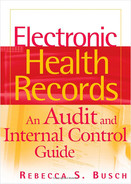
Electronic health records : an audit and internal control guide
Electronic Health Records: An Audit and Internal Control Guide describes the infrastructure of electronic health records and the impact that the government's new criteria will have on the private and public marketplace.Understand what to look for in a health care record management system and find tips and helpful guidance for implementation.
eBook

Classification and reporting guidelines for the pathology diagnosis of placenta accreta spectrum (PAS) disorders: recommendations from an expert panel
The terminology and diagnostic criteria presently used by pathologists to report invasive placentation is inconsistent and does not reflect current knowledge of the pathogenesis of the disease or the needs of the clinical care team. A consensus panel was convened to recommend terminology and reporting elements unified across the spectrum of PAS specimens (i.e., delivered placenta, total or partial hysterectomy with or without extrauterine tissues, curetting for retained products of conception). The proposed nomenclature under the umbrella diagnosis of placenta accreta spectrum (PAS) replaces the traditional categorical terminology (placenta accreta, increta, percreta) with a descriptive grading system that parallels the guidelines endorsed by the International Federation of Gynaecology and Obstetrics (FIGO). In addition, the nomenclature for hysterectomy specimens is separated from that for delivered placentas. The goal for each element in the system of nomenclature was to provide diagnostic criteria and guidelines for expected use in clinical practice.
Journal Article
Assessment of the impact on time to complete medical record using an electronic medical record versus a paper record on emergency department patients: a study
Background Electronic medical records are becoming an integral part of healthcare delivery. Objective The goal of this study was to compare paper documentation versus electronic medical record for non-traumatic chest pain to determine differences in time for physicians to complete medical records using paper versus electronic mediums. We also assessed physician satisfaction with the electronic format. Methods We conducted this before-after study in a single large tertiary care academic emergency department. In the ‘Before Period’, stopwatches determined the time for paper medical recording. In the ‘After Period’, a template-based electronic medical record was introduced and the time for electronic recording was measured. The time to record in the before and after periods were compared using a two-sided t test. We surveyed physicians to assess satisfaction. Results We enrolled 100 non-traumatic patients with chest pain in the before period and 73 in the after period. The documentation time was longer using electronic charting, (9.6±5.9 min vs 6.1±2.5 min; p<0.001). 18 of 20 physicians participating in the after period completed surveys. Physicians were not satisfied with the electronic patient recording for non-traumatic chest pain. Conclusions This is the first study that we are aware of which compared paper versus electronic medical records in the emergency department. Electronic recording took longer than paper records. Physicians were not satisfied using this electronic record. Given the time pressures on emergency physicians, a solution to minimise the charting time using electronic medical records must be found before widespread uptake of electronic charting will be possible.
Journal Article