
Catalogue Search | MBRL


Are you sure you want to remove the book from the shelf?

{{itemTitle}}
46
result(s) for
"Fortification, Roman."
Sort by:


The 2003-2007 Excavations in the Late Roman Fort at Yotvata
No detailed description available for \"The 2003-2007 Excavations in the Late Roman Fort at Yotvata\".
eBook

People and Spaces in Roman Military Bases
This study uses artefact distribution analyses to investigate the activities that took place inside early Roman imperial military bases. Focusing especially on non-combat activities, it explores the lives of families and other support personnel who are widely assumed to have inhabited civilian settlements outside the fortification walls. Spatial analyses, in GIS-type environments, are used to develop fresh perspectives on the range of people who lived within the walls of these military establishments, the various industrial, commercial, domestic and leisure activities in which they and combat personnel were involved, and the socio-spatial organisation of these activities and these establishments. The book includes examples of both legionary fortresses and auxiliary forts from the German provinces to demonstrate that more material-cultural approaches to the artefact assemblages from these sites give greater insights into how these military communities operated and demonstrate the problems of ascribing functions to buildings without investigating the full material record.
eBook


Hadrian's Wall and the End of Empire
There is no synthetic or comprehensive treatment of any late Roman frontier in the English language to date, despite the political and economic significance of the frontiers in the late antique period. Examining Hadrian's Wall and the Roman frontier of northern England from the fourth century into the Early Medieval period, this book investigates a late frontier in transition from an imperial border zone to incorporation into Anglo-Saxon kingdoms, using both archaeological and documentary evidence. With an emphasis on the late Roman occupation and Roman military, it places the frontier in the broader imperial context.
In contrast to other works, Hadrian's Wall and the End of Empire challenges existing ideas of decline, collapse, and transformation in the Roman period, as well as its impact on local frontier communities. Author Rob Collins analyzes in detail the limitanei, the frontier soldiers of the late empire essential for the successful maintenance of the frontiers, and the relationship between imperial authorities and local frontier dynamics. Finally, the impact of the end of the Roman period in Britain is assessed, as well as the influence that the frontier had on the development of the Anglian kingdom of Northumbria.
eBook
The 2003-2007 Excavations in the Late Roman Fort at Yotvata
The Late Roman fort at Yotvata is located in the southern Arava
some 40 km north of Eilat/Aqaba (ancient Aila). The modern Hebrew
name of the site is based on its suggested identification with
biblical Jotbathah (Deut 10:7), where the Israelites encamped
during their desert wanderings. The modern Arabic name of the site,
Ein Ghadian, may preserve the ancient Roman name Ad Dianam. Because
the Late Roman fort at Yotvata is visible as a low mound next to
the Arava road, it has long been known to scholars. Each June
between 2003 and 2007, Gwyn Davies (Florida International
University) and Jodi Magness (University of North Carolina at
Chapel Hill) co-directed excavations here. This volume provides the
results of those excavations, adding substantially to our knowledge
of Roman defenses in the third and fourth centuries of the Common
Era, along the trade route that traversed the southern Arava and on
the eastern frontier of the Empire.
eBook

Life and Letters from the Roman Frontier
Greetings, I ask that you send the things which I need for the use of my boys . . . which you well know I cannot properly get hold of here . . . --A Roman solider on the frontier of England around AD 100 Over three hundred letters and documents were recently discovered at the fort of Vindolanda, in Northern England, written on wooden tablets which have survived nearly 2,000 years. Painstakingly deciphered by Alan Bowman, the materials contribute a wealth of evidence for daily life in the Roman Empire. Military documents testify to the lifestyle of officers and soldiers stationed at Vindolanda, and portraits of domestic life are included in letters between the officers' wives and a letter from home promising a solider a package of socks. The engaging texts from thirty-four tablets provide insight into the similarities of daily existence in the Roman Empire and the present.
Alan K. Bowman is a Lecturer in Ancient History at the University of Oxford.
eBook

Life and letters on the Roman frontier : Vindolanda and its people
First published in 1998. Routledge is an imprint of Taylor Francis, an informa company.
eBook
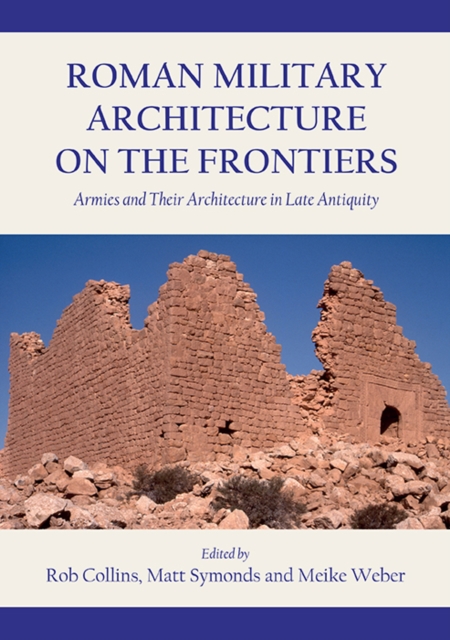
Roman Military Architecture on the Frontiers
The Roman army was one of the most astounding organizations in the ancient world, and much of the success of the Roman empire can be attributed to its soldiers. Archaeological remains and ancient texts provide detailed testimonies that have allowed scholars to understand and reconstruct the army’s organization and activities. This interest has traditionally worked in tandem with the study of Roman frontiers. Historically, the early imperial period, and in particular the emergence of the frontiers, has been the focus of research. During those investigations, however, the remains of the later Roman army were also frequently encountered, if not always understood. Recent decades have brought a burgeoning interest in not only the later Roman army, but also late antiquity more widely. It is the aim of this volume to demonstrate that while scholars grappling with the late Roman army may want for a rich corpus of inscriptions and easily identifiable military installations, research is revealing a dynamic, less-predictable force that was adapting to a changing world, in terms of both external threats and its own internal structures. The dynamism and ingenuity of the late Roman army provides a breath of fresh air after the suffocating uniformity of its forbears. The late Roman army was a vital and influential element in the late antique empire. Having evolved through the 3rd century and been formally reorganized under Diocletian and Constantine, the limitanei guarded the frontiers, while the comitatenses provided mobile armies that were fielded against external enemies and internal threats. The transformation of the early imperial army to the late antique army is documented in the rich array of texts from the period, supplemented by a perhaps surprisingly rich archaeological record.
eBook