
Catalogue Search | MBRL


Are you sure you want to remove the book from the shelf?

{{itemTitle}}
16,906
result(s) for
"Foucault"
Sort by:


Race and the education of desire : Foucault's History of sexuality and the colonial order of things
Michel Foucault's History of Sexuality has been one of the most influential books of the last two decades. It has had an enormous impact on cultural studies and work across many disciplines on gender, sexuality, and the body. Bringing a new set of questions to this key work, Ann Laura Stoler examines volume one of History of Sexuality in an unexplored light. She asks why there has been such a muted engagement with this work among students of colonialism for whom issues of sexuality and power are so essential. Why is the colonial context absent from Foucault's history of a European sexual discourse that for him defined the bourgeois self? In Race and the Education of Desire, Stoler challenges Foucault's tunnel vision of the West and his marginalization of empire. She also argues that this first volume of History of Sexuality contains a suggestive if not studied treatment of race.
Drawing on Foucault's little-known 1976 College de France lectures, Stoler addresses his treatment of the relationship between biopower, bourgeois sexuality, and what he identified as \"racisms of the state.\" In this critical and historically grounded analysis based on cultural theory and her own extensive research in Dutch and French colonial archives, Stoler suggests how Foucault's insights have in the past constrained—and in the future may help shape—the ways we trace the genealogies of race.
Race and the Education of Desire will revise current notions of the connections between European and colonial historiography and between the European bourgeois order and the colonial treatment of sexuality. Arguing that a history of European nineteenth-century sexuality must also be a history of race, it will change the way we think about Foucault.
eBook

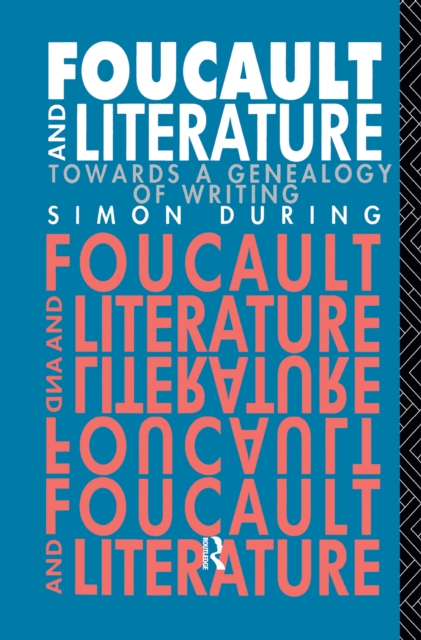
Foucault and Literature
The writings of the French historian, literary critic and philosopher Michel Foucault have been of immense importance in the formation of the “new historicism” and “cultural materialism” which currently dominate international literary studies. Foucault’s accounts of power, sexuality and discourse have had a profound influence, and will remain central to future debates and developments.
Foucault and Literature provides a detailed introduction to the whole body of Foucault’s work, and assesses its impact on Anglo-American literary studies. Simon During offers a critique both of Foucault and of the literary studies that have been influenced by him. As such, his book will be of interest to all those involved in the study and teaching of literary criticism and theory, as well as those who have a particular interest in the work of Michel Foucault.
Simon During is Senior Lecturer in the English Department of the University of Melbourne, Australia.
eBook

Archives and the Event of God
The philosophical works of Michel Foucault have profoundly influenced many disciplines, but his influence on theology has seldom been considered. Archives and the Event of God unravels the effects that Foucault’s Archaeology of Knowledge and Discipline and Punish have had on the study of theology and religion.
eBook


The Political Philosophy of Michel Foucault
This book is the first to systematically reconstruct Michel Foucault’s political and philosophical thought across his career. It argues, in the areas of epistemology, power, subjectivity, resistance, politics, and ethics, that Foucault’s work represents the articulation of a consistent and progressive philosophical and political viewpoint. The work is thus an important intervention into the field of Foucault studies, where many continue to claim that Foucault’s work is contradictory, nonsensical, or nihilistic.
Introduction 1. Epistemology 2. Power I 3. Power II 4. Subjectivity 5. Resistance 6. Critique 7. Ethics
Mark G.E. Kelly is Lecturer in Philosophy at Middlesex University.
'This book is the one scholars and students should turn to for the much needed analysis of the key theoretical concepts in Foucault’s work--concepts such as power, subjectivity, resistance and critique. It also provides a sustained defense of the consistency of Foucault’s views over time. Kelly has succeeded in grasping Foucault from the inside out.' – David Weberman, Central European University, Hungary
eBook

Foucault : a very short introduction
Foucault is one of those rare philosophers who has become a cult figure. From aesthetics to the penal system; from madness and civilisation to avant-garde literature, he rejected old models of thinking and replaced them with versions that are still debated today. This book introduces and explores aspects of his life, work, and thought.
Book

Governmentality
First developed by Michel Foucault more than thirty years ago, \"governmentality\" has become an essential set of tools for many researchers in the social and political sciences today. What is \"governmentality\"? How does this perspective challenge the way we understand political power and its contestation? This new introduction offers advanced undergraduate and graduate students both a highly accessible guide and an original contribution to debates about power and governmentality.
The book aims to serve four main functions:
To situate governmentality as an intellectual development within Foucault's thinking about the microphysics of power and his genealogical methods;
To reveal how research in governmentality has changed as the idea encounters new academic fields, political contexts and regional settings;
To examine one of the more recent encounters between governmentality and the social sciences - its interaction with international relations and global politics;
To offer researchers some methodological suggestions for undertaking studies in governmentality, stressing that its critical edge becomes blunted if it is detached from historical/genealogical modes of inquiry.
This book offers a set of conceptual and methodological observations intended to keep research in governmentality a living, critical thought project. Above all, it argues that the challenge of understanding the world calls for the addition of new thinking equipment to the governmentality toolbox. Governmentality: Critical Encounters will prove useful for students of social and political theory, international relations, political sociology, anthropology and geography.
eBook