
Catalogue Search | MBRL


Are you sure you want to remove the book from the shelf?

{{itemTitle}}
17
result(s) for
"France History Revolution, 1789-1799 Foreign public opinion, British."
Sort by:

Revolutionary Writings : Reflections on the Revolution in France and the First Letter on a Regicide Peace
\"Burke's Reflections on the Revolution in France was the first sustained theoretical critique of the French Revolution; and is now recognised as the classic statement of modern conservatism. Reflections surveys the British political culture of traditionalism, gradualism and deference, and contrasts it with the French Revolutionaries' programme of appeal to abstract right, transformational change and popular agency. Ultimately Burke advocated a counterrevolutionary war and the restoration of the French monarchy. This accessible new edition brings together for the first time Burke's first and last published thoughts on the revolution including as it does the first Letter on a Regicide Peace; a work that has contributed to a particular view of international society. Featuring a comprehensive introduction and extensive annotations, Iain Hampsher-Monk's edition helps readers new to Burke to better understand the historical, political and philosophical context behind his writings, and the significance of contemporary and classical allusions\"-- Provided by publisher.
BOOK

The Cambridge Companion to British Literature of the French Revolution in the 1790s
The French Revolution ignited the biggest debate on politics and society in Britain since the Civil War 150 years earlier. The public controversy lasted from the initial, positive reaction to French events in 1789 to the outlawing of the radical societies in 1799. This Cambridge Companion highlights the energy, variety and inventiveness of the literature written in response to events in France and the political reaction at home. It contains thirteen specially commissioned essays by an international team of historians and literary scholars, a chronology of events and publications, and an extensive guide to further reading. Six essays concentrate on the principal writers of the Revolution controversy: Burke, Paine, Godwin and Wollstonecraft. Others deal with popular radical culture, counter-revolutionary culture, the distinctive contribution of women writers, novels of opinion, drama, and poetry. This volume will serve as a comprehensive yet accessible reference work for students, advanced researchers and scholars.
eBook

The Cambridge companion to British literature of the French Revolution in the 1790s
\"The French Revolution ignited the biggest debate on politics and society in Britain since the Civil War 150 years earlier. The public controversy lasted from the initial, positive reaction to French events in 1789 to the outlawing of the radical societies in 1799. This Cambridge Companion highlights the energy, variety and inventiveness of the literature written in response to events in France and the political reaction at home. It contains thirteen specially commissioned essays by an international team of historians and literary scholars, a chronology of events and publications, and an extensive guide to further reading. Six essays concentrate on the principal writers of the Revolution controversy: Burke, Paine, Godwin and Wollstonecraft. Others deal with popular radical culture, counter-revolutionary culture, the distinctive contribution of women writers, novels of opinion, drama, and poetry. This volume will serve as a comprehensive yet accessible reference work for students, advanced researchers and scholars\"-- Provided by publisher.
Book
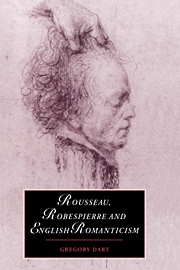
Rousseau, Robespierre and English Romanticism
This book re-opens the question of Rousseau's influence on the French Revolution and on English Romanticism, by examining the relationship between his confessional writings and his political theory. Gregory Dart argues that by looking at the way in which Rousseau's writings were mediated by the speeches and actions of the French Jacobin statesman Maximilien Robespierre, we can gain a clearer and more concrete sense of the legacy he left to English writers. He shows how the writings of William Godwin, Mary Wollstonecraft, William Wordsworth and William Hazlitt rehearse and reflect upon the Jacobin tradition in the aftermath of the French revolutionary Terror.
eBook

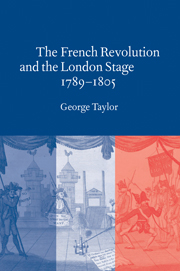
The French Revolution and the London Stage, 1789–1805
During the French Revolution most performances on the London stage were strictly censored, but political attitudes found indirect expression. New and popular genres like pantomime, gothic drama, history plays, musical and spectacular entertainment, and, above all, melodrama provided metaphors for the hopes and fears inspired by the conflict in France and subsequent European wars. This 2001 book looks at how British drama and popular entertainment were affected by the ideas and events of the French Revolution and Napoleonic Wars. He argues that melodrama had its origins in this period, with certain gothic villains displaying qualities attributed to Robespierre and Napoleon, and that recurrent images of incarceration and dispossession reflected fears of arbitrary persecution, from the tyranny of the Bastille to the Jacobin's Reign of Terror. By a cultural analysis of the popular entertainment and theatre performances of the eighteenth and nineteenth centuries Taylor reveals issues of ideological conflict and psychological stress.
eBook

The romantic crowd : sympathy, controversy and print culture
\"In the long eighteenth century, sympathy was understood not just as an emotional bond, but also as a physiological force, through which disruption in one part of the body produces instantaneous disruption in another. Building on this theory, Romantic writers explored sympathy as a disruptive social phenomenon, which functioned to spread disorder between individuals and even across nations like a 'contagion'. It thus accounted for the instinctive behaviour of people swept up in a crowd. During this era sympathy assumed a controversial political significance, as it came to be associated with both riotous political protest and the diffusion of information through the press. Mary Fairclough reads Edmund Burke, Mary Wollstonecraft, William Godwin, John Thelwall, William Hazlitt and Thomas De Quincey alongside contemporary political, medical and philosophical discourse. Many of their central questions about crowd behaviour still remain to be answered by the modern discourse of collective psychology\"--Provided by publisher.
Book

Reflections on the Revolution in France
The most enduring work of its time,Reflections on the Revolution in Francewas written in 1790 and has remained in print ever since. Edmund Burke's analysis of revolutionary change established him as the chief framer of modern European conservative political thought. This outstanding new edition of theReflectionspresents Burke's famous text along with a historical introduction by Frank M. Turner and four lively critical essays by leading scholars.The volume sets theReflectionsin the context of Western political thought, highlights its ongoing relevance to contemporary debates, and provides abundant critical notes, a glossary, and a glossary-index to ensure its accessibility. Contributors to the book examine various provocative aspects of Burke's thought. Conor Cruise O'Brien explores Burke's hostility to \"theory,\" Darrin McMahon considers Burke's characterization of the French Enlightenment, Jack Rakove contrasts the views of Burke and American constitutional framers on the process of drawing up constitutions, and Alan Wolfe investigates Burke, the social sciences, and liberal democracy.
eBook

The Romantic Crowd
In the long eighteenth century, sympathy was understood not just as an emotional bond, but also as a physiological force, through which disruption in one part of the body produces instantaneous disruption in another. Building on this theory, Romantic writers explored sympathy as a disruptive social phenomenon, which functioned to spread disorder between individuals and even across nations like a 'contagion'. It thus accounted for the instinctive behaviour of people swept up in a crowd. During this era sympathy assumed a controversial political significance, as it came to be associated with both riotous political protest and the diffusion of information through the press. Mary Fairclough reads Edmund Burke, Mary Wollstonecraft, William Godwin, John Thelwall, William Hazlitt and Thomas De Quincey alongside contemporary political, medical and philosophical discourse. Many of their central questions about crowd behaviour still remain to be answered by the modern discourse of collective psychology.
eBook