
Catalogue Search | MBRL


Are you sure you want to remove the book from the shelf?

{{itemTitle}}
36
result(s) for
"France History Revolution, 1789-1799 Literature and the revolution."
Sort by:

Teaching representations of the French Revolution
\"Offers techniques for teaching literature of the French Revolution in college courses, including considerations of the revolution's effects on modern ideas, republicanism and human rights, laïcité, and Charlie Hebdo, along with comparative approaches involving Germany, Greece, Haiti, Italy, Latin America, and Spain. Provides bibliographical resources, a timeline, and filmography\"-- Provided by publisher.
Book

The Cambridge Companion to British Literature of the French Revolution in the 1790s
The French Revolution ignited the biggest debate on politics and society in Britain since the Civil War 150 years earlier. The public controversy lasted from the initial, positive reaction to French events in 1789 to the outlawing of the radical societies in 1799. This Cambridge Companion highlights the energy, variety and inventiveness of the literature written in response to events in France and the political reaction at home. It contains thirteen specially commissioned essays by an international team of historians and literary scholars, a chronology of events and publications, and an extensive guide to further reading. Six essays concentrate on the principal writers of the Revolution controversy: Burke, Paine, Godwin and Wollstonecraft. Others deal with popular radical culture, counter-revolutionary culture, the distinctive contribution of women writers, novels of opinion, drama, and poetry. This volume will serve as a comprehensive yet accessible reference work for students, advanced researchers and scholars.
eBook
Performing History
In his examination of the ways in which theatre participates in the ongoing representations of and debates about the past, Freddie Rokem concentrates on the ways in which theatre after World War II has presented different aspects of the French Revolution and the Holocaust, showing us that by \"performing history\" actors bring the historical past and the theatrical present together.
eBook

Tragedy Walks the Streets
Tragedy Walks the Streets challenges the conventional understanding that the evolution of European drama effectively came to a halt during France's Revolutionary era. In this interdisciplinary history on the emergence of modern drama in European culture, Matthew S. Buckley contends that the political theatricality of the Revolution tested and forced the evolution of dramatic forms, supplanting the theater itself as the primary stage of formal development. Drawing on a wide range of texts and images, he demonstrates how the social and political enlistment of dramatic theatricality inflected rising social and political tensions in pre-Revolutionary France, shaped French Revolutionary political culture, conditioned British political and cultural responses to the Revolution, and served as the impetus for Büchner's radical formal innovations of the 1830s. Setting aside traditional boundaries of literary scholarship, Buckley pursues instead a history of dramatic form that encompasses the full range of dramatic activity in the changing cultural life of the late eighteenth and early nineteenth century, including art, architecture, journalism, political performance, and social behavior. Surveying this expanded field of inquiry, Buckley weaves together a coherent formal genealogy of the drama during this period and offers a new, more continuous generic history of modern drama in its first and most turbulent phase of development.
eBook

Passions of the sign : revolution and language in Kant, Goethe, and Kleist
Passions of the Sign traces the impact of the French Revolution on Enlightenment thought in Germany as evidenced in the work of three major figures around the turn of the nineteenth century: Immanuel Kant, Johann Wolfgang von Goethe, and Heinrich von Kleist. Andreas Gailus examines a largely overlooked strand in the philosophical and literary reception of the French Revolution, one which finds in the historical occurrence of revolution the expression of a fundamental mechanism of political, conceptual, and aesthetic practice. With a close reading of a critical essay by Kleist, an in-depth discussion of Kant's philosophical writing, and new readings of the novella form as employed by both Goethe and Kleist, Gailus demonstrates how these writers set forth an energetic model of language and subjectivity whose unstable nature reverberates within the very foundations of society. Unfolding in the medium of energetic signs, human activity is shown to be subject to the counter-symbolic force that lies within and beyond it. History is subject to contingency and is understood not as a progressive narrative but as an expanse of revolutionary possibilities; language is subject to the extra-linguistic context of utterance and is conceived primarily not in semantic but in pragmatic terms; and the individual is subject to impersonal affect and is figured not as the locus of self-determination but as the site of passions that exceed the self and its pleasure principle. At once a historical and a conceptual study, this volume moves between literature and philosophy, and between textual analysis and theoretical speculation, engaging with recent discussions on the status of sovereignty, the significance of performative language in politics and art, and the presence of the impersonal, even inhuman, within the economy of the self.
eBook
Coleridge, revision and romanticism : after the revolution, 1793-1818
The Romantic phenomenon of multiple texts has been shaped by the link between revision and authorial intent. However, what has been overlooked are the profound implications of multiple and contradictory versions of the same text for a materialist approach; using the works of Coleridge as a case study and the afterlife of the French Revolution as the main theme, this monograph lays out the methodology for a more detailed multi-layered analysis. Scrutinising four works of Coleridge (two poems, a newspaper article and a play), where every major variant is read as a separate work with its own distinct socio-historical context, Ve-Yin Tee challenges the notion that any one text is representative of its totality. By re-reading Coleridge in the light of alternative textual materials within that time, he opens a wider scope for meaning and the understanding of Coleridge's oeuvre.
eBook
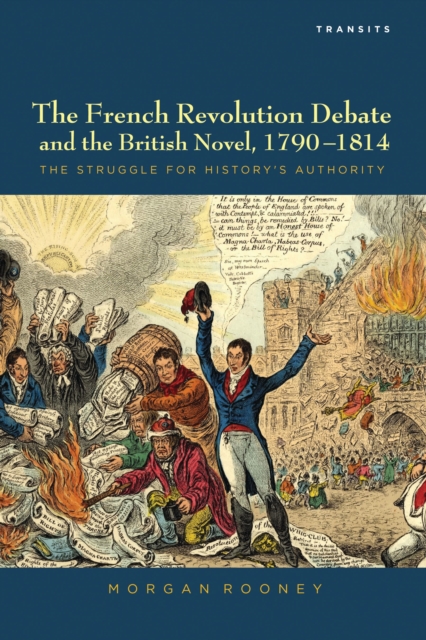
The French revolution debate and the British novel, 1790-1814 : the struggle for history's authority
This study examines how debates about history during the French Revolution informed and changed the nature of the British novel between 1790 and 1814. During these years, intersections between history, political ideology, and fiction, as well as the various meanings of the term \"history\" itself, were multiple and far reaching. Morgan Rooney elucidates these subtleties clearly and convincingly. While political writers of the 1790s—Burke, Price, Mackintosh, Paine, Godwin, Wollstonecraft, and others—debate the historical meaning of the Glorious Revolution as a prelude to broader ideological arguments about the significance of the past for the present and future, novelists engage with this discourse by representing moments of the past or otherwise vying to enlist the authority of history to further a reformist or loyalist agenda. Anti-Jacobin novelists such as Charles Walker, Robert Bisset, and Jane West draw on Burkean historical discourse to characterize the reform movement as ignorant of the complex operations of historical accretion. For their part, reform-minded novelists such as Charlotte Smith, William Godwin, and Maria Edgeworth travesty Burke's tropes and arguments so as to undermine and then redefine the category of history. As the Revolution crisis recedes, new novel forms such as Edgeworth's regional novel, Lady Morgan's national tale, and Jane Porter's early historical fiction emerge, but historical representation—largely the legacy of the 1790s' novel—remains an increasingly pronounced feature of the genre. Whereas the representation of history in the novel, Rooney argues, is initially used strategically by novelists involved in the Revolution debate, it is appropriated in the early nineteenth century by authors such as Edgeworth, Morgan, and Porter for other, often related ideological purposes before ultimately developing into a stable, nonpartisan, aestheticized feature of the form as practiced by Walter Scott. The French Revolution Debate and the British Novel, 1790–1814 demonstrates that the transformation of the novel at this fascinating juncture of British political and literary history contributes to the emergence of the historical novel as it was first realized in Scott's Waverley (1814).
eBook
Welsh poetry of the French revolution, 1789-1805 (Wales and the French revolution)
This anthology of Welsh poetry and English translations presents some of Wales's radical and reactionary responses to the French Revolution and its cultural legacy, 1789-1805.
eBook

Romanticism at the end of history
Through provocative and searching readings of the poetry of Wordsworth; the poems, criticism, and journalism of Coleridge; the Confessions of De Quincey; and Sir Walter Scott's Waverley, Christensen concludes that during complicated times of war and revolution English Romantic writers were forced to redefine their role as artists.
eBook
The French Revolution and the London Stage, 1789–1805
During the French Revolution most performances on the London stage were strictly censored, but political attitudes found indirect expression. New and popular genres like pantomime, gothic drama, history plays, musical and spectacular entertainment, and, above all, melodrama provided metaphors for the hopes and fears inspired by the conflict in France and subsequent European wars. This 2001 book looks at how British drama and popular entertainment were affected by the ideas and events of the French Revolution and Napoleonic Wars. He argues that melodrama had its origins in this period, with certain gothic villains displaying qualities attributed to Robespierre and Napoleon, and that recurrent images of incarceration and dispossession reflected fears of arbitrary persecution, from the tyranny of the Bastille to the Jacobin's Reign of Terror. By a cultural analysis of the popular entertainment and theatre performances of the eighteenth and nineteenth centuries Taylor reveals issues of ideological conflict and psychological stress.
eBook