
Catalogue Search | MBRL


Are you sure you want to remove the book from the shelf?

{{itemTitle}}
10,819
result(s) for
"Franco, Francisco"
Sort by:

Franco : anatomy of a dictator
\"On 20th November 1975, General Francisco Franco died in Madrid, just before his 83rd birthday. At the time of his death he had been the head of a dictatorial regime with the title of 'Caudillo' for almost 40 years. In this book, Enrique Moradiellos redraws Franco in three dimensions - Franco, the man; Franco, the Caudillo and Franco's Spain. In so doing, he offers a reappraisal of Franco's personality, his leadership style and the nature of the regime that he established and led until his death. As a dictator who established his power prior to World War II and maintained it well into the 1970s, Franco was one of the most central figures of twentieth-century European history. In Spain today, he is a spectre from a regrettable recent past, uncomfortable yet still very real and significant. Although a realtively minor dictator in comparison with Mussolini, Hitler or Stalin, Franco was more fortunate than them in terms of survival, long-lasting influence and public image. A study of his regime and its historical evolution sheds new light on fundamental questions of European history, including the social and cultural bases for totalitarian or authoritarian challenges to democracy and sources of political legitimacy grounded in the charisma of a leader. In this book, Enrique Moradiellos Garcia examines the dictatorship as well as the dictator and, in doing so, reveals new aspects to our understanding of General Franco, the Caudillo.\"--Dust jacket cover.
Book

Unearthing Franco's Legacy
Unearthing Franco's Legacy: Mass Graves and the Recovery of
Historical Memory in Spain addresses the political, cultural,
and historical debate that has ensued in Spain as a result of the
recent discovery and exhumation of mass graves dating from the
years during and after the Spanish Civil War (1936-39). The victor,
General Francisco Franco, ruled as a dictator for thirty-six years,
during which time he and his supporters had thousands of political
dissidents or suspects and their families systematically killed and
buried in anonymous mass graves. Although Spaniards living near the
burial sites realized what was happening, the conspiracy of silence
imposed by the Franco regime continued for many years after his
death in 1975 and after the establishment of a democratic
government.
While the people of Germany, France, and Italy have confronted
the legacies of the repressive regimes that came to power in those
countries during the 1920s, '30s, and '40s, the unearthing of the
anonymous dead in Spain has focused attention on how Spaniards have
only recently begun to revisit their past and publicly confront
Franco's legacy. The essays by historians, anthropologists,
literary scholars, journalists, and cultural analysts gathered here
represent the first interdisciplinary analysis of how present-day
Spain has sought to come to terms with the violence of Franco's
regime. Their contributions comprise an important example of how a
culture critiques itself while mining its collective memory.
eBook


Francisco Franco Is Back: The Contested Reemergence of a Fascist Moral Exemplar
Based on long-term ethnographic research on contemporary exhumations of mass graves from the Spanish Civil War (1936–1939), as well as analysis of the exhumation of Francisco Franco from the Valley of the Fallen, this paper looks at the ways in which the dictator’s moral exemplarity has evolved over time since his military victory in 1939. During the early years of his dictatorship, Franco’s propaganda machine built the legend of a historical character touched by divine providence who sacrificed himself to save Spain from communism. His moral charisma was enriched by associating his historical mission with a constellation of moral exemplars drawn from medieval and imperial Spain. After his death, his moral exemplarity dwindled as democratic Spain embraced a political discourse of national reconciliation. Yet, since 2000, a new negative exemplarity of Franco as a war criminal has come into sharp focus, in connection with the exhumation of the mass graves of tens of thousands of Republican civilians executed by his army and paramilitary. In recent years, Franco has reemerged as a fascist exemplar alongside a rise of the extreme right. To understand the revival of his fascist exemplarity, I focus on two processes: the rise of the political party Vox, which claims undisguised admiration for Franco’s legacy (a process I call “neo-exemplarity”), and the dismantling in October 2019 of Franco’s honorable burial and the debate over the treatment that his mortal remains deserve (a process I call “necro-exemplarity”).
Journal Article
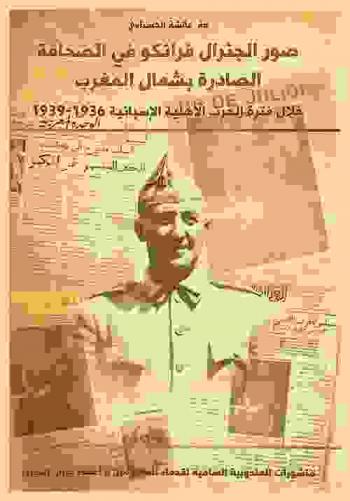
صور الجنرال فرانكو في الصحافة الصادرة بشمال المغرب خلال فترة الحرب الأهلية الإسبانية 1936-1939
يعالج الإصدار الموسوم بـ «صور الجنرال فرانكو في الصحافة الصادرة بشمال المغرب خلال فترة الحرب الأهلية الإسبانية 1936-1939» للباحثة الدكتورة عائشة الحسناوي، موضوع الحرب الأهلية الإسبانية من زاوية غابت في الدراسات والأعمال الأكاديمية المغربية على قلتها، ذلك أنه يتناول بالدرس والتحليل والتوثيق امتدادات الحرب الأهلية الإسبانية في المنطقة الشمالية الخاضعة للحماية الأسبانية يومها من زاوية المساهمة الإعلامية في أوارها، والانقسام الفكري الأيديولوجي الذي شهدته الصحافة المكتوبة بالشمال المغربي إبان فترة تلك الحرب، وذلك جراء موقفها المتباين وأحيانا المتضارب من قائد الحرب، الجنرال فرانكو، الذي اختلف حوله الإعلام الدولي بصفة عامة، وانقسم في موقفه بين المتصارعين بإسبانيا ؛ أي بين فرانكو، والجمهورية الإسبانية الثانية، تفاعلا مع الظرفية العالمية التي كانت منقسمة خلال نفس الفترة بين الأنظمة الديكتاتورية الفاشية والأنظمة الشيوعية. فالحرب كانت عبارة عن انفجار كبير للتناقضات الفكرية بين الإسبانيتين «إسبانيا فرانكو وإسبانيا الجبهة الشعبية»، هذه التناقضات يمكن اختزالها في الصراع بين أيديولوجيتي الفاشية والشيوعية، وقد كانت منطقة الحماية الإسبانية ومنطقة طنجة الدولية مسرحا لنشر مفاهيمها ومبادئها عبر مختلف وسائل الإعلام، وفي مقدمتها الصحافة المكتوبة التي شهدت بدورها تحولات عميقة. فقد كان طبيعيا أن تتأثر صحافة شمال المغرب بالإعلام الدولي وتتخذ مواقف مختلفة من الجنرال فرانكو، الذي جر منطقة الحماية الإسبانية بساكنتها ومؤهلاتها وقدراتها إلى حرب لا دخل للمغرب والمغاربة فيها. ويأتي الإصدار الذي ألفته الباحثة الدكتورة عائشة الحسناوي، كمبادرة أكاديمية للتعرف على بعض الجوانب من سياسة فرانكو الإعلامية بشمال المغرب، حيث وظف من خلالها الإمكانات البشرية والمادية لمنطقة الحماية الإسبانية في حملته العسكرية التي انطلقت من شمال المغرب. فقد بنى فرانكو سياسته الإعلامية على الدين والتاريخ والحماية ؛ مستغلا في حملته الدعائية العلاقات المغربية الإسبانية والتاريخ المشترك بين البلدين، والدور الإسباني الفرانكاوي في تمدين شمال المغرب، وإعطاء الحماية دور الريادة والسبق التاريخي الإسباني في المغرب.
Book

Making Modern Spain
In this elegantly written study, Alfante explores the work of select nineteenth-century writers, intellectuals, journalists, politicians, and clergy who responded to cultural and spiritual shifts caused by the movement toward secularization in Spain. Focusing on the social experience, this book probes the tensions between traditionalism and liberalism that influenced public opinion of the clergy, sacred buildings, and religious orders. The writings of Cecilia Böhl de Faber (Fernán Caballero), Gustavo Adolfo Bécquer, Benito Pérez Galdós, and José María de Pereda addressed conflicts between modernizing forces and the Catholic Church about the place of religion and its signifiers in Spanish society. Foregrounding expropriation (government confiscation of civil and ecclesiastical property) and exclaustration (the expulsion of religious communities), and drawing on archival research, the history of disentailment, cultural theory, memory studies, and sociology, Alfante demonstrates how Spain’s liberalizing movement profoundly influenced class mobility and faith among the populace.
eBook

Das Labyrinth der Lichter : roman
\"Nine-year-old Alicia lost her parents during the Spanish Civil War when the Nacionales (the fascists) savagely bombed Barcelona in 1938. It is twenty years later. Tired of her work as investigator for Spain's secret police in Madrid, a job she has held for more than a decade, the twenty-nine-year old plans to quit. At the insistence of her boss, she remains to solve one last case: the mysterious disappearance of Spain's Minister of Culture, Mauricio Valls. With her partner, the intimidating policeman Juan Manuel Vargas, Alicia discovers a possible clue - a rare book by the author Victor Mataix hidden in Valls' office in his Madrid mansion. As Alicia and Vargas come closer to finding Valls, they uncover a tangled web of kidnappings and murders tied to the Franco regime, whose corruption is more widespread and horrifying than anyone imagined. Now Alicia's life is in danger.\" -- abridgment of a summary on goodreads.com
BOOK

The memory of Spanish Gypsies: Scholarship, oral history, and archive research
This study explores avenues of research pertaining to the lives and experiences of Gitanos or Calé (Spanish Gypsies) during the Spanish Civil War and General Francisco Franco’s dictatorship. The essay locates little-explored scholarship, oral testimonials, and archives that can be used for further investigation into the experiences of Gitanos in a period that needs to be documented with greater rigor. It facilitates availability of material regarding this part of Spain’s past and present lines of inquiry that require attention. The main goal here is, in short, to foster open discussion about the challenges and hardships of this marginal group in a still obscure and unexposed period of Spain’s history.
Journal Article

Truman, Franco's Spain, and the Cold War
\"President Harry S. Truman harbored an abiding disdain for Spain and its government. During his presidency (1945-1953), the State Department and the Department of Defense lobbied Truman to form an alliance with Spain to leverage that nation's geostrategic position, despite Francisco Franco's authoritarian dictatorship. Truman's negative views on Spain developed from his Baptist upbringing and youth during the Spanish-American War and his first term in the US Senate. As a Freemason and Protestant, Truman struggled to overcome his bias against a regime that persecuted those with similar affiliations, and whose politics were set against the liberal democracy, the workers and farmers the \"Man from Independence\" championed throughout his career. The eventual alliance between the two countries came only after years of argument for such a shift by nearly the entire US diplomatic and military establishment. Truman begrudgingly accepted an agreement with the Spanish government after years of pressure, and with the overarching need for allies during the Cold War. This delay increased the financial cost of the 1953 defense agreements with Spain, undermined US planning for the defense of Europe, and caused dysfunction over foreign policy at the height of the Cold War. Truman never reconciled to this accommodation, continuing to consider Spain, its history, and culture with a mix of apathy and derision. This important book tells the story of Truman's hostility to Spain and its impact on this military, diplomatic, and commercial relationship, the history of the early Cold War, and the extent of presidential leadership in strategic foreign policy shifts.\"-- Inside jacket flap.
Book
