
Catalogue Search | MBRL


Are you sure you want to remove the book from the shelf?

{{itemTitle}}
422
result(s) for
"Frankenstein"
Sort by:

Frankenstein
James Whale's Frankenstein (1931) spawned a phenomenon that has been rooted in world culture for decades. This cinematic Prometheus has generated countless sequels, remakes, rip-offs, and parodies in every media, and this granddaddy of cult movies constantly renews its followers in each generation. Along with an in-depth critical reading of the original 1931 film, this book tracks Frankenstein the monster's heavy cultural tread from Mary Shelley's source novel to today's Internet chat rooms. --Back cover.
Book

Frankenstein
What you see on the screen was born here: the premier monster story of English literature--a tale of science pursued to horrifying extremes.Includes new illustrations by Amanda Shaffer and a new introduction by Melissa Marr An origin story nearly as famous as the book itself: One dreary summer on the shores of Lake Geneva, amid discussions of.
eBook
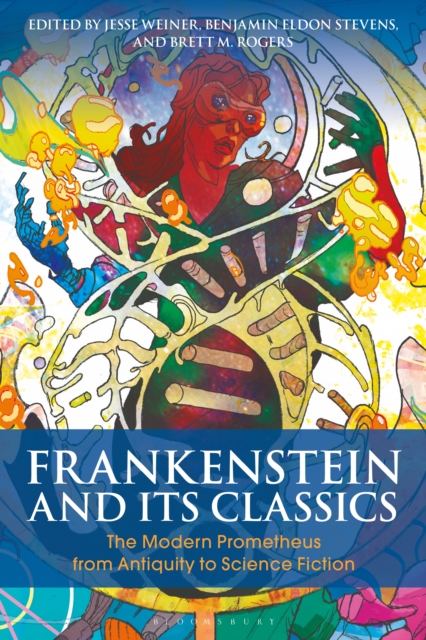
Frankenstein and its classics : the modern Prometheus from antiquity to science fiction
'Frankenstein and Its Classics' is a collection of scholarship dedicated to how Frankenstein and works inspired by it draw on ancient Greek and Roman literature, history, philosophy and myth. Presenting 12 new essays intended for students, scholars and other readers of Mary Shelley's novel, the volume explores classical receptions in some of Frankenstein's most important scenes, sources and adaptations.
eBook

ASEAN and the Frankenstein dilemma: Will ASEAN become a monster? version 1; peer review: 1 approved, 1 not approved
Background: International organizations are pivotal as actors in international relations. Although its establishment represents a state, they have their objectives separate from their creators. The Association of Southeast Asian Nations [ASEAN] was created to handle cooperation and maintain peace and security in Southeast Asia. Although ASEAN was equipped with institutional organs to fulfil its purposes, member states' influence is unavoidable. This situation raises the Frankenstein dilemma in which creators cannot fully control its creature. This research aims to elaborate on ASEAN as a separate institution with independent objectives and how far member states can manage ASEAN as its creation.
Methods: This study uses descriptive-analytical legal research as a method to examine ASEAN constitutional instruments and its first legal text to elaborate on its capacity as a legal person and its role in distinguishing interests between member states. The two ASEAN constitutional instruments are the Bangkok Declaration, 1967, and The ASEAN Charter, 2007, while the first legal instrument is the Treaty of Amity and Cooperation. All of the resources were gathered from ASEAN legal instruments database.
Results: After carefully examining the documents, since its establishment ASEAN has kept member states at arms-length to realize their interests; the ASEAN position is only to legalize what its member state wants. Even after 40 years, this situation has not changed. While ASEAN has independent objectives and structures, its member states always made institutional designs to control ASEAN's capacity to act in the international forum. In this case, ASEAN is always under the authority of its member states and has never evolved like Frankenstein's creature.
Conclusions: ASEAN will never turn into a monster as ASEAN never has sole interests that contradict its members. ASEAN member states always design ASEAN constitutional and legal instruments to restrict its role as an independent legal person in international forums.
Journal Article


Remaking the Frankenstein myth on film : between laughter and horror
Focusing on films outside the horror genre, this book offers a unique account of the Frankenstein myth’s popularity and endurance. Although the Frankenstein narrative has been a staple in horror films, it has also crossed over into other genres, particularly comedy and science fiction, resulting in such films as Abbott and Costello Meet Frankenstein, Young Frankenstein, The Rocky Horror Picture Show, Bladerunner, and the Alien and Terminator film series. In addition to addressing horror’s relationship to comedy and science fiction, the book also explores the versatility and power of the Frankenstein narrative as a contemporary myth through which our deepest attitudes concerning gender (masculine versus feminine), race (Same versus Other), and technology (natural versus artificial) are both revealed and concealed. The book not only examines the films themselves, but also explores early drafts of film scripts, scenes that were cut from the final releases, publicity materials, and reviews, in order to consider more fully how and why the Frankenstein myth continues to resonate in the popular imagination.
eBook


The Chimera, the Robot Artist, and the Cardboard Hand
In this paper, we present findings from an exploratory qualitative study that investigated how hands-on activities can help learners think of socioscientific issues more concretely. These activities borrowed themes, such as the responsibilities of creators and limits of scientific exploration from the culturally ubiquitous Frankenstein story to stimulate students’ thinking about socioscientific issues faced by scientists when they create and manipulate life. Our findings suggest that hands-on activities can open up new ways for learners to think about the social and ethical ramifications of emergent scientific practices and advancements. By allowing them to work on different hands-on activities that imitate scientific work, learners could explore various ethical questions around the creation and manipulation of organic and artificial life, which in turn could allow them to think about complex issues more elaborately. Our findings provide a framework for understanding young learners’ conceptualizations and perceptions of various socioscientific issues. Lessons from this study can also inform practitioners and professionals about how to design and implement hands-on activities that are inexpensive, accessible, and broadly appealing to diverse groups of learners.
Journal Article