
Catalogue Search | MBRL


Are you sure you want to remove the book from the shelf?

{{itemTitle}}
4,692
result(s) for
"Franks History."
Sort by:
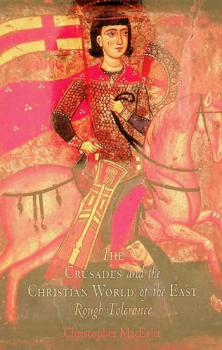
The crusades and the Christian world of the East : rough tolerance
Annotation In the wake of Jerusalem's fall in 1099, the crusading armies of western Christians known as the Franks found themselves governing not only Muslims and Jews but also local Christians, whose culture and traditions were a world apart from their own. The crusader-occupied swaths of Syria and Palestine were home to many separate Christian communities: Greek and Syrian Orthodox, Armenians, and other sects with sharp doctrinal differences. How did these disparate groups live together under Frankish rule? In The Crusades and the Christian World of the East, Christopher MacEvitt marshals an impressive array of literary, legal, artistic, and archeological evidence to demonstrate how crusader ideology and religious difference gave rise to a mode of coexistence he calls \"rough tolerance.\" The twelfth-century Frankish rulers of the Levant and their Christian subjects were separated by language, religious practices, and beliefs. Yet western Christians showed little interest in such differences. Franks intermarried with local Christians and shared shrines and churches, but they did not hesitate to use military force against Christian communities. Rough tolerance was unlike other medieval modes of dealing with religious difference, and MacEvitt illuminates the factors that led to this striking divergence.\"It is commonplace to discuss the diversity of the Middle East in terms of Muslims, Jews, and Christians,\" MacEvitt writes, \"yet even this simplifies its religious complexity.\" While most crusade history has focused on Christian-Muslim encounters, MacEvitt offers an often surprising account by examining the intersection of the Middle Eastern and Frankish Christian worlds during the century of the First Crusade.
Book

The Crusades and the Christian World of the East
In the wake of Jerusalem's fall in 1099, the crusading armies of western Christians known as the Franks found themselves governing not only Muslims and Jews but also local Christians, whose culture and traditions were a world apart from their own. The crusader-occupied swaths of Syria and Palestine were home to many separate Christian communities: Greek and Syrian Orthodox, Armenians, and other sects with sharp doctrinal differences. How did these disparate groups live together under Frankish rule? InThe Crusades and the Christian World of the East, Christopher MacEvitt marshals an impressive array of literary, legal, artistic, and archeological evidence to demonstrate how crusader ideology and religious difference gave rise to a mode of coexistence he calls \"rough tolerance.\" The twelfth-century Frankish rulers of the Levant and their Christian subjects were separated by language, religious practices, and beliefs. Yet western Christians showed little interest in such differences. Franks intermarried with local Christians and shared shrines and churches, but they did not hesitate to use military force against Christian communities. Rough tolerance was unlike other medieval modes of dealing with religious difference, and MacEvitt illuminates the factors that led to this striking divergence. \"It is commonplace to discuss the diversity of the Middle East in terms of Muslims, Jews, and Christians,\" MacEvitt writes, \"yet even this simplifies its religious complexity.\" While most crusade history has focused on Christian-Muslim encounters, MacEvitt offers an often surprising account by examining the intersection of the Middle Eastern and Frankish Christian worlds during the century of the First Crusade.
eBook


Religious Franks
This volume in honour of Mayke De Jong offers twenty-five essays focused upon the importance of religion to Frankish politics, a discourse to which De Jong herself has contributed greatly in her academic career. The prominent and internationally renowned contributors offer fresh perspectives on various themes such as the nature of royal authority, the definition of polity, unity and dissent, ideas of correction and discipline, the power of rhetoric and the rhetoric of power, and the diverse ways in which power was institutionalised and employed by lay and ecclesiastical authorities. As such, this volume offers a uniquely comprehensive and valuable contribution to the field of medieval history, in particular the study of the Frankish world in the eighth and ninth centuries.
eBook

Crusaders and Franks
While research on the crusades tends increasingly to bifurcate into study of the crusade idea and the crusading expeditions, and study of the Frankish states the crusaders established in the Levant, Benjamin Kedar confirms-through the articles reproduced in this latest selection of his articles-his adherence to the school that endeavours to deal with both branches of research. Of the ten studies that deal with the crusading expeditions, one examines the maps that might have been available to the First Crusaders and their Muslim opponents, another discusses in detail the Jerusalem massacre of July 1099 and its place in Western historiography down to our days, a third sheds light on the largely neglected doings of the Fourth Crusaders who decided to sail to Acre rather than to Constantinople, while a fourth exposes unknown features of the well-known sculpture of the returning crusader-most probably Count Hugh I of Vaudémont- who is embracing his wife. Of the ten studies that deal with the Frankish Levant, one proposes a hypothesis on the composition stages of William of Tyre's chronicle, another provides new evidence on the Latin hermits who chose to live in the Frankish states, a third examines the catalogue of the library of the cathedral of Nazareth, while a fourth calls attention to convergences of Eastern Christians, Muslims and Franks in sacred spaces and offers a typology of such events, and a fifth proposes a methodology for the identification of trans-cultural borrowing in the Frankish Levant.
Preface; Franks in the Eastern Mediterranean, 1047(with Reuven Amitai); A Note on Jerusalem's Bīmārīstan and Jerusalem's Hospital; L'appel de Clermont vu de Jérusalem; The Forcible Baptisms of 1096: History and Historiography; Crusade Historians and the Massacres of 1096; Emicho of Flonheim and the Apocalyptic Motif in the 1096 Massacres: Between Paul Alphandéry and Alphonse Dupront; Some Reflections on Maps, Crusading and Logistics; The Jerusalem Massacre of July 1099 in the Western Historiography of the Crusades; Did Muslim Survivors of the 1099 Massacre of Jerusalem Settle in Damascus? The True Origins of the al-Salihiyya Suburb (with Daniella Talmon-Heller); An Early Muslim Reaction to the First Crusade?; Again: Genoa's Golden Inscription and King Baldwin I's Privilege of 1104; The Voyages of Giuàn-Ovadiah in Syria and Iraq and the Enigma of his Conversion; The Significance of a Twelfth-Century Sculptural Group: Le Retour du Croisé (with Nurith Kenaan-Kedar); Some New Light on the Composition Process of William of Tyre's Historia ; The Fourth Crusade's Second Front; The Outer Walls of Frankish Jaffa; Civitas and Castellum in the Latin Kingdom of Jerusalem: Contemporary Frankish Perceptions; The Latin Hermits of the Frankish Levant Revisited; On Books and Hermits in Nazareth’s Short Twelfth Century; The Eastern Christians in the Frankish Kingdom of Jerusalem: An Overview; Convergences of Oriental Christian, Muslim and Frankish Worshippers: The Case of Saydnaya and the Knights Templar; Problems in the Study of Trans-Cultural Borrowing in the FrankishLevant (with Cyril Aslanov); Index.
Benjamin Z. Kedar is an emeritus professor of history at the Hebrew University, Jerusalem, Israel.
eBook

The Frankish World, 750-900
In these essays Carolingian government is explored through the workings of courts and assemblies; through administrative texts; through contemporaries’ historical writing; through the rituals, looking back to Roman times and reflecting the long continuity of administration in the areas constituting Francia that supplemented and reinforced social and political solidarities; and through the ideological and material dilemmas confronted by ninth-century churchmen: the material wealth of the church, a necessary precondition to its influence, attracted a variety of private interests that inhibited its ability to perform its public duty. Janet Nelson extends her perspective to include the settlement of disputes, often without recourse to courts or to conflict, and the application of law. An introduction sets Francia in context and outlines its main features. More recent work on gender history is represented here by studies of the political, intellectual and religious activities of women in the Frankish world. Although circumscribed, the activities of women acting on their own will can be clearly detected. While the male authorship of nearly all early medieval texts has usually been taken for granted, Janet Nelson makes a case for the possibility that a number were written by women.
eBook

Bishops and the Politics of Patronage in Merovingian Gaul
Following the dissolution of the Western Roman Empire, local Christian leaders were confronted with the problem of how to conceptualize and administer their regional churches. As Gregory Halfond shows, the bishops of post-Roman Gaul oversaw a transformation in the relationship between church and state. He shows that by constituting themselves as a corporate body, the Gallic episcopate was able to wield significant political influence on local, regional, and kingdom-wide scales.
Gallo-Frankish bishops were conscious of their corporate membership in an exclusive order, the rights and responsibilities of which were consistently being redefined and subsequently expressed through liturgy, dress, physical space, preaching, and association with cults of sanctity. But as Halfond demonstrates, individual bishops, motivated by the promise of royal patronage to provide various forms of service to the court, often struggled, sometimes unsuccessfully, to balance their competing loyalties. However, even the resulting conflicts between individual bishops did not, he shows, fundamentally undermine the Gallo-Frankish episcopate's corporate identity or integrity. Ultimately, Halfond provides a far more subtle and sophisticated understanding of church-state relations across the early medieval period.
eBook

Mountains Of Memory
InMountains of Memory,seasoned wilderness dweller Don Scheese charts a long season of watching for and fighting fires in Idaho's River of No Return Wilderness&151the largest federal wilderness area in the mainland United States. An inspiring tale of self-discovery,Mountains of Memorypaints a complex portrait of the natural, institutional, and historical forces that have shaped the great forested landscapes of the American West.
A student of nature writing as well as a fire lookout with over a decade of experience, Scheese recounts his life at the top of the world, along with daring adventures such as backpacking and mountaineering in the Bighorn Crags and kayaking down the Middle Fork of the Salmon River. All the while, he touches upon the mysterious and powerful realities of the wilderness around him and stunning dawns visible within the glass cage perched on a 9,000-foot mountain, stirring flashes of lightning visible all around the dark landscape as the radio crackles with reports of strikes observed and fires spotted, long-awaited trips down the mountain to civilization for cold beer and hot pizza.
In the tradition of Edward Abbey and Gary Snyder, Don Scheese offers readers a meditation on the meaning and value of wilderness at the beginning of the twenty-first century.
eBook

Merovingian Mortuary Archaeology and the Making of the Early Middle Ages
Clothing, jewelry, animal remains, ceramics, coins, and weaponry are among the artifacts that have been discovered in graves in Gaul dating from the fifth to eighth century. Those who have unearthed them, from the middle ages to the present, have speculated widely on their meaning. This authoritative book makes a major contribution to the study of death and burial in late antique and early medieval society with its long overdue systematic discussion of this mortuary evidence. Tracing the history of Merovingian archaeology within its cultural and intellectual context for the first time, Effros exposes biases and prejudices that have colored previous interpretations of these burial sites and assesses what contemporary archaeology can tell us about the Frankish kingdoms. Working at the intersection of history and archaeology, and drawing from anthropology and art history, Effros emphasizes in particular the effects of historical events and intellectual movements on French and German antiquarian and archaeological studies of these grave goods. Her discussion traces the evolution of concepts of nationhood, race, and culture and shows how these concepts helped shape an understanding of the past. Effros then turns to contemporary multidisciplinary methodologies and finds that we are still limited by the types of information that can be readily gleaned from physical and written sources of Merovingian graves. For example, since material evidence found in the graves of elite families and particularly elite men is more plentiful and noteworthy, mortuary goods do not speak as directly to the conditions in which women and the poor lived. The clarity and sophistication with which Effros discusses the methods and results of European archaeology is a compelling demonstration of the impact of nationalist ideologies on a single discipline and of the struggle toward the more pluralistic vision that has developed in the post-war years.
eBook