
Catalogue Search | MBRL


Are you sure you want to remove the book from the shelf?

{{itemTitle}}
103
result(s) for
"Freak shows"
Sort by:


The spectacle of deformity
In 1847, during the great age of the freak show, the British periodical Punch bemoaned the public's “prevailing taste for deformity.” This vividly detailed work argues that far from being purely exploitative, displays of anomalous bodies served a deeper social purpose as they generated popular and scientific debates over the meanings attached to bodily difference. Nadja Durbach examines freaks both well-known and obscure including the Elephant Man; “Lalloo, the Double-Bodied Hindoo Boy,” a set of conjoined twins advertised as half male, half female; Krao, a seven-year-old hairy Laotian girl who was marketed as Darwin's “missing link”; the ”Last of the Mysterious Aztecs” and African “Cannibal Kings,” who were often merely Irishmen in blackface. Upending our tendency to read late twentieth-century conceptions of disability onto the bodies of freak show performers, Durbach shows that these spectacles helped to articulate the cultural meanings invested in otherness--and thus clarified what it meant to be British—at a key moment in the making of modern and imperial ideologies and identities.
eBook

Professor Renoir's Collection of Oddities, Curiosities, and Delights
In 1896, fourteen-year-old \"giant\" Fern \"Babe\" Killingsworth joins a travelling carnival where she befriends a dwarf and some animals, with whom she escapes the clutches of a corrupt businessman.
Book


Exploring the cultural history of continental European freak shows and 'enfreakment'
This collection offers cultural historical analyses of enfreakment and freak shows, examining the social construction and spectacular display of wondrous, monstrous, or curious Otherness in the formerly relatively neglected region of Continental Europe. Forgotten stories are uncovered about freak-show celebrities, medical specimen, and philosophical fantasies presenting the anatomically unusual in a wide range of sites, including curiosity cabinets, anatomical museums, and traveling circus ac.
eBook

Canadian carnival freaks and the extraordinary body, 1900-1970s
\"In 1973, a five year old girl known as Pookie was exhibited as \"The Monkey Girl\" at the Canadian National Exhibition. Pookie was the last of a number of children exhibited as 'freaks' in twentieth-century Canada. Jane Nicholas takes us on a search for answers about how and why the freak show persisted into the 1970s. In Canadian Carnival Freaks and the Extraordinary Body, 1900-1970s, Nicholas offers a sophisticated analysis of the place of the freak show in twentieth-century culture. Freak shows survived and thrived because of their flexible business model, government support, and by mobilizing cultural and medical ideas of the body and normalcy. This book is the first full length study of the freak show in Canada and is a significant contribution to our understanding of the history of Canadian popular culture, attitudes toward children, and the social construction of able-bodiness. Based on an impressive research foundation, the book will be of particular interest to anyone interested in the history of disability, the history of childhood, and the history of consumer culture.\"-- Provided by publisher.
Book

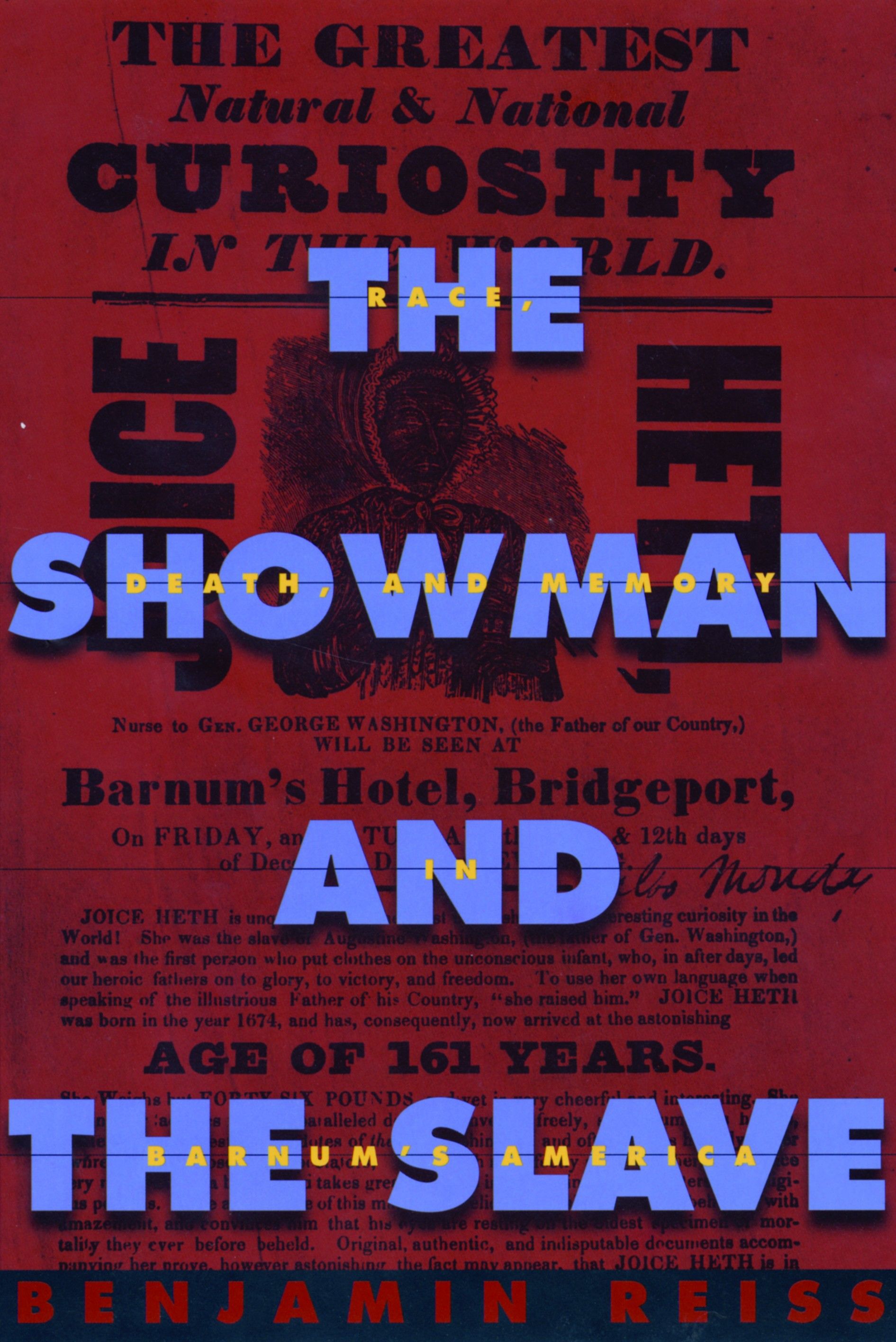
The showman and the slave : race, death, and memory in Barnum's America
Reiss uses P. T. Barnum's Joice Heth hoax to examine the race relations in the antebellum North. Barnum's first exhibit as a showman, Heth was an enslaved woman said to be the 161-year-old former nurse of the infant George Washington. The newly emerging commercial press turned her act into one of the first media spectacles in American history.
eBook


The Freak-garde
Since the 1890s, American artists have employed the arts of the freak show to envision radically different ways of being. The result is a rich avant-garde tradition that critiques and challenges capitalism from within.
The Freak-gardetraces the arts of the freak show from P. T. Barnum to Matthew Barney and demonstrates how a form of mass culture entertainment became the basis for a distinctly American avant-garde tradition. Exploring a wide range of writers, filmmakers, photographers, and artists who have appropriated the arts of the freak show, Robin Blyn exposes the disturbing power of human curiosities and the desires they unleash. Through a series of incisive and often startling readings, Blyn reveals how such figures as Mark Twain, Djuna Barnes, Tod Browning, Lon Chaney, Nathanael West, and Diane Arbus use these desires to propose alternatives to the autonomous and repressed subject of liberal capitalism. Blyn explains how, rather than grounding revolutionary subjectivities in imaginary realms innocent of capitalism, freak-garde works manufacture new subjectivities by exploiting potentials inherent to capitalism.
Defying conventional wisdom,The Freak-gardeultimately argues that postmodernism is not the death of the avant-garde but the inheritor of a vital and generative legacy. In doing so, the book establishes innovative approaches to American avant-garde practices and embodiment and lays the foundation for a more nuanced understanding of the disruptive potential of art under capitalism.
eBook