
Catalogue Search | MBRL


Are you sure you want to remove the book from the shelf?

{{itemTitle}}
1,624
result(s) for
"Free Republic"
Sort by:
Law and Freedom
In this article, the focus will first be on the distinction Spinoza makes in his Tractatus theologi-co-politicus on the different strivings of human beings and the two different conceptions of law —natural and ad arte—in relation to freedom. Proceeding from these distinctions and Spinoza’s objective with his philosophical enquiries, I will then consider whether a change occurs between the earlier TTP and the later unfinished Tractatus politicus. Both texts are marked by a naturalist turn, the indifference of religion, moral neutrality, the identification of right and power and the denial of natural hierarchy, but nonetheless one can also observe a change in the TP, where the naturalistic premise is more explicit, the human condition more on the forefront and the use of the concepts more precise; the ‘people’, for example, are replaced by the ‘multitude’. In search of sources and aspects for the naturalist turn and the specific conceptual evolution between the TTP and TP, we will consider the example of Machiavelli (and thereafter of Lucretius), De la Court’s notion of a free republic building on Machiavelli and the revolutionary ideas of Van den Enden aimed at improving on his predecessor. The different aspects linked to the use of the concept of multitude in the TP will then be analyzed in relation to the sources and aspects mentioned so as to return to the initial ques-tions concerning law and freedom
Journal Article

Contesting Trade in Central America
Through detailed case studies on Costa Rica, El Salvador, and Nicaragua, Spalding examines the debate surrounding the adoption of CAFTA alongside the simultaneous changes to the economic and political landscape of Central America at the turn of this century.
eBook

War Stories
How does the American public formulate its opinions about U.S. foreign policy and military engagement abroad?War Storiesargues that the media systematically distort the information the public vitally needs to determine whether to support such initiatives, for reasons having more to do with journalists' professional interests than the merits of the policies, and that this has significant consequences for national security. Matthew Baum and Tim Groeling develop a \"strategic bias\" theory that explains the foreign-policy communication process as a three-way interaction among the press, political elites, and the public, each of which has distinct interests, biases, and incentives.
Do media representations affect public support for the president and faithfully reflect events in times of diplomatic crisis and war? How do new media--especially Internet news and more partisan outlets--shape public opinion, and how will they alter future conflicts? In answering such questions, Baum and Groeling take an in-depth look at media coverage, elite rhetoric, and public opinion during the Iraq war and other U.S. conflicts abroad. They trace how traditional and new media select stories, how elites frame and sometimes even distort events, and how these dynamics shape public opinion over the course of a conflict.
Most of us learn virtually everything we know about foreign policy from media reporting of elite opinions. InWar Stories, Baum and Groeling reveal precisely what this means for the future of American foreign policy.
eBook
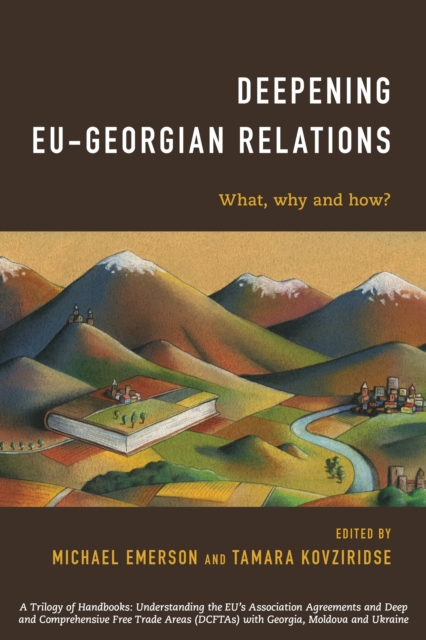
Deepening EU-Georgian relations
This handbook explains in readily comprehensible language what the new Association Agreement between the European Union and Georgia means in legal, political and economic terms. This treaty is a milestone in the history of Georgia's place in Europe, and definitively marks the country's post-Soviet independence. It is also a new model treaty for the EU's relations with its closest neighbours.
eBook

Machiavelli's God
To many readers ofThe Prince, Machiavelli appears to be deeply un-Christian or even anti-Christian, a cynic who thinks rulers should use religion only to keep their subjects in check. But inMachiavelli's God, Maurizio Viroli, one of the world's leading authorities on Machiavelli, argues that Machiavelli, far from opposing Christianity, thought it was crucial to republican social and political renewal--but that first it needed to be renewed itself. And without understanding this, Viroli contends, it is impossible to comprehend Machiavelli's thought.
Viroli places Machiavelli in the context of Florence's republican Christianity, which was founded on the idea that the true Christian is a citizen who serves the common good. In this tradition, God participates in human affairs, supports and rewards those who govern justly, and desires men to make the earthly city similar to the divine one. Building on this tradition, Machiavelli advocated a religion of virtue, and he believed that, without this faith, free republics could not be established, defend themselves against corruption, or survive. Viroli makes a powerful case that Machiavelli, far from being a pagan or atheist, was a prophet of a true religion of liberty, a way of moral and political living that would rediscover and pursue charity and justice.
The translation of this work has been funded by SEPS - Segretariato Europeo per le Pubblicazioni Scientifiche.
eBook

Religious Responses to Environmental Crises in the Orange Free State Republic, C. 1896-C. 1898
The purpose of this article is to explore the religious responses within the Orange Free State republic to the environmental crises in the period c. 1896 to c. 1898. During this time the state was subjected to severe drought, flooding, and the outbreak of various diseases. The article examines the way in which these afflictions where interpreted by the Christian and wider community in terms of God’s wrath for unrepented sins. The persistence of synchronistic elements of folk religion was seen to have brought plagues like those found in Exodus which were visited upon the Pharaoh and his kingdom. This interruptive frame work led to calls for national repentance, but also a resistance to scientific and medical resolutions to the crises. It also reinforced racial divisions. Black Africans were perceived as the carriers of the disease so their movement was prohibited. The article goes on to show how the effect of this biblical frame of reference protected the concept of God as the ever-present active God in every aspect of life against the scientific rationalism of the age, while at the same time ironically hindering the work of mission and the life of the church.
Journal Article

Climbing the Charts
Despite the growth of digital media, traditional FM radio airplay still remains the essential way for musicians to achieve commercial success.Climbing the Chartsexamines how songs rise, or fail to rise, up the radio airplay charts. Looking at the relationships between record labels, tastemakers, and the public, Gabriel Rossman develops a clear picture of the roles of key players and the gatekeeping mechanisms in the commercial music industry. Along the way, he explores its massive inequalities, debunks many popular misconceptions about radio stations' abilities to dictate hits, and shows how a song diffuses throughout the nation to become a massive success.
Contrary to the common belief that Clear Channel sees every sparrow that falls, Rossman demonstrates that corporate radio chains neither micromanage the routine decision of when to start playing a new single nor make top-down decisions to blacklist such politically inconvenient artists as the Dixie Chicks. Neither do stations imitate either ordinary peers or the so-called kingmaker radio stations who are wrongly believed to be able to make or break a single. Instead, Rossman shows that hits spread rapidly across radio because they clearly conform to an identifiable style or genre. Radio stations respond to these songs, and major labels put their money behind them through extensive marketing and promotion efforts, including the illegal yet time-honored practice of payoffs known within the industry as payola.
Climbing the Chartsprovides a fresh take on the music industry and a model for understanding the diffusion of innovation.
eBook

Ripples of Hope
In Ripples of Hope, Robert M. Press tells the stories of mothers, students, teachers, journalists, attorneys, and many others who courageously stood up for freedom and human rights against repressive rulers and who helped bring about change through primarily nonviolent means. Global in application and focusing on Kenya, Liberia and Sierra Leone, this tribute to the strength of the human spirit also breaks new ground in social movement theories, showing how people on their own or in small groups can make a difference.
eBook

Enclosed
This impassioned and rigorous analysis of the territorial plight of the Q'eqchi Maya of Guatemala highlights an urgent problem for indigenous communities around the world - repeated displacement from their lands. Liza Grandia uses the tools of ethnography, history, cartography, and ecology to explore the recurring enclosures of Guatemala's second largest indigenous group, who number a million strong. Having lost most of their highland territory to foreign coffee planters at the end of the 19th century, Q'eqchi' people began migrating into the lowland forests of northern Guatemala and southern Belize. Then, pushed deeper into the frontier by cattle ranchers, lowland Q'eqchi' found themselves in conflict with biodiversity conservationists who established protected areas across this region during the 1990s.
The lowland, maize-growing Q'eqchi' of the 21st century face even more problems as they are swept into global markets through the Dominican Republic-Central America Free Trade Agreement (DR-CAFTA) and the Puebla to Panama Plan (PPP). The waves of dispossession imposed upon them, driven by encroaching coffee plantations, cattle ranches, and protected areas, have unsettled these agrarian people.Encloseddescribes how they have faced and survived their challenges and, in doing so, helps to explain what is happening in other contemporary enclosures of public \"common\" space.
Watch the book trailer: https://www.youtube.com/watch?v=pTLvmg3mHE8
eBook

Laiklik Sözleşmesi Temelinde Güdümlü Muhalefet: Serbest Cumhuriyet Fırkası
1930 yılında üç ay sürmesine rağmen Serbest Cumhuriyet Fırkası olayı, Türk siyasi hayatının en önemli demokrasi tecrübelerinden birisi olarak kabul edilebilir. Türkiye'de laikliğin ideolojik olarak kurumlaşmasında bu tecrübenin önemli bir yeri vardır. İktidar sahipleri, toplumun genelinin cumhuriyetin radikal dönüşümlerini kabullenmediğini / kaldıramadığını SCF olayında açık bir şekilde görmüştür. Ayrıca bu olay, Türkiye'de laiklik meselesinin bir iktidar meselesi olduğunu göstermiştir. bu duruma bağlı olarak iktidar, kendisine karşı gelişen muhalefet hareketlerini laikliğe karşı bir tehlike ya da \"mürteci\" olmakla suçlayan bir retorik geliştirmiştir. bu retorik etrafında gelişen çatışma, Türk demokrasi tarihinde karşılığı olan ve aşılması güç bir ayrışma olarak kabul edilebilir. bu makalede SCF olayında irtica retoriğinin nasıl kullanıldığı ve yeni rejimde laikliğin kurumlaşması açısından taşıdığı önem tartışılacaktır.
Journal Article