
Catalogue Search | MBRL


Are you sure you want to remove the book from the shelf?

{{itemTitle}}
481,186
result(s) for
"Free trade"
Sort by:


Contesting Trade in Central America
Through detailed case studies on Costa Rica, El Salvador, and Nicaragua, Spalding examines the debate surrounding the adoption of CAFTA alongside the simultaneous changes to the economic and political landscape of Central America at the turn of this century.
eBook

Free trade reimagined : the world division of labor and the method of economics
This text begins with a sustained criticism of the heart of the emerging world economy, the theory and practice of free trade. The author, however, does not defend protectionism against free trade. Instead, he attacks and revises the terms on which the traditional debate between free traders and protectionists has been joined.
Book
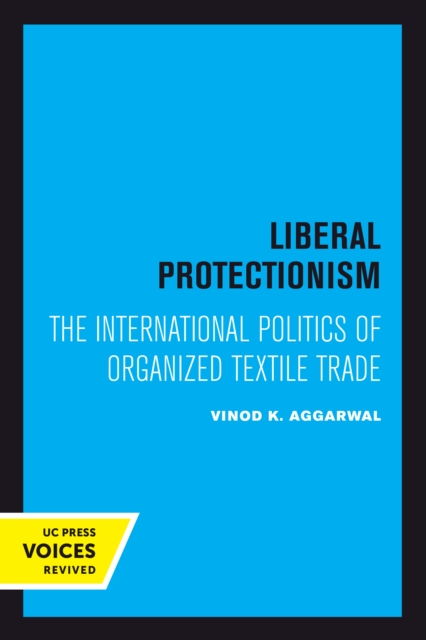
Liberal Protectionism
What does organized trade portend for the future of the post-World
War II trading order? Are we seeing a transition from liberalism to
protectionism? These questions are central to Vinod K. Aggarwal's
penetrating analysis of conflict and cooperation in trade among
developed and less developed countries. In his examination of the
evolution of organized trade, Aggarwal specifically analyses
international regimes in textile and apparel trade. The author uses
an original theoretical approach to investigate international
regimes. Why are regimes desirable? Aggarwal shows how such accords
can protect broader arrangements, allow countries to control one
another's behavior, and minimize information and organization costs
in negotiations. Several factors account for the form of regimes.
The strength of regimes is enhanced by an asymmetry of
international power. A hegemon is more willing and able to maintain
a regime. Both the nature and scope of regimes are determined by
the relative degree of trade competition and cognitive consensus
among actors. As trade competition increases, and actors decide to
link related issues, regimes become more protectionist in their
goals and wider in their coverage. Aggarwal's theory successfully
accounts for the transformation of international regimes in textile
trade, demonstrating the importance of systematically incorporating
international level factors into our theories. His empirical work
is based on extensive archival research and interviews with key
negotiators. Aggarwal concludes that the pattern of international
cooperation which evolved in textile trade provides a portrait of
the future for trade in other industrial sectors. He finds the
trend of arrangements in textile trade disturbing and argues that
organized trade will not prevent-and may in fact promote a slide
from liberalism to protectionism. Regimes originally developed to
counter protectionism may evolve into systems of organized
protection that encourage neither efficiency nor equity. A lucid
analysis of recent historical developments in textile trade, this
study sheds light on the movement toward increasing protection in
other sectors of trade as well. It is a significant work that will
prove valuable to those who study international trade and regimes.
This title is part of UC Press's Voices Revived program,
which commemorates University of California Press's mission to seek
out and cultivate the brightest minds and give them voice, reach,
and impact. Drawing on a backlist dating to 1893, Voices
Revived makes high-quality, peer-reviewed scholarship
accessible once again using print-on-demand technology. This title
was originally published in 1986.
eBook


The comprehensive and progressive agreement for Trans-Pacific Partnership : implications for Southeast Asia
\"The Comprehensive and Progressive Agreement for Trans-Pacific Partnership (CPTPP) is a free trade agreement involving major countries across the Asia Pacific region. The trade pact, which entered into force on 30 December 2018, is considered by many to be the \"gold standard\", given its ambitious scope and depth. This volume offers multi-dimensional insights into the CPTPP and its impact on Southeast Asia. It begins with broad analyses covering the historical, economic and geopolitical aspects of the CPTPP. Subsequent chapters focus on the nature and implications of three key path-breaking provisions in the trade agreement, namely investor-state dispute settlement, intellectual property rights and state-owned enterprises. The effect of the CPTPP on Southeast Asia in terms of regional production networks is also examined from the perspective of Japanese multinational enterprises. The potential economic impact of the agreement is analysed for member countries (Vietnam and Malaysia) as well as countries that aspire to join the CPTPP in the future (Indonesia and Thailand). The world trading system is in disarray: the World Trade Organization has been weakened, perhaps terminally; the world's two economic superpowers are locked in deep, politicized disputes; the forces of populism and nationalism are everywhere complicating the return to a more liberal, rules-based order. These trends are challenging one of the building blocks of ASEAN economic development, namely these countries' outward-looking trade and investment policies. With impeccable timing this important volume by a group of eminent authors assesses these issues with reference to the Comprehensive and Progressive Agreement for Trans-Pacific Partnership. The CPTPP excludes the three largest traders—China, the EU and the US—but it is a welcome second-best initiative that may have broader, positive ripple effects. This is the volume to read to gain a deeper understanding of the many complex issues at play.\" -- Hal Hill, H.W. Arndt Professor Emeritus of Southeast Asian Economies, College of Asia & the Pacific, Australian National University
eBook


Enclosed
This impassioned and rigorous analysis of the territorial plight of the Q'eqchi Maya of Guatemala highlights an urgent problem for indigenous communities around the world - repeated displacement from their lands. Liza Grandia uses the tools of ethnography, history, cartography, and ecology to explore the recurring enclosures of Guatemala's second largest indigenous group, who number a million strong. Having lost most of their highland territory to foreign coffee planters at the end of the 19th century, Q'eqchi' people began migrating into the lowland forests of northern Guatemala and southern Belize. Then, pushed deeper into the frontier by cattle ranchers, lowland Q'eqchi' found themselves in conflict with biodiversity conservationists who established protected areas across this region during the 1990s.
The lowland, maize-growing Q'eqchi' of the 21st century face even more problems as they are swept into global markets through the Dominican Republic-Central America Free Trade Agreement (DR-CAFTA) and the Puebla to Panama Plan (PPP). The waves of dispossession imposed upon them, driven by encroaching coffee plantations, cattle ranches, and protected areas, have unsettled these agrarian people.Encloseddescribes how they have faced and survived their challenges and, in doing so, helps to explain what is happening in other contemporary enclosures of public \"common\" space.
Watch the book trailer: https://www.youtube.com/watch?v=pTLvmg3mHE8
eBook