
Catalogue Search | MBRL


Are you sure you want to remove the book from the shelf?

{{itemTitle}}
10
result(s) for
"Freehand technical sketching Technique."
Sort by:

Drawn to design : analyzing architecture through freehand drawing
The book is a guide for students and teachers to understand the need for, the role of and the methods and techniques of freehand analytical sketching in architecture. The presentation focuses on drawing as an approach to and phase of architectural design. The conceptual goal of this approach is to use drawing not as illustration or depiction, but exploration. The first part of the book discusses underlying concepts of freehand sketching in design education and practice as a compliment to digital technologies. The main component is a series of chapters that constitute a typology of fundamental issues in architecture and urban design; for instance, issues of \"facade\" are illustrated with sketch diagrams that show how facades can be explored and sketched through a series of specific questions and step-by-step procedures. This book is especially timely in an age in which the false conflict between \"traditional vs. digital\" gives way to multiple design tools, including sketching.
Book
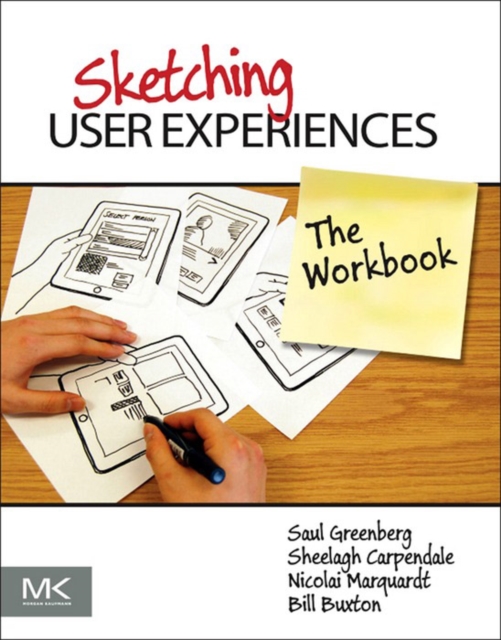
Sketching user experiences
Sketching Working Experience: The Workbook provides information about the step-by-step process of the different sketching techniques.It offers methods called design thinking, as a way to think as a user, and sketching, a way to think as a designer.
eBook


Sketching user experiences : getting the design right and the right design
Sketching User Experiences approaches design and design thinking as something distinct that needs to be better understood—by both designers and the people with whom they need to work— in order to achieve success with new products and systems. So while the focus is on design, the approach is holistic. Hence, the book speaks to designers, usability specialists, the HCI community, product managers, and business executives. There is an emphasis on balancing the back-end concern with usability and engineering excellence (getting the design right) with an up-front investment in sketching and ideation (getting the right design). Overall, the objective is to build the notion of informed design: molding emerging technology into a form that serves our society and reflects its values. Grounded in both practice and scientific research, Bill Buxton’s engaging work aims to spark the imagination while encouraging the use of new techniques, breathing new life into user experience design.Covers sketching and early prototyping design methods suitable for dynamic product capabilities: cell phones that communicate with each other and other embedded systems, \"smart\" appliances, and things you only imagine in your dreamsThorough coverage of the design sketching method which helps easily build experience prototypes—without the effort of engineering prototypes which are difficult to abandonReaches out to a range of designers, including user interface designers, industrial designers, software engineers, usability engineers, product managers, and othersFull of case studies, examples, exercises, and projects, and access to video clips that demonstrate the principles and methods
eBook


Sketching User Experiences: The Workbook
Sketching Working Experience: The Workbook provides information about the step-by-step process of the different sketching techniques. It offers methods called design thinking, as a way to think as a user, and sketching, a way to think as a designer. User-experience designers are designers who sketch based on their actions, interactions, and experiences. The book discusses the differences between the normal ways to sketch and sketching used by user-experience designers. It also describes some motivation on why a person should sketch and introduces the sketchbook. The book reviews the different sketching methods and the modules that contain a particular sketching method. It also explains how the sketching methods are used. Readers who are interested in learning, understanding, practicing, and teaching experience design, information design, interface design, and information architecture will find this book relevant.Features standalone modules detailing methods and exercises for practitioners who want to learn and develop their sketching skills Extremely practical, with illustrated examples detailing all steps on how to do a method Excellent for individual learning, for classrooms, and for a team that wants to develop a culture of design practice Perfect complement to Buxton’s Sketching User Experience or any UX text Author-maintained companion website at http://grouplab.cpsc.ucalgary.ca/sketchbook/
eBook
Freehand drawing and discovery
Features access to video tutorials!
Designed to help architects, planners, and landscape architects use freehand sketching to quickly and creatively generate design concepts, Freehand Drawing and Discovery uses an array of cross-disciplinary examples to help readers develop their drawing skills. Taking a \"both/and\" approach, this book provides step-by-step guidance on drawing tools and techniques and offers practical suggestions on how to use these skills in conjunction with digital tools on real-world projects. Illustrated with nearly 300 full color drawings, the book includes a series of video demonstrations that reinforces the sketching techniques.
eBook

Sketching User Experiences
Sketching Working Experience: The Workbook provides information about the step-by-step process of the different sketching techniques. It offers methods called design thinking, as a way to think as a user, and sketching, a way to think as a designer. User-experience designers are designers who sketch based on their actions, interactions, and experiences. The book discusses the differences between the normal ways to sketch and sketching used by user-experience designers. It also describes some motivation on why a person should sketch and introduces the sketchbook. The book reviews the different sketching methods and the modules that contain a particular sketching method. It also explains how the sketching methods are used. Readers who are interested in learning, understanding, practicing, and teaching experience design, information design, interface design, and information architecture will find this book relevant. Features standalone modules detailing methods and exercises for practitioners who want to learn and develop their sketching skills Extremely practical, with illustrated examples detailing all steps on how to do a method Excellent for individual learning, for classrooms, and for a team that wants to develop a culture of design practice Perfect complement to Buxton's Sketching User Experience or any UX text Author-maintained companion website at http://grouplab.cpsc.ucalgary.ca/sketchbook/.
Book
Basics Freehand Drawing
Die Bedeutung des Freihandzeichnens für die Architektenausbildung wird oft verkannt. Dabei ist das eigene freie Zeichnen unverzichtbar für jeden Gestalter. Durch Zeichnen lernt er sehen und beobachten. Die räumliche Vorstellungskraft entwickelt sich.
Basics Freihandzeichnen erklärt Schritt für Schritt die Entwicklung perspektivischer Darstellungen vom Bildaufbau über verschiedene Zeichentechniken bis hin zum Einsatz von Farbe.
eBook