
Catalogue Search | MBRL


Are you sure you want to remove the book from the shelf?

{{itemTitle}}
115
result(s) for
"French language Grammar Study and teaching"
Sort by:
The Second Language Acquisition of French Tense, Aspect, Mood and Modality
Temporal-aspectual systems have a great potential of informing our understanding of the developing competence of second language learners. So far, the vast majority of empirical studies investigating L2 acquisition have largely focused on past temporality, neglecting the acquisition of the expression of the present and future temporalities with rare exceptions (aside from ESL learners), leaving unanswered the question of how the investigation of different types of temporality may inform our understanding of the acquisition of temporal, aspectual and mood systems as a whole. This monograph addresses this question by focusing on three main objectives: a) to contribute to the already impressive body of research in the L2 acquisition of tense, aspect and mood/modality from a generative perspective, and in so doing to present a more complete picture of the processes of L2 acquisition in general; b) to bridge the gap between linguistic theory and L2 acquisition; c) to make empirical findings more accessible to language instructors by proposing concrete pedagogical applications.
eBook
The acquisition of French as a second language : new developmental perspectives
It has been argued that the study of child L2 development can inform different maturational accounts of language acquisition. One such specific proposal was put forward by Meisel (2008), arguing for a cut-off point for monolingual or bilingual first language acquisition - (2)L1 - type of development at 3-4 years. The paper analyses the longitudinal development of object clitics in child L2 French (L1 Swedish) and compares the developmental sequence in child L2 learners (n = 7) with different Ages of onset of Acquisition (AoA) (from 3;0 to 6;5) to the adult L2 sequence that was found in previous studies (Granfeldt & Schlyter 2004). The study also includes age-matched simultaneous bilingual children (n = 3) and monolingual controls (n = 5). The results show that some of the child L2 learners with an AoA over 4 years display structures that are typical of adult L2 acquisition, whereas these structures were not found in the simultaneous bilingual children or in the child second language acquisition (cL2) children with an AoA under 4 years. It is suggested that differences in developmental sequences are due to a combination of AoA and the level of L1 linguistic development at the onset of L2 acquisition.
eBook

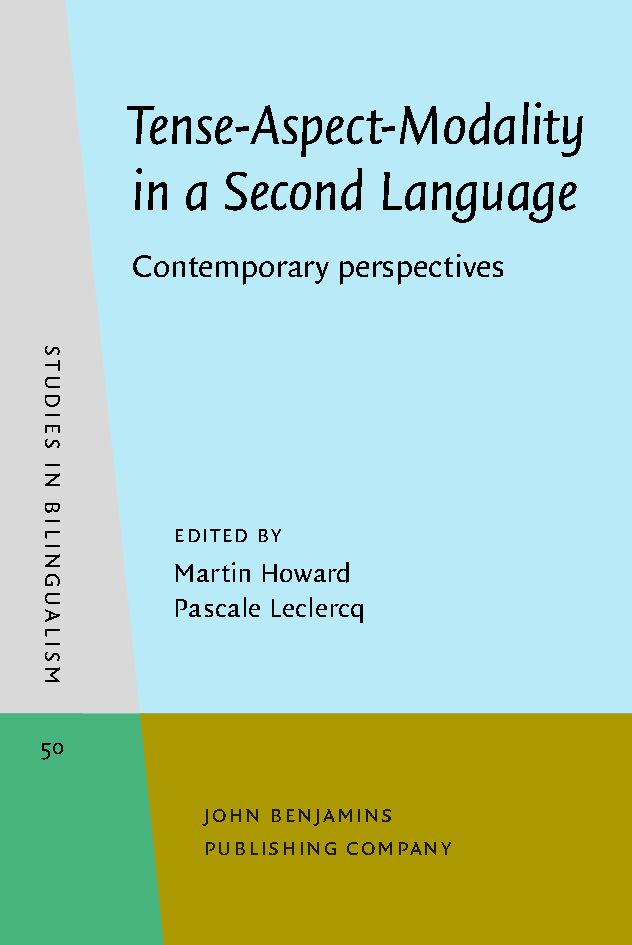
Tense-aspect-modality in a second language : contemporary perspectives
Situated within the long-established domain of temporality research in Second Language Acquisition, this book aims to provide an update on recent research directions in the field through a range of papers which explore relatively new territory. Those areas include the expression of modality and counterfactuality, the effect of first language transfer, aspectuo-temporal comprehension, aspectuo-temporal marking at a wider discursive level, and methodological issues in the study of the acquisition of aspect. The studies presented explore English and French as second languages, involving both child and adult learners from a range of first language backgrounds in both instructed and naturalistic learning contexts. The studies draw on both spoken and written data which explore various facets of the learners' second language comprehension and production. The volume offers new, but complementary insights to previous research, as well as pointing to directions for future research in this burgeoning field of study.
eBook


Open-book assessment in French language instruction: a study on enhancing the grammatical skills of pre-service teachers
The preparation of second language (L2) pre-service teachers requires pedagogical tools that move beyond rote memorization. While open-book assessment (OBA) offers a promising alternative, a research gap exists regarding its empirical effect on the L2 grammatical skills, affective experiences, and developing pedagogical beliefs of this population. This study addressed this gap by investigating the effect of OBA in French language instruction. Using a mixed-methods, quasi-experimental design, 60 pre-service French teachers were randomly assigned to an experimental group (
n
= 30) receiving weekly open-book quizzes or a control group (
n
= 30) receiving closed-book quizzes over a 10-week intervention. Data were collected from a grammatical skills pre-test/post-test, a perception survey, and semi-structured interviews. Quantitative results showed a substantial and statistically significant improvement in grammatical skills for the experimental group (mean gain = + 8.07,
p
< .001), whereas the control group showed no improvement. Survey data revealed positive perceptions of OBA, highlighting its role in promoting application (
M
= 4.57), reducing anxiety (
M
= 4.07), and influencing future teaching intentions (
M
= 4.57). Qualitative findings corroborated these results, revealing a cognitive shift from recall to active problem-solving, a positive affective experience, and a profound transformation of pedagogical beliefs. The findings conclude that OBA is a highly effective strategy that both enhances L2 grammatical competence and models formative assessment for future educators, suggesting its integration can improve language proficiency while equipping pre-service teachers with an innovative assessment model.
Journal Article

Le français non‐binaire: Linguistic forms used by non‐binary speakers of French
In response to shifting sociocultural constructions of gender and the emerging visibility of non‐binary subject positions, grammatically binary linguistic systems, such as French, are being challenged, subverted, and adapted. This paper describes and analyzes formal, structural, and ideological aspects of how contemporary French speakers are confronting and innovating beyond the gender binary, highlighting the lack of scholarly attention and increase in public salience afforded to these issues. Survey data from 174 adult speakers of French are used to outline the forms used by non‐binary Francophones, the degree of form variance, and the self‐reported comprehensibility ratings of these forms. The findings establish consistent trends in the non‐binary language forms used and their comprehensibility, while highlighting the importance of variance for individual agency in non‐binary Francophone communities. These findings are foundational to a consideration of the of teaching non‐binary forms in foreign language classrooms and curricula for inclusivity and competence development. The Challenge L2 educators strive to create inclusive classrooms for students of all genders. However, a lack of resources on gender non‐binary language forms limits the ability to fully realize inclusion. How can all L2 identities be made sayable? How can teaching to and about non‐binary speakers support inclusivity and competence development?
Journal Article

L1 EXPLICIT INSTRUCTION CAN IMPROVE L2 ONLINE AND OFFLINE PERFORMANCE
This study investigated the effectiveness of providing L1 explicit information (EI) with practice for making more accurate and faster interpretations of L2 French Imparfait (IMP). Two treatments were investigated: (a) “L2-only,” providing EI about the L2 with L2 interpretation practice, and (b) “L2+L1,” providing the exact same L2-only treatment and including EI about the L1 (English) with practice interpreting L1 features that are equivalent to the IMP. Fifty L2 French learners were randomly assigned to either L2-only, L2+L1, or a control group. Online (self-paced reading) and offline (context-sentence matching) measures from pretest, posttest, and delayed posttests showed that providing additional L1 EI and practice improved not only offline L2 accuracy, but also the speed of online L2 processing. To our knowledge, this makes original and significant contributions about the nature of EI with practice and the role of the L1 (Tolentino & Tokowicz, 2014), and it extends a recent line of research examining EI effects in online sentence processing (Andringa & Curcic, 2015).
Journal Article