
Catalogue Search | MBRL


Are you sure you want to remove the book from the shelf?

{{itemTitle}}
30
result(s) for
"French language Self-instruction."
Sort by:


Aprende y Mejora Rápidamente Tu Francés
Aprender un idioma extranjero a través de situaciones reales es, probablemente, la manera más segura de fijarlo en la memoria y poder utilizarlo con agilidad en el momento en que surge la ocasión.Con el CD audio, este libro se convierte en un instrumento muy útil para aprender francés de manera gradual y eficaz.Los diálogos y las tablas ayudarán.
eBook

French all-in-one for dummies
Your comprehensive guide to speaking, reading, and writing in French French is a beautiful language but can be quite difficult to learn.Whether you need to learn the language for a French class, or for business or leisure travel, French for Dummies All-In-One makes it easier.
eBook

French grammar
\"The 'Easy learning French grammar' is designed to be used with both young and adult learners, as a group reference book to complement your course book during classes, or as a recommended text for self-study and homework/coursework\"--Foreword (page v).
Book

Do all roads really lead to Rome? The case of spelling acquisition
The French orthographic code is complex, and its acquisition is laborious (Catach, 2008; Fayol & Jaffré, 2008). Three hypotheses attempt to explain orthographic knowledge acquisition (OKA). For some, exposure to the code leads to OKA through a self-learning process (Share, 2004). For others, OKA benefits from graphophonological processes (Coltheart, Rastle, Perry, Langdon, & Ziegler, 2001). Finally, some authors suggest that OKA is possible thanks to visual specific processes (Ans, Carbonnel, & Valdois, 1998). The main goal of this study was to test these hypotheses in a classroom context with comparable samples. In total, 143 2nd-grade children participated in this quasi-experimental study with a pretest, immediate posttest, and delayed posttest design. We assigned participants to one of four conditions. For three conditions, we created three teaching procedures based on each of the hypotheses: frequency of contacts with target words; explicit teaching of graphophonological properties of words; explicit teaching of visual properties of words. The fourth served as a control group. ANOVA analyses indicated that all three experimental conditions favored OKA, showing that the different teaching procedures led to spelling development. However, the visual condition was the most favorable. Three main conclusions can be drawn from this study: (a) models of OKA should account for the different paths that can lead to spelling acquisition; (b) visual properties of words and their acquisition need additional research, and (c) applied research in real classroom contexts is not only relevant for informing teaching practices but also for better understanding how learning takes place.
Journal Article
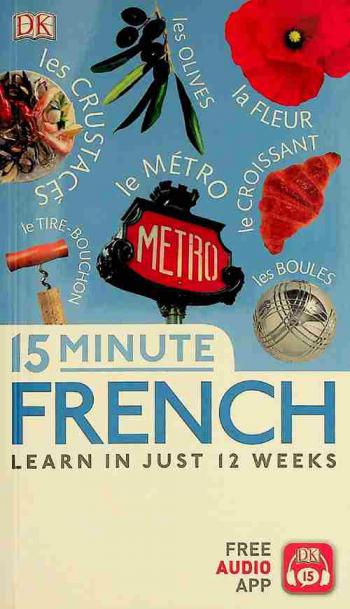
15-minute French : learn in just 12 weeks
The perfect book for anyone who wants to learn French fast. Comes with a free downloadable audio app for Apple and Android phones, enabling learners to hear words and phrases spoken by native French speakers. 12 themed chapters are broken down into 15-minute daily lessons, spanning a range of practical themes, from socialising to doing business. Each lesson combines French vocabulary and grammar essentials with full-colour photographs for a user-friendly, accessible language guide.
Book

Institutionalised autonomisation of language learning in a French language centre
The UFR Lansad (Language centre teaching languages to specialists of other disciplines) was created in 2014 at the University of Lorraine. The process leading to its creation was led by a small number of teachers and researchers, from the pre-existing teams of the previous Lorraine universities (Molle et al. 2019). It is the result of didactic reflection and expertise, which convinced the University board to set up a structure dedicated to foreign language teaching. After several evolutions, the newly-created structure positioned itself as a policy maker in language teaching. Finally, the university board asked the UFR to set up a language training model that could be implemented throughout the institution. This training model involves blended-learning systems that emphasise the concepts of self-directed learning and autonomy and gives a central role to the EDOlang platform and the self-access centres since “part of the research and practice on learner autonomy is situated in self-access language learning settings” (Chateau and Tassinari 2021: 53). After a brief history of the creation of the UFR, the article focuses on this model, inspired by research carried out within the CRAPEL team (Guèly et al. 2021; Holec 2000). It also describes how the model is the result of the dissemination of innovative training courses implemented through action research over the last ten years (Chateau and Zumbihl 2010, 2012; Chateau and Bailly 2021). Furthermore, the paper explains how the institutional recognition of the training framework illustrates the need to promote a strong link between research and training.
Journal Article
On the acquisition of some basic word spelling mechanisms in a deep (French) and a shallow (Spanish) system
An experiment was carried out to compare the time course of the acquisition of two basic spelling mechanisms in Spanish, a shallow system, and French, a deep system. The first was lexical. It relies on the orthographic lexicon, a hypothetical structure containing the orthographic representations of words accessible for word spelling. To evaluate its contribution the participants were asked to spell words of high and low frequency containing phonemes which can take different graphemic values. The second mechanism relies on sub-lexical processes. Its contribution was evaluated asking the participants to spell words containing consistent phoneme-to-grapheme translation pairs which were identical in Spanish and French. Two contrasting predictions were considered, one derived from the Orthographic Depth Hypothesis (ODH, Frost,
2005
) and the other from the Self-Teaching Hypothesis (STH, Share,
2004
). According to the ODH, the orthographic lexicon should develop more rapidly in French than in Spanish because Spanish spellers can rely on phoneme-to-grapheme translation mechanisms to spell most words, meaning that they do not need to resort to the orthographic lexicon. In contrast, the STH suggests that effective identification of a word gradually generates its orthographic representation. The results revealed that both spelling mechanisms develop far faster in Spanish than in French. The fact that word frequency effects appeared earlier in Spanish than in French, indicating that the orthographic lexicon incorporates words more rapidly in a shallow than in a deep system, is clearly incompatible with the ODH and easier to handle in the context of the STH.
Journal Article