
Catalogue Search | MBRL


Are you sure you want to remove the book from the shelf?

{{itemTitle}}
1,335
result(s) for
"Frontières."
Sort by:
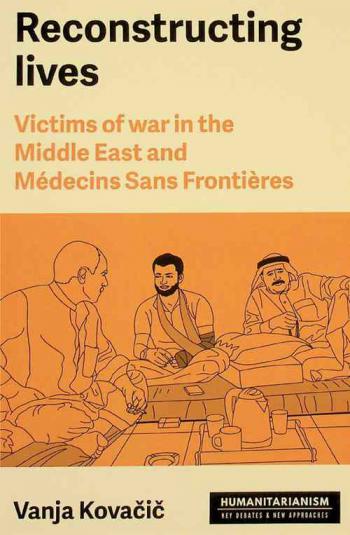
Reconstructing lives : victims of war in the Middle East and Médecins Sans Frontières
\"This book attempts to establish a more holistic approach to the rehabilitation of war-injured civilians, one that adjusts to the patients' long-term needs. Kovačič not only offers an insight into the daily realities of patients during and after rehabilitation, but seeks to develop a new way to perceive, respect and involve them in health care. Based on comprehensive interviews with patients and MSF staff, as well as extended field observations, Reconstructing lives follows Syrian and Iraqi war-injured civilians in their journey to recovery. From their improvised medical treatment in their home countries, to the MSF-run hospital in Amman Jordan, to their return home, Kovačič explores how individuals attempt to pick up the pieces of their previous lives, add new elements from their treatment and travel experiences, and finally establish a new reconstructed reality. The book explores how the interaction between MSF staff and their patients contributes to the immense task of healing that awaits victims of war. The reader visits the intimate medical and domestic spaces that usually remain closed to the outside observer, spaces rich with human contact, perceptions, emotions, conflicts and reconciliations\"--Page 4 of cover.
Book

Border walls
Two decades after the fall of the Berlin Wall, why are the notable democracies of the United States, India, and Israel building massive walls and fences on their borders? Despite predictions of a borderless world through globalization, these three countries alone have built security barriers totaling an astonishing 5,700 kilometers in length. In this groundbreaking work, Reece Jones analyzes how these controversial walls were justified, their impact on those living behind them, and the long-term effects of the hardening of political boundaries. Border Walls is a bold, important intervention that demonstrates that the exclusion and violence necessary to secure the borders of the modern state often undermine the very ideals of freedom and democracy the barriers are meant to protect.
eBook

Discrepant parallels : cultural implications of the Canada-US border
The 49th parallel has long held a symbolic importance to Canadian cultural nationalists as a strong, though permeable, border. But in contemporary Canadian culture, the border has multiple meanings, and imbalances of cultural power occur both across the Canada-US border as well as within Canada. 'Discrepant Parallels' examines divergent relationships to, and investments in, the Canada-US border in a variety of media, such as travel writing, fiction, poetry, drama, and television.
Book

The shifting border: Legal cartographies of migration and mobility
The border is one of the most urgent issues of our times. We tend to think of a border as a static line, but recent bordering techniques have broken away from the map, as governments have developed legal tools to limit the rights of migrants before and after they enter a country’s territory. The consequent detachment of state power from any fixed geographical marker has created a new paradigm: the shifting border, an adjustable legal construct untethered in space. This transformation upsets our assumptions about waning sovereignty, while also revealing the limits of the populist push toward border-fortification. At the same time, it presents a tremendous opportunity to rethink states’ responsibilities to migrants. This book proposes a new, functional approach to human mobility and access to membership in a world where borders, like people, have the capacity to move.
eBook

Against borders : the case for abolition
\"A passionate manifesto for border abolition, arguing that we must transform society and our relationships to one another, and build a world in which everyone has the freedom to move and to stay\"-- Provided by publisher.
BOOK

Line in the Sand : A History of the Western U.S. -Mexico Border
\"Line in the Sand\" details the dramatic transformation of the western U.S.-Mexico border from its creation at the end of the Mexican-American War in 1848 to the emergence of the modern boundary line in the first decades of the twentieth century. In this sweeping narrative, Rachel St. John explores how this boundary changed from a mere line on a map to a clearly marked and heavily regulated divide between the United States and Mexico. Focusing on the desert border to the west of the Rio Grande, this book explains the origins of the modern border and places the line at the center of a transnational history of expanding capitalism and state power in the late nineteenth and early twentieth centuries. Moving across local, regional, and national scales, St. John shows how government officials, Native American raiders, ranchers, railroad builders, miners, investors, immigrants, and smugglers contributed to the rise of state power on the border and developed strategies to navigate the increasingly regulated landscape. Over the border's history, the U.S. and Mexican states gradually developed an expanding array of official laws, ad hoc arrangements, government agents, and physical barriers that did not close the line, but made it a flexible barrier that restricted the movement of some people, goods, and animals without impeding others. By the 1930s, their efforts had created the foundations of the modern border control apparatus. Drawing on extensive research in U.S. and Mexican archives,\"Line in the Sand\" weaves together a transnational history of how an undistinguished strip of land became the significant and symbolic space of state power and national definition that we know today.
eBook

Europe's border crisis : biopolitical security and beyond
The European Union (EU) Commission champions a 'migrant-centred' approach to border security and 'irregular' migration management: it claims not only to observe human rights, but also to use surveillance to enhance the humanitarian protection of 'endangered' lives on land and at sea. Yet research presented by Non-Governmental Organizations and 'irregular' migrants' own testimonies reveal systemic border violence, dehumanization in spaces of detention, and exposure to death via abandonment in hostile environments. This book turns to conceptual resources found in biopolitical theory in order to move diagnoses of Europe's border crisis beyond that of a 'gap' between the policy 'rhetoric' of humanitarianism and the 'reality' of 'irregular' migrants' embodied experiences. It argues that both 'positive' and 'negative' dimensions of EU border security are symptomatic of tensions within biopolitical techniques of government and what Roberto Esposito refers to as the paradigm of immunization. While bordering practices are designed to play a defensive role they contain the potential for excessive and often lethal security mechanisms that end up threatening the very values and lives they purport to protect. Each chapter draws on a different biopolitical key to identify and interrogate diverse technologies of power at a range of border sites. Must border security always result in dehumanization and death? Are humanitarian discourses sufficient for critiquing contemporary forms of border violence? Is a more affirmative approach to border politics possible? 'Europe's border crisis' addresses these pressing questions and advances new research agendas for critical border and migration studies beyond existing debates about 'control' versus 'escape'.
Book

The Global Remapping of American Literature
This book charts how the cartographies of American literature as an institutional category have varied radically across different times and places. Arguing that American literature was consolidated as a distinctively nationalist entity only in the wake of the U.S. Civil War, Paul Giles identifies this formation as extending until the beginning of the Reagan presidency in 1981. He contrasts this with the more amorphous boundaries of American culture in the eighteenth century, and with ways in which conditions of globalization at the turn of the twenty-first century have reconfigured the parameters of the subject.
In light of these fluctuating conceptions of space, Giles suggests new ways of understanding the shifting territory of American literary history. ranging from Cotton Mather to David Foster Wallace, and from Henry Wadsworth Longfellow to Zora Neale Hurston. Giles considers why European medievalism and Native American prehistory were crucial to classic nineteenth-century authors such as Emerson, Hawthorne, and Melville. He discusses how twentieth-century technological innovations, such as air travel, affected representations of the national domain in the texts of F. Scott Fitzgerald and Gertrude Stein. And he analyzes how regional projections of the South and the Pacific Northwest helped to shape the work of writers such as William Gilmore Simms, José Martí, Elizabeth Bishop, and William Gibson.
Bringing together literary analysis, political history, and cultural geography,The Global Remapping of American Literaturereorients the subject for the transnational era.
eBook


Defending the Border
This book, one of the first in English about everyday life in the Republic of Georgia, describes how people construct identity in a rapidly changing border region. Based on extensive ethnographic research, it illuminates the myriad ways residents of the Caucasus have rethought who they are since the collapse of the Soviet Union.
Through an exploration of three towns in the southwest corner of Georgia, all of which are situated close to the Turkish frontier, Mathijs Pelkmans shows how social and cultural boundaries took on greater importance in the years of transition, when such divisions were expected to vanish. By tracing the fears, longings, and disillusionment that border dwellers projected on the Iron Curtain, Pelkmans demonstrates how elements of culture formed along and in response to territorial divisions, and how these elements became crucial in attempts to rethink the border after its physical rigidities dissolved in the 1990s.
The new boundary-drawing activities had the effect of grounding and reinforcing Soviet constructions of identity, even though they were part of the process of overcoming and dismissing the past. Ultimately, Pelkmans finds that the opening of the border paradoxically inspired a newfound appreciation for the previously despised Iron Curtain as something that had provided protection and was still worth defending.
eBook