
Catalogue Search | MBRL


Are you sure you want to remove the book from the shelf?

{{itemTitle}}
2,500
result(s) for
"Fugitives from justice."
Sort by:

Les misérables
Retells the story of escaped convict Jean Valjean, who, while trying to forget his past and live an honest life, risks his freedom to take care of a motherless young girl during a period of political unrest in Paris.
BOOK

Run for the Border
Mexico and the United States exist in a symbiotic relationship: Mexico frequently provides the United States with cheap labor, illegal goods, and, for criminal offenders, a refuge from the law. In turn, the U.S. offers Mexican laborers the American dream: the possibility of a better livelihood through hard work. To supply each other's demands, Americans and Mexicans have to cross their shared border from both sides. Despite this relationship, U.S. immigration reform debates tend to be security-focused and center on the idea of menacing Mexicans heading north to steal abundant American resources. Further, Congress tends to approach reform unilaterally, without engaging with Mexico or other feeder countries, and, disturbingly, without acknowledging problematic southern crossings that Americans routinely make into Mexico. In Run for the Border, Steven W. Bender offers a framework for a more comprehensive border policy through a historical analysis of border crossings, both Mexico to U.S. and U.S. to Mexico. In contrast to recent reform proposals, this book urges reform as the product of negotiation and implementation by cross-border accord; reform that honors the shared economic and cultural legacy of the U.S. and Mexico. Covering everything from the history of Anglo crossings into Mexico to escape law authorities, to vice tourism and retirement in Mexico, to today's focus on Mexican border-crossing immigrants and drug traffickers, Bender takes lessons from the past 150 years to argue for more explicit and compassionate cross-border cooperation. Steeped in several disciplines, Run for the Border is a blend of historical, cultural, and legal perspectives, as well as those from literature and cinema, that reflect Bender's cultural background and legal expertise.
eBook

The iron dragon's mother
Caitlin of House Sans Merci is the young half-human pilot of a sentient mechanical dragon. Returning from her first soul-stealing raid, she discovers an unwanted hitchhiker-- in her head. When Caitlin is framed for the murder of her brother, she must disappear into Industrialized Faerie and look for the one person who can clear her. Unfortunately, the stakes are higher than she knows... and her deeds will change her world forever. -- adapted from jacket
Book

Uncle Sam's policemen : the pursuit of fugitives across borders
Extraordinary rendition-the practice of abducting criminal suspects in locations around the world-has been criticized as an unprecedented expansion of U.S. police powers. But America's aggressive pursuit of fugitives beyond its borders far predates the global war on terror. Uncle Sam's Policemen investigates the history of international manhunts, arguing that the extension of U.S. law enforcement into foreign jurisdictions at the turn of the twentieth century forms an important chapter in the story of American empire.In the late 1800s, expanding networks of railroads and steamships made it increasingly easy for criminals to evade justice. Recognizing that domestic law and order depended on projecting legal authority abroad, President Theodore Roosevelt declared in 1903 that the United States would \"leave no place on earth\" for criminals to hide. Charting the rapid growth of extradition law, Katherine Unterman shows that the United States had fifty-eight treaties with thirty-six nations by 1900-more than any other country. American diplomats put pressure on countries that served as extradition havens, particularly in Latin America, and cloak-and-dagger tactics such as the kidnapping of fugitives by Pinkerton detectives were fair game-a practice explicitly condoned by the U.S. Supreme Court.The most wanted fugitives of this period were not anarchists and political agitators but embezzlers and defrauders-criminals who threatened the emerging corporate capitalist order. By the early twentieth century, the long arm of American law stretched around the globe, creating an informal empire that complemented both military and economic might.
eBook

Shades of memory
\"After escaping the FBI, Riley and her family have become fugitives, and not just from the law. Every bad guy on the planet wants a piece of Riley. Gregg has been kidnapped. Worse than that, Price's newly discovered magic is dangerously out of control, and her own is trying to kill her. She has little time to worry about any of that before all hell breaks loose in Diamond City, and she finds herself smack dab in the crossfire\"--Back cover.
Book


The Stray Bullet
William S. Burroughs arrived in Mexico City in 1949, having slipped out of New Orleans while awaiting trial on drug and weapons charges that would almost certainly have resulted in a lengthy prison sentence. Still uncertain about being a writer, he had left behind a series of failed business ventures-including a scheme to grow marijuana in Texas and sell it in New York-and an already long history of drug use and arrests. He would remain in Mexico for three years, a period that culminated in the defining incident of his life: Burroughs shot his common-law wife, Joan Vollmer, while playing William Tell with a loaded pistol. (He would be tried and convicted of murder in absentia after fleeing Mexico.)
First published in 1995 in Mexico, where it received the Malcolm Lowry literary essay award,The Stray Bulletis an imaginative and riveting account of Burroughs's formative experiences in Mexico, his fascination with Mexico City's demimonde, his acquaintances and friendships there, and his contradictory attitudes toward the country and its culture. Mexico, Jorge García-Robles makes clear, was the place in which Burroughs embarked on his \"fatal vocation as a writer.\"
Through meticulous research and interviews with those who knew Burroughs and his circle in Mexico City, García-Robles brilliantly portrays a time in Burroughs's life that has been overshadowed by the tragedy of Joan Vollmer's death. He re-creates the bohemian Roma neighborhood where Burroughs resided with Joan and their children, the streets of postwar Mexico City that Burroughs explored, and such infamous figures as Lola la Chata, queen of the city's drug trade. This compelling book also offers a contribution by Burroughs himself-an evocative sketch of his shady Mexican attorney, Bernabé Jurado.
eBook
Welcome to the punch
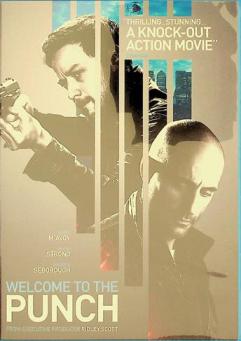
Three years ago, master criminal Jacob Sternwood escaped London during a daring robbery that left detective Max Lewinsky physically and emotionally scarred. When a failed heist puts Sternwood's son in a hospital, the fugitive is forced to come out of hiding, giving Max his second chance to get the one criminal who got away. But as Max returns to the pursuit of his arch-nemesis, he begins to uncover evidence of a vast conspiracy that may put him in even greater danger than his personal vendetta.
DVD

The Last Lincoln Conspirator
Despite all that has been written about the April 1865 assassination of President Abraham Lincoln, the story of John Surratt--the only conspirator who got away--remains untold and largely unknown. The capture and shooting of John Wilkes Booth twelve days after he shot Lincoln is a well-known and well-covered story. The fate of the eight other accomplices of Booth has also been widely written about. Four, including Surratt's mother, Mary, were convicted and hanged, and four were jailed. John Surratt alone managed to evade capture for twenty months and escape punishment once he was put on trial. In this tale of adventure and mystery, Andrew Jampoler tells what happened to that last conspirator, who after Booth's death became the most wanted man in America.
eBook