
Catalogue Search | MBRL


Are you sure you want to remove the book from the shelf?

{{itemTitle}}
9
result(s) for
"Fugue (Musique)"
Sort by:

Bach's Art of fugue and Musical offering
\"Bach's Art of Fugue and Musical Offering is the first comprehensive study of two closely related masterworks of the late Baroque fugal style. The initial volume in a series of American Bach Society Guides produced in collaboration with Oxford University Press, it unpacks these famously cerebral collections as endlessly fascinating material for study and play. Intended for a general readership, this compact guide also summarizes for practitioners a considerable body of knowledge about these singular works. Bach scholar and keyboard player Matthew Dirst explains their idiosyncratic musical language in initial chapters while reviewing how both projects took shape during Bach's final decade, as he reoriented his creative energies around capstone works of various kinds. The most systematic of these, the Art of Fugue and Musical Offering reflect his lifelong fascination with learned counterpoint, as demonstrated in elaborate series of fugues and canons in both and in an unusually intricate trio sonata in the latter. Later chapters provide commentary on individual movements and groups of pieces and on the historical reception of this music, including its impact on other disciplines. Recurring themes include Bach's diligent exploration of contrapuntal types and techniques, his embrace of musical games of various sorts, and his creative assimilation of diverse musical styles.\"-- Provided by publisher.
BOOK

Three Connecticut Composers
First Published in 1997. Routledge is an imprint of Taylor & Francis, an informa company.
eBook

Samuel Babcock (ca. 1760-1813)
Samuel Babcock was an active Boston-area composer who made a significant contribution to the repertory of American psalmody.Best known for his tunebook, Middlesex Harmony, Babcock composed extended and plain psalm tunes, set pieces, fuging tunes, and anthems, and frequently used three-part vocal textures.
eBook

Schoenberg and His World
As the twentieth century draws to a close, Arnold Schoenberg (1874-1951) is being acknowledged as one of its most significant and multifaceted composers.Schoenberg and His Worldexplores the richness of his genius through commentary and documents.
Marilyn McCoy opens the volume with a concise chronology, based on the latest scholarship, of Schoenberg's life and works. Essays by Joseph Auner, Leon Botstein, Reinhold Brinkmann, J. Peter Burkholder, Severine Neff, and Rudolf Stephan examine aspects of his creative output, theoretical writings, relation to earlier music, and the socio-cultural contexts in which he worked.
The documentary portions ofSchoenberg and His Worldcapture Schoenberg at critical periods of his career: during the first decades of the century, primarily in his native Vienna; from 1926 to 1933, in Berlin; and from 1933 on, in the U.S. Included here is the first complete translation into English of the remarkableFestschriftprepared for the 38-year-old Schoenberg by his pupils in 1912; it presciently explored the diverse talents as a composer, teacher, painter, and theorist for which he was later to be recognized. The Berlin years, when he held one of the most prestigious teaching positions in Europe, are represented by interviews with him and articles about his public lectures.
The final portion of the volume, devoted to the theme Schoenberg and America, focuses on how the composer viewed--and was viewed by--the country where he spent his final eighteen years. Sabine Feisst brings together and comments upon sources which, contrary to much received opinion, attest to both the considerable impact that Schoenberg had upon his newly adopted land and his own deep involvement in its musical life.
eBook
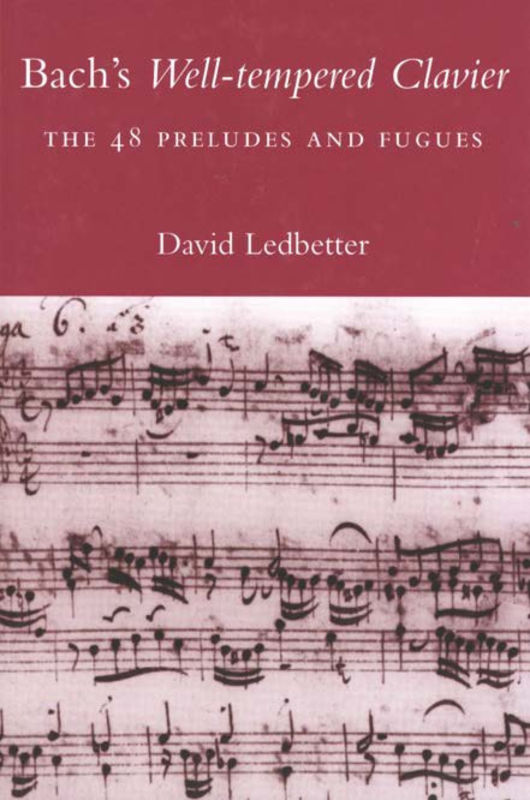
Bach’s Well-tempered Clavier
Bach'sWell-tempered Clavier(or the 48 Preludes and Fugues) stands at the core of baroque keyboard music and has been a model and inspiration for performers and composers ever since it was written. This invaluable guide to the 96 pieces explains Bach's various purposes in compiling the music, describes the rich traditions on which he drew, and provides commentaries for each prelude and fugue.In his text, David Ledbetter addresses the main focal points mentioned by Bach in his original 1722 title page. Drawing on Bach literature over the past three hundred years, he explores German traditions of composition types and Bach's novel expansion of them; explains Bach's instruments and innovations in keyboard technique in the general context of early eighteenth-century developments; reviews instructive and theoretical literature relating to keyboard temperaments from 1680 to 1750; and discusses Bach's pedagogical intent when composing theWell-tempered Clavier. Ledbetter's commentaries on individual preludes and fugues equip readers with the concepts necessary to make their own assessment and include information about the sources when details of notation, ornaments, and fingerings have a bearing on performance.
eBook
BBC Proms. 1994, Last night of the Proms. Toccata and fugue in D minor, BMV565
The 100th Last Night of the Proms with the BBC Symphony Orchestra, BBC Singers and Chorus. Highlights- in addition to the traditional Last Night repertoire - include Bryn Terfel singing Walton's Belshazzar's Feast, Evelyn Glennie performing two of the three movements of Paul Creston's Concerto for Marimba, and Michael Davis performing the famous 'Meditation' from Thaïs, featuring an eloquent violin solo marked 'Andante religioso'.
Streaming Video
BBC Proms. 2000, The last night of the BBC Proms. Fantasia and fugue
BBC Proms 2000 was the 106th season of the world's greatest classical music festival, taking place between 14th July and 9th September 2000. This year, an outstanding young American soloist makes her Proms debut on the Last Night alongside an internationally renowned British soprano, and a recently rediscovered piece of Shostakovich makes its first ever appearance. The composer of Pomp and Circumstance transcribes Bach and we bid farewell to Sir Andrew Davis at the end of his outstanding period at the helm of the BBC Symphony Orchestra. Performances include Mozart's Violin Concerto No.4 in D, extracts from Strauss's Salome, and works from Grainger, Delius, Elgar and Henry Wood.
Streaming Video
Toccata, adagio, fugue BWV 564
This is part of a performance by Evgeny Kissin at the Chorégies d'Orange, directed by Christopher Nupen.
Streaming Video