
Catalogue Search | MBRL


Are you sure you want to remove the book from the shelf?

{{itemTitle}}
990
result(s) for
"Functional programming (Computer science)"
Sort by:

Introducing Elixir : getting started in functional programming
Smooth, powerful, and small, the Elixir programming language is an excellent place for newcomers to learn about functional programming. This book shows readers how Elixir combines the robust functional programming of Erlang with an approach that looks more like Ruby. Readers will learn how Elixir simplifies some of Erlang's odder corners and reaches toward metaprogramming with powerful macro features. Updated to cover Elixir 1.4.-- Source other than the Library of Congress.
Book
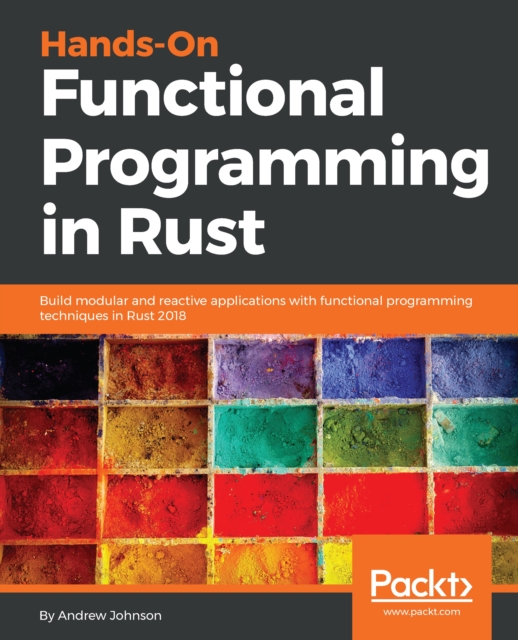
Hands-On Functional Programming in Rust
Functional programming allows developers to divide programs into smaller, reusable components that ease the creation and maintenance of software as a whole. Combining power of Rust, you can develop robust applications that fulfill modern day software requirements. This book will help you discover Rust features to build software in a functional way.
eBook

Type-driven development with Idris
Types are often seen as a tool for checking errors, with the programmer writing a complete program first and using the type checker to detect errors. And while tests are used to show presence of errors, they can only find errors that you explicitly test for. In type-driven development, types become your tools for constructing programs and, used appropriately, can show the absence of errors. And you can express precise relationships between data, your assumptions are explicit and checkable, and you can precisely state and verify properties. Type-driven development lets users write extensible code, create simple specifications very early in development, and easily create mock implementation for testing. This book, written by the creator of Idris, teaches programmers how to improve the performance and accuracy of programs by taking advantage of a state-of-the-art type system.
Book

Machine Learning with Scala Quick Start Guide
Scala as a programming language is a highly scalable integration of object-oriented and functional programming, which makes it easy to build scalable and complex big data applications. This book is a handy guide for machine learning developers and data scientists who want to train effective machine learning models using this popular language.
eBook


Testing machine learning based systems: a systematic mapping
Context:A Machine Learning based System (MLS) is a software system including one or more components that learn how to perform a task from a given data set. The increasing adoption of MLSs in safety critical domains such as autonomous driving, healthcare, and finance has fostered much attention towards the quality assurance of such systems. Despite the advances in software testing, MLSs bring novel and unprecedented challenges, since their behaviour is defined jointly by the code that implements them and the data used for training them.Objective:To identify the existing solutions for functional testing of MLSs, and classify them from three different perspectives: (1) the context of the problem they address, (2) their features, and (3) their empirical evaluation. To report demographic information about the ongoing research. To identify open challenges for future research.Method:We conducted a systematic mapping study about testing techniques for MLSs driven by 33 research questions. We followed existing guidelines when defining our research protocol so as to increase the repeatability and reliability of our results.Results:We identified 70 relevant primary studies, mostly published in the last years. We identified 11 problems addressed in the literature. We investigated multiple aspects of the testing approaches, such as the used/proposed adequacy criteria, the algorithms for test input generation, and the test oracles.Conclusions:The most active research areas in MLS testing address automated scenario/input generation and test oracle creation. MLS testing is a rapidly growing and developing research area, with many open challenges, such as the generation of realistic inputs and the definition of reliable evaluation metrics and benchmarks.
Journal Article


The NIRS Brain AnalyzIR Toolbox
Functional near-infrared spectroscopy (fNIRS) is a noninvasive neuroimaging technique that uses low-levels of light (650–900 nm) to measure changes in cerebral blood volume and oxygenation. Over the last several decades, this technique has been utilized in a growing number of functional and resting-state brain studies. The lower operation cost, portability, and versatility of this method make it an alternative to methods such as functional magnetic resonance imaging for studies in pediatric and special populations and for studies without the confining limitations of a supine and motionless acquisition setup. However, the analysis of fNIRS data poses several challenges stemming from the unique physics of the technique, the unique statistical properties of data, and the growing diversity of non-traditional experimental designs being utilized in studies due to the flexibility of this technology. For these reasons, specific analysis methods for this technology must be developed. In this paper, we introduce the NIRS Brain AnalyzIR toolbox as an open-source Matlab-based analysis package for fNIRS data management, pre-processing, and first- and second-level (i.e., single subject and group-level) statistical analysis. Here, we describe the basic architectural format of this toolbox, which is based on the object-oriented programming paradigm. We also detail the algorithms for several of the major components of the toolbox including statistical analysis, probe registration, image reconstruction, and region-of-interest based statistics.
Journal Article

Modern Java in action : lambdas, streams, functional and reactive programming
\"Modern Java in Action\" connects new features of the Java language with their practical applications. Using crystal-clear examples and careful attention to detail, this book respects your time. It will help you expand your existing knowledge of core Java as you master modern additions like the Streams API and the Java Module System, explore new approaches to concurrency, and learn how functional concepts can help you write codes that's easier to read and maintain. -- From publisher's description.
Book

Node.js: Using JavaScript to Build High-Performance Network Programs
One of the more interesting developments recently gaining popularity in the server-side JavaScript space is Node.js. It's a framework for developing high-performance, concurrent programs that don't rely on the mainstream multithreading approach but use asynchronous I/O with an event-driven programming model.
Journal Article