
Catalogue Search | MBRL


Are you sure you want to remove the book from the shelf?

{{itemTitle}}
61
result(s) for
"Fund raising -- Law and legislation -- United States"
Sort by:
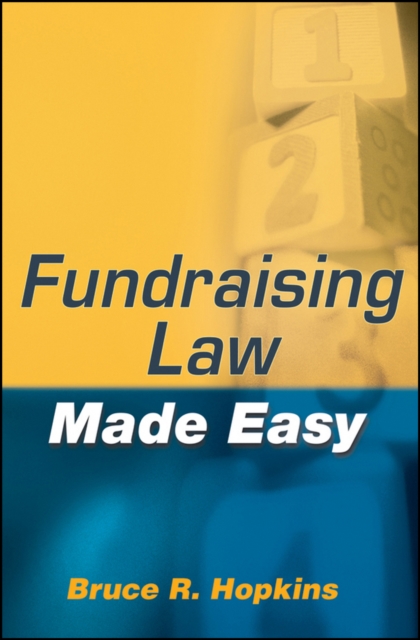
Fundraising law made easy
The ins and outs of fundraising law-made easy-from nonprofit law authority Bruce Hopkins Author Bruce R. Hopkins-a leading authority on the laws regulating fundraising-offers essential, practical legal information in easy-to-understand English. His practical tips and \"red flags\" provide useful advice and present critical information in an efficient and comprehensible fashion. Now your organization can be fully informed about the basic legal requirements affecting fundraising and avoid the perils lurking in the myriad tax-law traps. Fundraising Law Made Easy clearly shows you how, with everything you need to know about The fundraising process State charitable solicitation acts Federal tax charitable giving rules Requirements of the new Form 990 How constitutional law, governance, and IRS audit practices pertain to charitable fundraising Expert advice from Bruce Hopkins, the author of more than 20 books on nonprofit counsel, including The New Form 990 and Charitable Giving Law Made Easy Mandatory reading whether you are a charitable organization development officer, fundraising consultant, a trustee, or a director, Fundraising Law Made Easy illuminates the rules surrounding charitable giving, and authoritatively and thoroughly guides you through every aspect of its laws.
eBook
The Law of Fundraising
Untangle the web of fundraising regulations, with the latest updates for 2019 The Law of Fundraising is the definitive reference by the field's most respected authority, and the only book to tackle the increasingly complex maze of federal and state fundraising regulations.
eBook
The law of fundraising
Raising funds to fulfill a nonprofit organization's goals is critical to its success, but fundraising regulations are an increasingly complex maze. The Law of Fundraising, Fifth Edition is the definitive guide to demystifying federal and state fundraising regulations. With new discussion on Internet fundraising, political fundraising laws, and international fundraising, this book details federal and state laws, with an emphasis on administrative, tax, and constitutional laws. This guide is supplemented annually to keep nonprofit professionals on top of the latest fundraising legal developments.
eBook

Free to judge : the power of campaign money in judicial elections
The idea that wealthy people use their money to influence things, including politics, law, and media will surprise very few people. However, as Michael S. Kang and Joanna Shepherd argue in this readable and rich study of the state judiciary, the effect of money on judicial outcomes should disturb and anger everyone. In the current system that elects state judges, the rich and powerful can spend money to elect and re-elect judges who decide cases the way they want. Free to Judge is about how and why money increasingly affects the dispensation of justice in our legal system, and what can be done to stop it.
One of the barriers to action in the past has been an inability to prove that campaign donations influence state judicial decision-making. In this book, Kang and Shepherd answer that challenge for the first time, with a rigorous empirical study of campaign finance and judicial decision-making data. Pairing this with interviews of past and present judges, they create a compelling and persuasive account of people like Marsha Ternus, the first Iowa state supreme court justice to be voted out of office after her decision in a same-sex marriage case. The threat of such an outcome, and the desire to win reelection, results in judges demonstrably leaning towards the interests and preferences of their campaign donors across all cases.
Free to Judge is thus able to identify the pieces of our current system that invite bias, such as judicial reelection, and what reforms should focus on. This thoughtful and compellingly written book will be required reading for anybody who cares about creating a more just legal system.
eBook

The influence of campaign contributions in state legislatures
Campaign contributions are widely viewed as a corrupting influence but most scholarly research concludes that they have marginal impact on legislative behavior. Lynda W. Powell shows that contributions have considerable influence in some state legislatures but very little in others. Using a national survey of legislators, she develops an innovative measure of influence and delineates the factors that explain this great variation across the 99 U.S. state legislative chambers.
Powell identifies the personal, institutional, and political factors that determine how much time a legislator devotes to personal fundraising and fundraising for the caucus. She shows that the extent of donors' legislative influence varies in ways corresponding to the same variations in the factors that determine fundraising time. She also confirms a link between fundraising and lobbying with evidence supporting the theory that contributors gain access to legislators based on donations, Powell's findings have important implications for the debate over the role of money in the legislative process.
eBook

Lobbying, Rent-seeking, and the Constitution
Politicians across the political spectrum, from Barack Obama to Sarah Palin and Rand Paul, routinely castigate lobbyists for engaging in supposedly corrupt activities or having unequal access to elected officials. Since attaining office President Obama has imposed unprecedented new lobbying regulations, and he is not alone: both Congress and state and local legislative bodies have done so in recent years. At the same time, federal courts, relying upon the Supreme Court's new campaign finance decision in Citizens United v. FEC, have begun striking down lobbying regulations, including important regulations that limit campaign finance activities of lobbyists and impose a waiting period before legislators or legislative staffers may work as lobbyists. Two courts have held such laws could not be sustained on anticorruption grounds, and they are unlikely to be sustained on political equality grounds either. This Article advances an alternative rationale which could support some, though not all, of the recent wave of new lobbying regulations: the state's interest in promoting national economic welfare. Lobbyists threaten national economic welfare in two ways. First, lobbyists facilitate rent-seeking activities. Rentseeking occurs when individuals or groups devote resources to capturing government transfers, rather than putting them to a productive use, and lobbyists are often the key actors securing such benefits. Second, lobbyists tend to lobby for legislation that is itself an inefficient use of government resources. Part I of this Article provides an overview of the current state of lobbying regulation and lobbying jurisprudence. Part II proposes a new national economic welfare rationale for lobbying regulation. It begins by describing the political science literature on how lobbying works, as well as current statistics on the extent of lobbying on the federal level and the costs of lobbyist-driven rent-seeking on the national economy. Some of the new and proposed lobbying regulations, such as antibundling provisions and anti-revolving-door provisions, could decrease the total amount of interest group rent-seeking. The state's national economic welfare interest must be balanced against the First Amendment costs of lobbying regulation in infringing on the right to speak and petition the government. I defend this interest as an important (even potentially compelling) state interest that justifies at least some new lobbying regulations against constitutional challenge. Part III turns to objections and extensions of the argument. I respond to objections on both ends and means. On ends I consider the circumstances in which the promotion of national economic welfare can trump First Amendment rights. On means, I consider whether there is sufficient proof that lobbying regulations are sufficiently tailored to a reduction in rent-seeking and whether, because of the \"hydraulic\" nature of money in politics, attempts to regulate lobbying so as to decrease rent-seeking will be easy to evade. Under extensions, I consider whether the national economic welfare rationale could be used to justify the reenactment, as suggested by Justice Stevens, of the ban on spending corporate treasury funds in candidate elections, as well as the recent SEC \"pay-to-play\" rule for investment advisers.
Journal Article
The Law of Fundraising
Untangle the web of fundraising regulations, with the latest updates for 2017 The Law of Fundraising is the definitive reference by the field's most respected authority, and the only book to tackle the increasingly complex maze of federal and state fundraising regulations. Updated to cover the latest changes to fundraising law for 2017, this book includes new coverage of donor-advised funds, international fundraising, and the IRS's charitable spending initiative alongside updates on Form 990, political fundraising, and more. Both state and federal regulations are covered with an emphasis on administrative, tax, and constitutional law, alongside expert discussion on compliance issues, trends, and upcoming legislation. Accessible language aids in conceptual understanding, while extensive tables of cases, IRS rulings and pronouncements, checklists, and sample forms facilitate correct application. The companion website features additional tables, appendices, IRS guidelines, and other useful documents, providing attorneys, accountants, and nonprofit professionals with a rich toolkit for ensuring compliance. With all topics pertaining to finance under increasing federal scrutiny, laws surrounding fundraising are becoming increasingly difficult to parse. Mistakes can impact the nonprofit's bottom line, so keeping up-to-date is crucial; this book provides a comprehensive reference to the latest developments, along with expert forecasting of what is to come. Understand the latest state and federal laws surrounding fundraising activities Learn how the law governs Internet fundraising and other emerging issues Get up to date on the new rules surrounding donor-advised funds and international fundraising Examine prospective laws, regulatory trends, and how new rules impact fundraising professionals Fundraising is critical to the nonprofit's ability to carry out their mission, yet the regulatory tangle at both the state and federal level can be a nightmare to navigate. The Law of Fundraising streamlines compliance with the latest legal developments and invaluable tools for application.
eBook
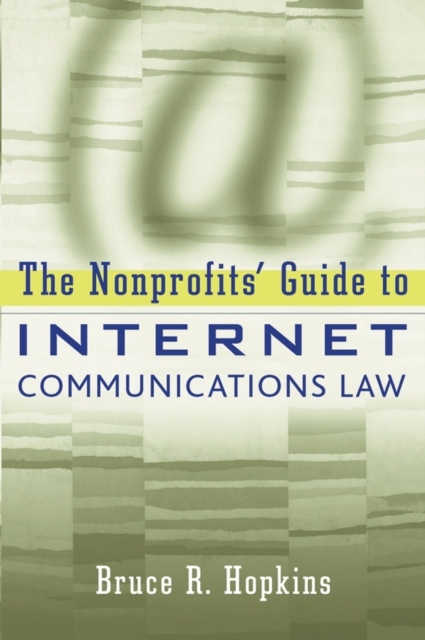
The nonprofits' guide to internet communications law
Invaluable guidance on the most important legal issues facing nonprofits today
Internet communication is the lifeblood of countless nonprofit organizations, yet there exists no specific law to provide for its regulation. Without solid legal guidance, nonprofits risk not only missing out on the unlimited opportunities that the Internet has to offer, but also jeopardizing their tax-exempt status. The Nonprofits' Guide to Internet Communications Law analyzes and explains the laws applicable to Internet communications by nonprofit organizations.
Nonprofit law expert Bruce Hopkins writes that with Congress and government agencies reluctant to create new law, it will ultimately be up to the courts to determine the future of Internet law affecting nonprofit organizations. Extrapolating from the underlying principles of existing law, Hopkins addresses the legal ramifications of Internet business activities, charitable-giving administration, fundraising programs, lobbying, political campaign activities, and more.
The Nonprofits' Guide to Internet Communications Law proves an unparalleled resource for this emerging field.
eBook

Healthier Fundraising in U. S. Elementary Schools: Associations between Policies at the State, District, and School Levels
We examined whether state laws and district policies pertaining to nutritional restrictions on school fundraisers were associated with school policies as reported by administrators in a nationally-representative sample of United States public elementary schools.
We gathered data on school-level fundraising policies via a mail-back survey during the 2009-10 and 2010-11 school years. Surveys were received from 1,278 public elementary schools (response rate = 60.9%). Data were also gathered on corresponding school district policies and state laws. After removing cases with missing data, the sample size for analysis was 1,215 schools.
After controlling for school characteristics, school policies were consistently associated with state laws and district policies, both those pertaining to fundraising generally, as well as specific restrictions on the sale of candy and soda in fundraisers (all Odds Ratios >2.0 and Ps<.05). However, even where district policies and state laws required fundraising restrictions, school policies were not uniformly present; school policies were also in place at only 55.8% of these schools, but were more common at schools in the West (77.1%) and at majority-Latino schools (71.4%), indicating uneven school-level implementation of district policy and state law.
District policies and state laws were associated with a higher prevalence of elementary school-level fundraising policies, but many schools that were subject to district policies and state laws did not have school-level restrictions in place, suggesting the need for further attention to factors hindering policy implementation in schools.
Journal Article

Change in School Nutrition―Related Laws From 2003 to 2008: Evidence From the School Nutrition―Environment State Policy Classification System
We examined state laws affecting the school food environment and changes in these laws between 2003 to 2008.
We used the Westlaw legal database to identify state-codified laws, with scoring derived from the updated School Nutrition-Environment State Policy Classification System, obtained from the Classification of Laws Associated With School Students Web site.
States significantly changed their school nutrition laws from 2003 to 2008, and many increased the stringency of the laws targeting competitive foods (snacks and entrées sold in competition with the school meal) and beverages sold in school and for in-school fundraising. Many states enacted laws that mandated the establishment of a coordinating or advisory wellness team or council. Stronger laws were enacted for elementary grades. We found tremendous variability in the strength of the laws and plenty of room for improvement.
State law governing school nutrition policies significantly changed from 2003 to 2008, primarily affecting the competitive food environment in schools. The extent to which changes in school nutrition laws will lead to desired health outcomes is an area for additional research.
Journal Article