
Catalogue Search | MBRL


Are you sure you want to remove the book from the shelf?

{{itemTitle}}
288
result(s) for
"GARCÍA LORCA, FEDERICO (1898-1936) Poetry "
Sort by:


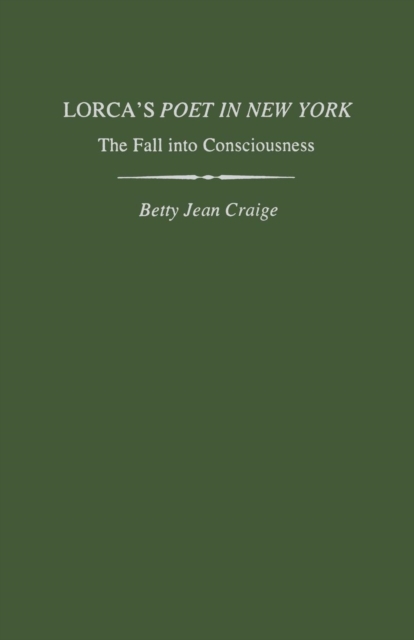
Lorca's Poet in New York
Written in 1929--1930, when Federico García Lorca was visiting Columbia University,Poet in New Yorkstands as one of the great Waste Land poems of the 20th century. It expresses, as Betty Jean Craige writes in this volume,\"a sudden radical estrangement of the poet from his universe\" -- an an estrangement graphically delineated in the dissonant, violent imagery which the poet derives from the technological world of New York.
Craige here describes -- through close analysis of the structure, style, and themes of individual works inPoet in New York-- the chaos into which this world plunges the poet, and the process whereby he is able, gradually, to recover his identity with the regenerative forces of nature. Her study demonstrates that, though seemingly unique in form and motifs,Poet in New Yorkis integral with Lorca's overall poetic achievement.
eBook

Lorca in Tune with Falla
Federico García Lorca (1889-1936) is widely regarded as the greatest Spanish poet of the twentieth century; Manuel de Falla (1876-1946) is Spain’s most performed composer of the same period. The two were very different – Lorca was gay, liberal, and a member of the avant garde , while Falla was a devout Catholic – yet they had a profound mutual influence. The two developed an intimate friendship, which ended when Lorca was shot by Nationalist forces at the beginning of the Spanish Civil War.
Lorca in Tune with Falla is the first book to trace Lorca’s impact on Falla’s music, and Falla’s influence on Lorca’s writings. Nelson R. Orringer explores the music underlying Poem of Deep Song , Gypsy Ballads , and Lament for Ignacio Sánchez Mejías , bringing out the analogous sounds and ideas that emerge in the active, ongoing connection between the artworks of both creators. The book emphasizes how this harmony increases knowledge and appreciation of both artists.
eBook
