
Catalogue Search | MBRL


Are you sure you want to remove the book from the shelf?

{{itemTitle}}
370
result(s) for
"GERMANY - HISTORY, LITERATURE, CULTURE "
Sort by:

Siegfried the Wrestler
Continually attacked by government officials and educators, installment or colportage novels fascinated their underprivileged readers.Melodrama and sensation were essential ingredients.The hurriedly written, rambling plots sought to electrify fantasies of women with new turn-of-the-century aspirations.
eBook

White rebels in Black : German appropriation of Black popular culture
\"Analyzing literary texts and films, White Rebels in Black shows how German authors have since the 1950s appropriated black popular culture, particularly music, to distance themselves from the legacy of Nazi Germany, authoritarianism, and racism, and how such appropriation changes over time. Priscilla Layne offers a critique of how blackness came to symbolize a positive escape from the hegemonic masculinity of postwar Germany, and how black identities have been represented as separate from, and in opposition to, German identity, foreclosing the possibility of being both black and German. Citing four autobiographies published by black German authors Hans Jèurgen Massaquo, Theodor Michael, Gèunter Kaufmann, and Charly Graf, Layne considers how black German men have related to hegemonic masculinity since Nazi Germany, and concludes with a discussion on the work of black German poet, Philipp Khabo Kèopsell.\"--Provided by publisher.
Book


Jewish Life in Austria and Germany Since 1945
Based on published primary and secondary materials and oral interviews with some eighty communal and organizational leaders, experts and scholars, this book provides a comparative account of the reconstruction of Jewish communal life in both Germany and in Austria (where 98% live in the capital, Vienna) after 1945. The author explains the process of reconstruction over the next six decades, and its results in each country.The monograph focuses on the variety of prevailing perceptions about topics such as: the state of Israel, one's relationship to the country of residence, the Jewish religion, the aftermath of the Holocaust, and the influx of post-soviet immigrants. Cohen-Weisz examines the changes in Jewish group identity and its impact on the development of communities. The study analyzes the similarities and differences in regard to the political, social, institutional and identity developments within the two countries, and their changing attitudes and relationships with surrounding societies; it seeks to show the evolution of these two country's Jewish communities in diverse national political circumstances and varying post-war governmental policies.
eBook
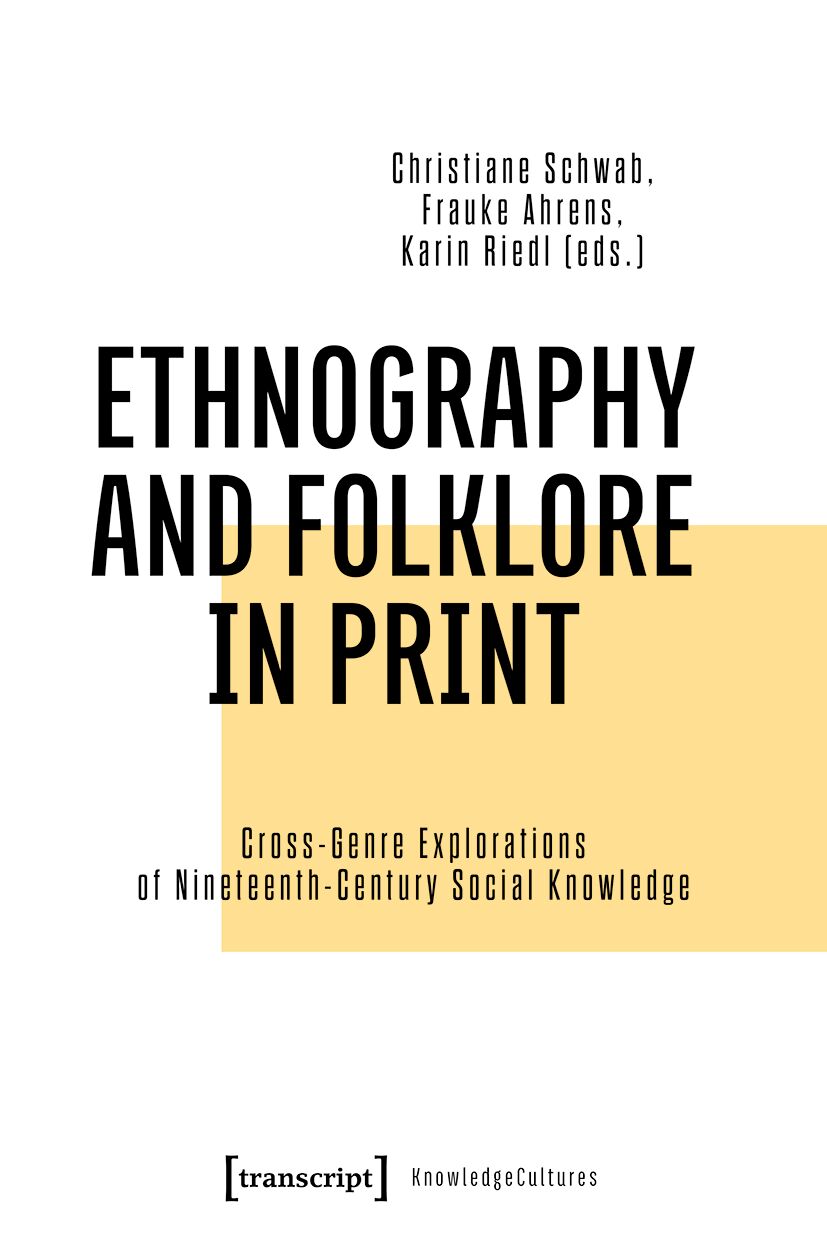
Ethnography and Folklore in Print
Throughout the nineteenth century, social expressions and
dynamics have been reflected in the surge of various printed
products. The contributors analyze a diverse range of sources,
such as caricatures, journalistic reports, travelogues,
scholarly volumes, social novels, and fairytale collections,
viewing them as early manifestations of social knowledge and
ethnographic representation situated at the confluence of
›popular‹ and ›scientific‹ publishing.
Their comprehensive exploration unveils alternative contexts
and dimensions of early ethnographic knowledge production,
providing insights into a history of social knowledge that
surpasses disciplinary, national, and genre-related
boundaries.
eBook