
Catalogue Search | MBRL


Are you sure you want to remove the book from the shelf?

{{itemTitle}}
17,347
result(s) for
"GESTION"
Sort by:

Averting disaster before it strikes : how to make sure your subordinates warn you while there is still time to act
Some of the major industrial disasters could have been prevented. When the facts of what happened are established, their stories share a common thread: before things spiralled out of control, there were workers at the affected sites who knew that the situation was dangerous, and could become catastrophic unless immediate action was taken. But tragically, nobody dared to tell the decision-makers who could have authorized that action. With no idea of the risks they were taking, the people in charge continued as normal... and disaster struck. Because vital information about risks could not flow freely from the shop floor to the director's office, the crucial decisions were not made in time. This observation has been documented in the following major technological accidents: Challenger space shuttle explosion (USA, 1986); Chernobyl nuclear plant disaster (USSR, 1986); Deepwater Horizon oil spill (USA, 2010); Fukushima-1 nuclear power plant disaster (Japan, 2011); and numerous other industrial disasters. After accidents like these, losses and costs for dealing with the consequences are often hundreds -- or even thousands -- of times greater than the finances that would have been required to deal with the risks when they were first recognized. This handbook is about how to transform the way large critical infrastructure companies communicate about safety and technological risks. It aims to support senior managers to get the information they need from their subordinates concerning the risks they are facing, in order to prevent accidents before it is too late. The recommendations in this handbook are based on interviews with 100 executives at various levels, working in 65 critical infrastructure companies around the world, in power, oil and gas, metals, chemicals and petrochemicals, mining and other industries. The recommendations of these leaders were also tested in the pilot project, in an industrial company which is the world leader in its sector. More than 400 managers at various levels of the corporate hierarchy, and employees at several of the company's industrial plants, took part in the project. This open access handbook is written for the owners, senior managers, and industrial safety directors of critical infrastructure companies.
BOOK

SAP on Azure Implementation Guide
Learn how to migrate your SAP data to Azure simply and successfully. Key Features * Learn why Azure is suitable for business-critical systems * Understand how to migrate your SAP infrastructure to Azure * Use Lift & shift migration, Lift & migrate, Lift & migrate to HANA, or Lift & transform to S/4HANA Book Description Cloud technologies have now reached a level where even the most critical business systems can run on them. For most organizations SAP is the key business system. If SAP is unavailable for any reason then potentially your business stops. Because of this, it is understandable that you will be concerned whether such a critical system can run in the public cloud. However, the days when you truly ran your IT system on-premises have long since gone. Most organizations have been getting rid of their own data centers and increasingly moving to co-location facilities. In this context the public cloud is nothing more than an additional virtual data center connected to your existing network. There are typically two main reasons why you may consider migrating SAP to Azure: You need to replace the infrastructure that is currently running SAP, or you want to migrate SAP to a new database. Depending on your goal SAP offers different migration paths. You can decide either to migrate the current workload to Azure as-is, or to combine it with changing the database and execute both activities as a single step. SAP on Azure Implementation Guide covers the main migration options to lead you through migrating your SAP data to Azure simply and successfully. What you will learn * Successfully migrate your SAP infrastructure to Azure * Understand the security benefits of Azure * See how Azure can scale to meet the most demanding of business needs * Ensure your SAP infrastructure maintains high availability * Increase business agility through cloud capabilities * Leverage cloud-native capabilities to enhance SAP Who this book is for SAP on Azure Implementation Guide is designed to benefit existing SAP architects looking to migrate their SAP infrastructure to Azure. Whether you are an architect implementing the migration or an IT decision maker evaluating the benefits of migration, this book is for you.
eBook

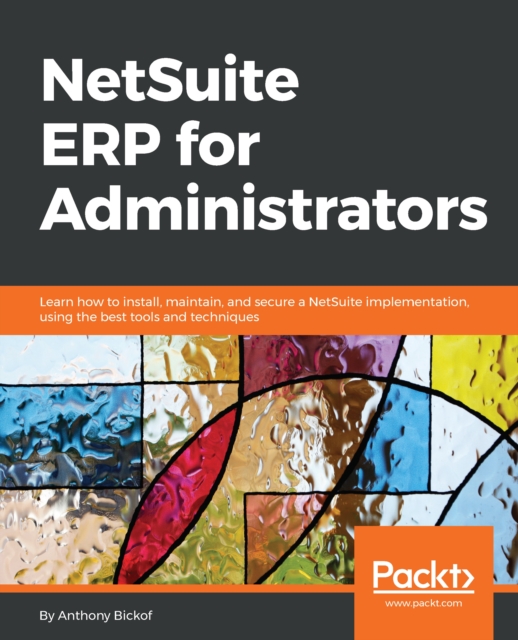
NetSuite ERP for Administrators
Learn steps and tasks to help a NetSuite administrator perform both his daily and monthly tasks efficiently. Advance his expertise to become NetSuite leader without having to spend time and money on corporate trainings. Key Features * Understand the business considerations and implementation of the NetSuite ERP * Gain a deep knowledge of enterprise security, data management, process automation, and analytics * Learn techniques to sail through system maintenance while ensuring accuracy and to practically troubleshoot issues Book Description NetSuite ERP is a complete, scalable cloud ERP solution targeted at fast-growing, mid-sized businesses and large enterprises. It's the smartly executed combination of financial management operations and built-in business intelligence, which enables companies to make data-driven and well-informed decisions. This book will help administrators become expert enough to be seen as the NetSuite leader at their company and to be able to advise department heads on specific processes, and strategic decisions. We start with an overview of ERP and NetSuite ERP, before going on to explain the built-in features to show the breadth of NetSuite ERP's product and its ease of use. We then discuss business aspects, focusing on the most important processes in NetSuite. Then you'll understand the implementation aspects that are generic enough to cover all the features. The focus then shifts to specific skills that you will need to administer for any system, such as roles, permissions, customization, and data imports. Moving on, you'll learn how to centralize the creation of search templates and give users the tools to pivot the data and expose it to the user in useful ways, such as on the dashboard. The book ends with checklists providing actionable steps that you as an administrator can take to do your job and support the application through new releases and troubleshooting problems. What you will learn * Explore how the framework streamlines the implementation of new and existing features * Leverage built-in tools to optimize your efficiency and effectiveness * Test configuration to check the implementation of role-specific permissions * Understand how to optimize the amount of data to be shared with users * Import data like new leads and employ current data like pricing updates * Perform on-going maintenance and troubleshoot issues Who this book is for This book is for administrators, consultants, and Project Managers who would like to improve their skills in the areas of configuration and system management. Basic experience implementing NetSuite is assumed.
eBook

Everyone a leader : a guide to leading high-performance organizations for engineers and scientists
\"Are you an engineer or scientist early in your career, or a student in either of these fields, looking to develop your leadership capabilities? Learn from David Colcleugh, former CEO of DuPont Canada, leadership educator, and author of Everyone a Leader. This book outlines innovative learning frameworks for acquiring competence in leadership that were developed at DuPont Canada applied to different concepts throughout the book.\"-- From publisher's website.
Book

Gestion financière des PME
Que peut-on dire de la gestion financière des PME ? Évaluer la qualité de leur gestion à la lumière de leur taux de fermeture pourrait nous amener à conclure qu’elle fait défaut. Or, ce serait inexact, car cela fait abstraction de certaines caractéristiques de ces entreprises, de la diversité de leur mode de fonctionnement et, surtout, de leur grande hétérogénéité. Parce qu’il n’existe pas de PME type, il n’existe pas non plus de comportement financier type pour l’ensemble des sociétés fermées.
Josée St-Pierre aborde les principales décisions financières dans les PME, les pratiques de gestion, les situations financières et l’environnement favorable ou restrictif dans lequel ces entreprises font des affaires. Au cours des quinze dernières années, ses recherches et l’analyse de travaux dans les domaines de la finance, de la psychologie, de l’économie et de la gestion lui ont permis de tirer une analyse nuancée de la réalité financière des PME. Le présent ouvrage montre le rôle central du chef d’entreprise, dont les objectifs teintent les décisions financières, et présente des comportements stratégiques amenant des entrepreneurs à exceller sur la scène mondiale. L’auteure démontre aussi les conséquences de choix mal éclairés mettant en péril des entreprises qui ne survivront pas aux défis de l’environnement d’affaires actuel, plus turbulent et incertain.
Cette deuxième édition, renouvelée de façon significative, conjugue la finance et l’entrepreneuriat pour mieux comprendre et expliquer la diversité des comportements financiers des PME, de même que pour stimuler les lecteurs à s’enrichir par le domaine de la finance entrepreneuriale grâce aux connaissances les plus à jour sur ces sujets.
eBook


Lifting the veil on HRIS adoption: the role of vendors and consultants in the diffusion of HR innovations
PurposeThis paper aims to analyze the adoption process of human resource information systems (HRIS) from a supply-side perspective emphasizing the practices of HRIS vendors and consultants. It aims to counterbalance the existing literature on HRIS, which has overwhelmingly studied HRIS adoption from the customer organization's viewpoint, hence systematically downplaying the active role of vendors and consultants in adoption processes.Design/methodology/approachThe research has been conducted on the HRIS market of the Benelux (Belgium–The Netherlands–Luxemburg) from a constructionist and exploratory perspective. The structure and dynamics underlying the market are gradually unveiled through open interviews with HRIS vendors and consulting firms (n = 22).FindingsThe paper reveals how the social shaping of HR innovations takes place and identifies nine types of pressures exerted by HRIS vendors and consultants on customer organizations: assessing, advising, advertising, case-building, demonstrating, configuring, accompanying, sustaining and supporting. Taken together, these pressures demonstrate the systematic presence and active role of external actors throughout the adoption process of HRIS within firms.Research limitations/implicationsIt is suggested that further supply-side studies of innovation diffusion processes of HRIS should be conducted to complement the existing, demand-side literature. In this view, emphasis should be set on technology providers and their ongoing interactions with customer firms.Originality/valueThe analytical precedence given to supply-side actors allows to conceptualize HRIS adoption as the dynamic result of negotiations between three groups of actors (HRIS vendors, HRIS consultants and customer firms), hence resulting in a more comprehensive and holistic view of HRIS adoption processes.
Journal Article

Small business
A guide to the nitty-gritty of small business This refreshingly straightforward book takes current and would-be entrepreneurs through the step-by-step process of starting, buying, or sustaining a small business. Discover whether entrepreneurship is for you and turn your business idea into a solid plan. Dig into jargon-free guidance on marketing, managing, and growing your business. Employee benefits, small business taxes, staying financially solvent--it's all in here, in terms anyone can understand. If you're itching to become your own boss, start with this guide. Inside... Evaluating your finances Building a business plan Funding your business idea Researching businesses to buy Attracting loyal customers Keeping an eye on the books Hiring & retaining employees Avoiding common mistakes.
Book

Big data, data mining and machine learning
With big data analytics comes big insights into profitability Big data is big business. But having the data and the computational power to process it isn't nearly enough to produce meaningful results. Big Data, Data Mining, and Machine Learning: Value Creation for Business Leaders and Practitioners is a complete resource for technology and marketing executives looking to cut through the hype and produce real results that hit the bottom line. Providing an engaging, thorough overview of the current state of big data analytics and the growing trend toward high performance computing architectures, the book is a detail-driven look into how big data analytics can be leveraged to foster positive change and drive efficiency. With continued exponential growth in data and ever more competitive markets, businesses must adapt quickly to gain every competitive advantage available. Big data analytics can serve as the linchpin for initiatives that drive business, but only if the underlying technology and analysis is fully understood and appreciated by engaged stakeholders. This book provides a view into the topic that executives, managers, and practitioners require, and includes: * A complete overview of big data and its notable characteristics * Details on high performance computing architectures for analytics, massively parallel processing (MPP), and in-memory databases * Comprehensive coverage of data mining, text analytics, and machine learning algorithms * A discussion of explanatory and predictive modeling, and how they can be applied to decision-making processes Big Data, Data Mining, and Machine Learning provides technology and marketing executives with the complete resource that has been notably absent from the veritable libraries of published books on the topic. Take control of your organization's big data analytics to produce real results with a resource that is comprehensive in scope and light on hyperbole.
eBook