
Catalogue Search | MBRL


Are you sure you want to remove the book from the shelf?

{{itemTitle}}
153
result(s) for
"GUATEMALA - HISTORY, POLITICS "
Sort by:


City of God
In Guatemala City today, Christianity isn't just a belief system--it is a counterinsurgency. Amidst postwar efforts at democratization, multinational mega-churches have conquered street corners and kitchen tables, guiding the faithful to build a sanctified city brick by brick. Drawing on rich interviews and extensive fieldwork, Kevin Lewis O'Neill tracks the culture and politics of one such church, looking at how neo-Pentecostal Christian practices have become acts of citizenship in a new, politically relevant era for Protestantism. Focusing on everyday practices--praying for Guatemala, speaking in tongues for the soul of the nation, organizing prayer campaigns to combat unprecedented levels of crime--O'Neill finds that Christian citizenship has re-politicized the faithful as they struggle to understand what it means to be a believer in a desperately violent Central American city. Innovative, imaginative, conceptually rich, City of God reaches across disciplinary borders as it illuminates the highly charged, evolving relationship between religion, democracy, and the state in Latin America.
eBook


ON GÓNGORA'S ANGÉLICA Y MEDORO
In the introduction to La Lengua poética de Góngora, Dámaso Alonso devotes 18 extremely interesting pages to the analysis of this poem. He shews clearly that it is a work of considerable intricacy, that it foreshadows the later culto poems and that such words as \"naturalidad\" cannot be used to describe it. In the following pages I want to approach this poem in a slightly different way, to see what it is in itself and to attempt an appreciation.
Journal Article

The Guatemalan Military Project
In 1999, the Guatemala truth commission issued its report on human rights violations during Guatemala's thirty-six-year civil war that ended in 1996. The commission, sponsored by the UN, estimates the conflict resulted in 200,000 deaths and disappearances. The commission holds the Guatemalan military responsible for 93 percent of the deaths. InThe Guatemalan Military Project, Jennifer Schirmer documents the military's role in human rights violations through a series of extensive interviews striking in their brutal frankness and unique in their first-hand descriptions of the campaign against Guatemala's citizens. High-ranking officers explain in their own words their thoughts and feelings regarding violence, political opposition, national security doctrine, democracy, human rights, and law. Additional interviews with congressional deputies, Guatemalan lawyers, journalists, social scientists, and a former president give a full and balanced account of the Guatemalan power structure and ruling system. With expert analysis of these interviews in the context of cultural, legal, and human rights considerations,The Guatemalan Military Projectprovides a successful evaluation of the possibilities and processes of conversion from war to peace in Latin America and around the world.
eBook

Ladinos with Ladinos, Indians with Indians : land, labor, and regional ethnic conflict in the making of Guatemala
This book reconceptualizes the political narrative of Guatemala's nineteenth century through a careful reconstruction of community-level conflict over land, labor, and local government in the western highland region.
eBook

Maya after War
Guatemala's thirty-six-year civil war culminated in peace accords in 1996, but the postwar transition has been marked by continued violence, including lynchings and the rise of gangs, as well as massive wage-labor exodus to the United States. For the Mam Maya municipality of Todos Santos Cuchumatán, inhabited by a predominantly indigenous peasant population, the aftermath of war and genocide resonates with a long-standing tension between state techniques of governance and ancient community-level power structures that incorporated concepts of kinship, gender, and generation. Showing the ways in which these complex histories are interlinked with wartime and enduring family/class conflicts,Maya after Warprovides a nuanced account of a unique transitional postwar situation, including the complex influence of neoliberal intervention.
Drawing on ethnographic field research over a twenty-year period, Jennifer L. Burrell explores the after-war period in a locale where community struggles span culture, identity, and history. Investigating a range of tensions from the local to the international, Burrell employs unique methodologies, including mapmaking, history workshops, and an informal translation of a historic ethnography, to analyze the role of conflict in animating what matters to Todosanteros in their everyday lives and how the residents negotiate power. Examining the community-based divisions alongside national postwar contexts,Maya after Warconsiders the aura of hope that surrounded the signing of the peace accords, and the subsequent doubt and waiting that have fueled unrest, encompassing generational conflicts. This study is a rich analysis of the multifaceted forces at work in the quest for peace, in Guatemala and beyond.
eBook
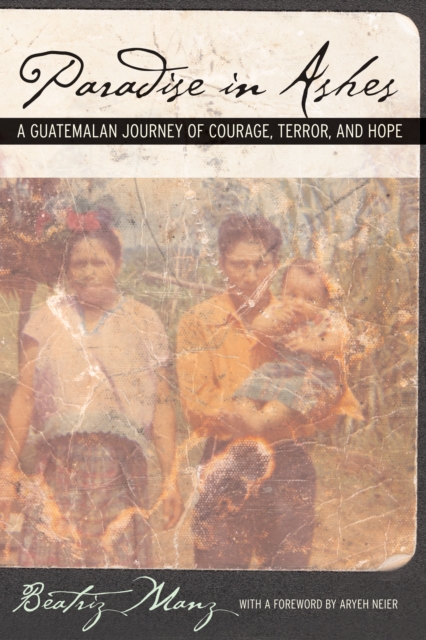
Paradise in Ashes
Paradise in Ashesis a deeply engaged and moving account of the violence and repression that defined the murderous Guatemalan civil war of the 1980s. In this compelling book, Beatriz Manz-an anthropologist who spent over two decades studying the Mayan highlands and remote rain forests of Guatemala-tells the story of the village of Santa María Tzejá, near the border with Mexico. Manz writes eloquently about Guatemala's tortured history and shows how the story of this village-its birth, destruction, and rebirth-embodies the forces and conflicts that define the country today. Drawing on interviews with peasants, community leaders, guerrillas, and paramilitary forces, Manz creates a richly detailed political portrait of Santa María Tzejá, where highland Maya peasants seeking land settled in the 1970s. Manz describes these villagers' plight as their isolated, lush, but deceptive paradise became one of the centers of the war convulsing the entire country. After their village was viciously sacked in 1982, desperate survivors fled into the surrounding rain forest and eventually to Mexico, and some even further, to the United States, while others stayed behind and fell into the military's hands. With great insight and compassion, Manz follows their flight and eventual return to Santa María Tzejá, where they sought to rebuild their village and their lives.
eBook