
Catalogue Search | MBRL


Are you sure you want to remove the book from the shelf?

{{itemTitle}}
1,359
result(s) for
"Gainsborough"
Sort by:

Thomas Gainsborough : the modern landscape
Thomas Gainsborough (1727-1788) is one of the great European painters of the 18th century. This volume is the first to present the English artist as a pivotal figure in the development of 'modern' landscape painting, a genre in which his painterly experiments were particularly innovative. Gainsborough himself favoured landscape painting, a field to which he made important contributions, over his well-known portraits. His works are fascinating for their painterly subtlety and technical variation. This volume brings together German and British traditions of viewing, interpreting, and studying Gainsborough. It looks at the connections to the Dutch landscapes, explains Gainsborough's unusual and experimental techniques from an art technological point of view, and situates his landscapes in the context of the social tensions of early industrialisation. Exhibition: Hamburger Kunsthalle, Germany (02.03. - 27.05.2018).
Book
Mixing, dipping, and fixing: the experimental drawing techniques of Thomas Gainsborough
The Morgan Library & Museum, New York, owns twenty-five works on paper by the 18th-century English artist Thomas Gainsborough. Scholarly publications over the past 20 years, as well as Gainsborough’s own writings, have highlighted his proclivity toward innovative methods and experimentation. In particular, a letter that the artist wrote in 1773 reveals details of his secret recipe for making oils on paper, such as his recommended use of lead white and the unorthodox practice of dipping his works in skim milk, possibly to prevent the pigments from discoloring. About a dozen of Gainsborough’s creations were included in a 2018 exhibition at The Morgan entitled Thomas Gainsborough: Experiments in Drawing. On this occasion, an in-depth scientific study aimed to explore the artist’s work as a draftsman, with a special focus on his mastery of materials, his technical innovations, and his development of an original approach to drawing. Initially, a selection of artworks was examined using magnification along with transmitted and raking light to improve surface visualization and to investigate the structure of each piece. Further photographic documentation with ultraviolet and infrared light was performed to gather preliminary information on the variety of white pigments employed, on the wet and dry chalk techniques used in certain works, as well as on the possible presence of coatings and underdrawings. Subsequently, scientific analysis by means of X-ray fluorescence (XRF) and Raman spectroscopies aimed at characterizing the white pigments present in The Morgan’s drawings, which mostly consisted of calcite and lead white. Moreover, a combination of advanced micro-sampling tools, i.e. polyvinyl chloride (PVC)-free erasers and fine polishing films, ad-hoc sample preparation methods, highly sensitive proteomics analysis via nano-liquid chromatography/mass spectrometry (nano-LC/MS), and sophisticated bioinformatics data processing was employed to assess Gainsborough’s use of skim milk as a “secret fixative” on some of his works. Results have revealed the presence of specifically bovine milk in all of the samples evaluated to date. Notably, only through the combined use of such advanced technical resources can the interrogation of all milk proteins retrieved from the samples provide evidence for the presence of a milk fixative and open the discussion about milk processing methods in the 18th century. In addition to granting conservators and art historians a deeper understanding of the complexity of Gainsborough’s drawing techniques, this study paves the way for further investigations to probe the use of casein-based fixatives by other artists working on paper such as Degas and Van Gogh.
Journal Article

The painter's daughters
The daughters of one of England's most famous portrait artists of the 1700s, Peggy and Molly Gainsborough are inseparable due to Molly's bouts of mental confusion, and as Peggy goes to great lengths to protect her sister's secret, she falls in love with a charming composer, which sparks the bitterest of betrayals.
Book
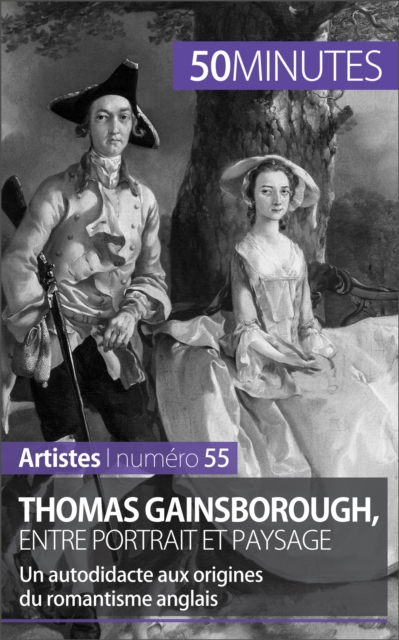
Thomas Gainsborough, entre portrait et paysage
Décryptez l'art de Thomas Gainsborough en moins d'une heure! Autodidacte de génie s'érigeant en opposition à l'art rigoureux de ses compatriotes, Thomas Gainsborough fait la part belle à la spontanéité et aux émotions. Son trait léger, vif et contrasté s'attache à faire ressortir brillamment le caractère de chacun de ses modèles. Mais si Gainsborough est un portraitiste très apprécié, il ne délaisse pas pour autant son genre de prédilection, le paysage. Toute sa carrière, il s'attèle à mêler harmonieusement les deux genres, une approche très originale pour l'époque. Ce livre vous permettra d'en savoir plus sur:
- Le contexte politique et culturel dans lequel Thomas Gainsborough s'inscrit
- La vie de l'artiste et son parcours
- Les caractéristiques et spécificités de son art
- Une sélection d'œuvres-clés de Gainsborough
- Son impact dans l'histoire de l'art Le mot de l'éditeur:
« Dans ce numéro de la série \"50MINUTES | Artistes\", Thomas Jacquemin nous fait découvrir l'art libre et novateur de Thomas Gainsborough. Images à l'appui, il passe en revue et explique toutes les spécificités de la production de l'artiste. Dans ce numéro, nous nous sommes notamment arrêtés sur Mr and Mrs Robert Andrews, sur le célèbre Enfant bleu, plus connu sous le nom de The Blue Boy, ou encore sur La Fille à la cruche. » Stéphanie Felten À PROPOS DE LA SÉRIE 50MINUTES | Artistes
La série « Artistes » de la collection « 50MINUTES » aborde plus de cinquante artistes qui ont profondément marqué l'histoire de l'art, du Moyen Âge à nos jours. Chaque livre a été conçu à la fois pour les passionnés d'art et pour les amateurs curieux d'en savoir davantage en peu de temps. Nos auteurs analysent avec précision les œuvres des plus grands artistes tout en laissant place à toutes les interprétations.
eBook

Paul Sandby Copying Gainsborough: Sharing, Sociability, and Self-fashioning
Remarking on a drawing by Thomas Gainsborough (1729-1788) of Two Women, Seen from Behind in a private collection, art historian Hugh Belsey cited a copy of the drawing by Paul Sandby (bapt. 1731-1809) in the Royal Collection at Windsor Castle, as the strongest evidence of a link between the two artists. A second copy by Sandby after another figure drawing by Gainsborough, a sheet also in the Royal Collection, which reproduces Gainsborough's A Couple in a Park in the Louvre in Paris France, is discussed. In their fashionable subjects, Sandby's copies after Gainsborough also reflect his concerted attempt after his return to London England to reconfigure the direction of his output, reshaping his artistic identity from military draftsman to professional watercolorist.
Journal Article

A portrait of Thomas Gainsborough (1727–1788) at Santa Barbara Museum of Art
Sloman finds a portrait of Thomas Gainsborough (1727-1788) at Santa Barbara Museum of Art. Gainsborough painted a number of self-portraits, but there are not many lifetime portraits of him by other artists. Only very occasionally did he sit for full-sized portraits in oils. An arrangement between Gainsborough and Sir Joshua Reynolds to paint one another came to nothing. There are one or two 'head' size (30 x 25 inches) oils by Gainsborough's nephew and assistant, Gainsborough Dupont (1754-97), and a small oil sketch by Johan Zoffany (1733-1810) (Tate Britain), painted in 1771-72 as a preparatory study for that painter's group portrait of Royal Academicians. The half-length portrait (50 x 40 inches) oil of Gainsborough belonging to the Santa Barbara Museum of Art is in every respect a work of considerable interest. Scholars have generally accepted the Santa Barbara picture as a likeness of Gainsborough but the authorship of the picture has long been open to question.
Journal Article

Cataloguing Thomas Gainsborough
Hugh Belsey’s catalogue of Gainsborough’s portraits and fancy pictures, with a contribution by Jonathan Yarker on the artist’s copies after old masters, is a monumental accomplishment, notably in its comprehensive treatment of the thousand or more portraits that are the core of Gainsborough’s achievement. Thomas Gainsborough: The Portraits, Fancy Pictures and Copies after Old Masters, by Hugh Belsey with a contribution by Jonathan Yarker. 1,112 pp. with 1,300 col. + b. & w. ills. (Paul Mellon Centre for Studies in British Art, London, with Yale University Press, New Haven and London, 2019), £150. ISBN 978–0–300232–09–7.
Journal Article
Gainsborough's Family Album/Early Gainsborough: 'From the Obscurity of a Country Town'
Shawe-Taylor reviews Gainsborough's Family Album at the National Portrait Gallery in London England and Early Gainsborough: 'From the Obscurity of a Country Town' at Gainsborough's House in Sudbury.
Journal Article

Men of Parts: Masculine Embodiment and the Male Leg in Eighteenth-Century England
This essay explores changes in eighteenth-century male clothing in the context of the history of sexual difference, gender roles, and masculinity. The essay contributes to a history of dress by reconstructing a range of meanings and social practices through which men's clothing was understood by its consumers. Furthermore, critically engaging with work on the “great male renunciation,” the essay argues that the public authority that accrued to men through their clothing was based not on a new image of a rational disembodied man but instead on an emphasis on the male anatomy and masculinity as intrinsically embodied. Drawing on findings from the material objects of eighteenth-century clothing, visual representations, and evidence from the archival records of male consumers, the essay adopts an interdisciplinary approach that allows historians to study sex and gender as embodied, rather than simply performed. In so doing, the essay not only treats “embodiment” as an historical category but also responds to recent shifts in the historical discipline and the wider academy towards a more corporealist approach to the body.
Journal Article