
Catalogue Search | MBRL


Are you sure you want to remove the book from the shelf?

{{itemTitle}}
36
result(s) for
"Galician language Syntax."
Sort by:


The Syntax-Information Structure Interface
It is quite remarkable that, after over a half-century of research in generative grammar, there is still uncertainty and debate surrounding the analysis of preverbal subjects in a number of null-subject languages. The implications of this debate are far-reaching for generative theory: if preverbal subjects are analyzed as non-arguments, it calls into question the proposed universality of the EPP (as in e.g. Alexiadou & Anagnostopoulou 1998), as well as its associated features and feature-strengths.
Galician, spoken in the northwest of Spain, is an under-documented Romance language within the generative paradigm. In this book, the author details an experimental program for establishing clausal word order appropriateness and preferences in a variety of information structure contexts, while informing theoretical debate on preverbal subjects. The experimental methodology and information structure assumptions employed create several testable predictions. The statistical data suggest that Galician is a predominantly SVO language and that preverbal subjects behave like canonical subjects, and not CLLD constituents. The empirical data discussed inform the modified model of the preverbal field that the author proposes for Galician, which takes into account a number of recent analyses of Western Iberian Romance clausal phenomena such as the enclisis-proclisis divide, topicalization, focalization, and recomplementation.
eBook
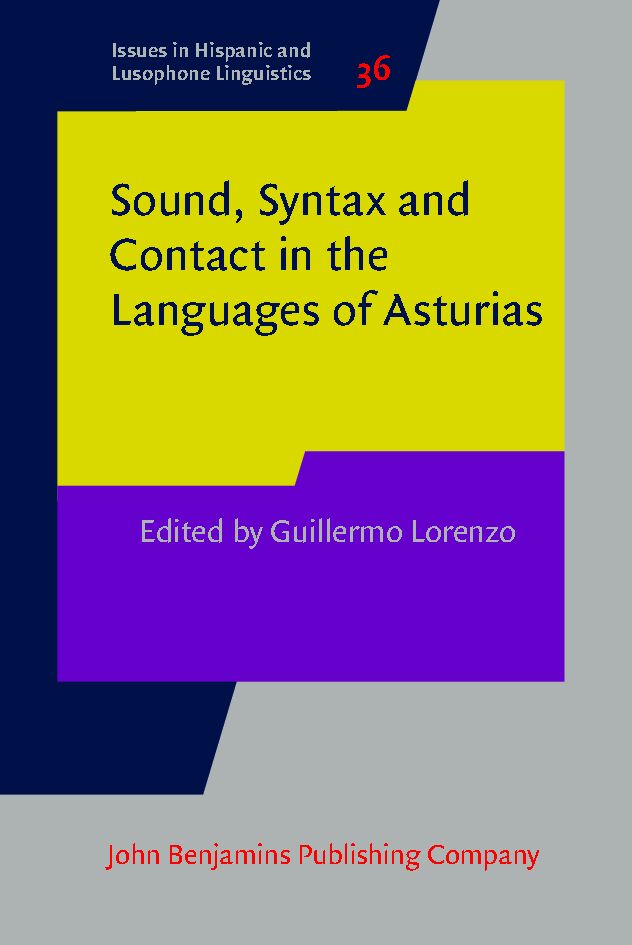
Sound, Syntax and Contact in the Languages of Asturias
This is the first generative-oriented volume ever published about Asturian and Asturian Galician, two Romance languages which, along with their intrinsic interest, are crucial to understand the parametric distance between Spanish and Galician/Portuguese.
eBook

The middle voice and connected constructions in Ibero-Romance : a variationist and dialectal account
An investigation of the reflexive marker in so-called \"middle constructions\", using corpus data and providing a contrastive and variationist analysis on the basis of the different behavior of these markers in two closely-related languages, Spanish and Galician, and their dialects.
eBook

Training and evaluation of vector models for Galician
This paper presents a large and systematic assessment of distributional models for Galician. To this end, we have first trained and evaluated static word embeddings (e.g., word2vec, GloVe), and then compared their performance with that of current contextualised representations generated by neural language models. First, we have compiled and processed a large corpus for Galician, and created four datasets for word analogies and concept categorisation based on standard resources for other languages. Using the aforementioned corpus, we have trained 760 static vector space models which vary in their input representations (e.g., adjacency-based versus dependency-based approaches), learning algorithms, size of the surrounding contexts, and in the number of vector dimensions. These models have been evaluated both intrinsically, using the newly created datasets, and on extrinsic tasks, namely on POS-tagging, dependency parsing, and named entity recognition. The results provide new insights into the performance of different vector models in Galician, and about the impact of several training parameters on each task. In general, fastText embeddings are the static representations with the best performance in the intrinsic evaluations and in named entity recognition, while syntax-based embeddings achieve the highest results in POS-tagging and dependency parsing, indicating that there is no significant correlation between the performance in the intrinsic and extrinsic tasks. Finally, we have compared the performance of static vector representations with that of BERT-based word embeddings, whose fine-tuning obtains the best performance on named entity recognition. This comparison provides a comprehensive state-of-the-art of current models in Galician, and releases new transformer-based models for NER. All the resources used in this research are freely available to the community, and the best models have been incorporated into SemantiGal, an online tool to explore vector representations for Galician.
Journal Article

Teaching L2 Galician through the traditional songbooks: The case of the direct object +human with the preposition a
Explaining the grammatical structures that characterize the Galician language system to university students of L2 Galician involves certain difficulties, both in terms of contact with Spanish and due to its nature as an L2 language. It must be noted that such learners’ L1 is mostly Spanish, French, English or Italian. We propose in this paper an activity in which students engage in a process of practical reflection on real examples of the language. The activity will focus in par-ticular on the absence of the preposition a with the direct object (DO), i.e., Nós saudamos o teu amigo (“We greet your friend”), using for this purpose a corpus of traditional Galician popular songs, and following the recommendations of the Content and Language Integrated Learning (CLIL) model. Within this theoretical and practical approach students will also acquire knowledge of Galician culture and history, through information found in the anonymous poetry of the songbook itself.
Journal Article

Variable Acceptability of Differential Object Marking in Bilingual Galician–Spanish Speakers: An Exploratory Study
This paper presents an initial study of the acceptability of differential object marking (DOM) by Galician–Spanish bilinguals in Galicia. The research explores judgments provided by these bilinguals (n = 69) on DOM in both Galician and Spanish and it also explores data from a monolingual Spanish control group (n = 12). The surveys target contexts covering key syntactic and semantic–pragmatic contexts for DOM in Galician and Spanish, based on the existing literature. The Galician data reveal a tendency towards reduced acceptability of DOM compared to Spanish, but without a generalized rejection of DOM in any of the contexts. The Spanish data show variability in both groups. The study contributes insights from an under-studied language pair and aims to open avenues for further work. More generally, it enhances our understanding of DOM in bilingual grammars, particularly in microcontact situations.
Journal Article
Galician Perfective Periphrases among Complex Predicates: Degrees of Grammaticalization and the Possibility of a Perfect Tense
The so-called perífrasis perfectivas in Galician present the action as concluded or realized. This particular aspectual feature constitutes the common ground for an otherwise heterogeneous set of constructions, ranging from rematar de ‘finish’+ infinitive (e.g., rematóu de beber ‘(s/he) finished drinking’) to ter ‘have’ + participle (e.g., teñen ido ‘(they) have gone (Rep.)’). This work provides a critical assessment of their syntactic and semantic properties in cases where the participle may not show agreement. This is the case for periphrases built on three auxiliaries: ter, levar, and dar, of which ter + participle stands out as the most grammaticalized one. The case of ter is further investigated in relation to European Portuguese (EP) and Brazilian Portuguese (BP), where ter + participle is considered a fully-fledged perfect tense. Additionally, the use of these periphrases in areas where Spanish is also present is evaluated from a contact perspective.
Journal Article

Bertinho: Galician BERT Representations
This paper presents a monolingual BERT model for Galician. We follow the recent trend that shows that it is feasible to build robust monolingual BERT models even for relatively low-resource languages, while performing better than the well-known official multilingual BERT (mBERT). More particularly, we release two monolingual Galician BERT models, built using 6 and 12 transformer layers, respectively; trained with limited resources (~45 million tokens on a single GPU of 24GB). We then provide an exhaustive evaluation on a number of tasks such as POS-tagging, dependency parsing and named entity recognition. For this purpose, all these tasks are cast in a pure sequence labeling setup in order to run BERT without the need to include any additional layers on top of it (we only use an output classification layer to map the contextualized representations into the predicted label). The experiments show that our models, especially the 12-layer one, outperform the results of mBERT in most tasks.
Journal Article
A computational psycholinguistic evaluation of the syntactic abilities of Galician BERT models at the interface of dependency resolution and training time
This paper explores the ability of Transformer models to capture subject-verb and noun-adjective agreement dependencies in Galician. We conduct a series of word prediction experiments in which we manipulate dependency length together with the presence of an attractor noun that acts as a lure. First, we evaluate the overall performance of the existing monolingual and multilingual models for Galician. Secondly, to observe the effects of the training process, we compare the different degrees of achievement of two monolingual BERT models at different training points. We also release their checkpoints and propose an alternative evaluation metric. Our results confirm previous findings by similar works that use the agreement prediction task and provide interesting insights into the number of training steps required by a Transformer model to solve long-distance dependencies.
Journal Article