
Catalogue Search | MBRL


Are you sure you want to remove the book from the shelf?

{{itemTitle}}
5,112
result(s) for
"Gambling systems."
Sort by:


A New Reliability Coefficient Using Betting Commitment Evidence Distance in Dempster–Shafer Evidence Theory for Uncertain Information Fusion
Dempster–Shafer evidence theory is widely used to deal with uncertain information by evidence modeling and evidence reasoning. However, if there is a high contradiction between different pieces of evidence, the Dempster combination rule may give a fusion result that violates the intuitive result. Many methods have been proposed to solve conflict evidence fusion, and it is still an open issue. This paper proposes a new reliability coefficient using betting commitment evidence distance in Dempster–Shafer evidence theory for conflict and uncertain information fusion. The single belief function for belief assignment in the initial frame of discernment is defined. After evidence preprocessing with the proposed reliability coefficient and single belief function, the evidence fusion result can be calculated with the Dempster combination rule. To evaluate the effectiveness of the proposed uncertainty measure, a new method of uncertain information fusion based on the new evidence reliability coefficient is proposed. The experimental results on UCI machine learning data sets show the availability and effectiveness of the new reliability coefficient for uncertain information processing.
Journal Article

The geographic distribution of gaming machine proceeds in New Zealand
Within NZ gambling and its associated harms are well-researched topics. However, most studies to date have relied upon the use of survey methodology or have focused on individual regions. In this paper we distribute gaming machine proceeds (GMP) from gaming venues to the surrounding localities in order to derive estimates of GMP per capita. It is hoped these estimates will enable the trusts who operate the electronic gaming machines (EGMs), and who are responsible for reinvesting a proportion of proceeds back into the community, to more accurately target funding towards the areas most affected by the harms of EGM gambling. Our estimates of GMP per capita also provide a means of assessing the criterion validity of the recently developed Dynamic Deprivation Index. Furthermore, although it is well known that Māori and Pacific Island populations have a higher incidence of problem gambling, our results imply that when controlling for socio-economic deprivation and the geographic location of EGMs the associations between ethnicity and GMP per capita are weak. From a policy perspective, this suggests the most effective way of limiting the harms of EGM gambling on these populations is to place tighter controls on the number of venues within their communities.
Journal Article

Gambling in Victoria: Changes in Participation, Problem Gambling and Gambling Environment Between 2008 and 2018
Gambling and its impacts are an important public health issue. The relationship between gambling, problem gambling and gambling harm is complex and dynamic. Replicate prevalence studies are useful for surveillance and monitoring gambling impacts within jurisdictions. The purpose of this study was to compare changes in gambling and problem gambling in the Victorian adult population between 2008 and 2018 by investigating individual gambling activities and exploring their relationship with the Victorian gambling ecosystem. Gambling participation has decreased; problem gambling prevalence has not. Investigation beyond these summary measures reveals important details: (a) Electronic Gaming Machines (EGMs), casino table games, race and sports betting (‘high-risk activities’), informal private betting, and Keno, and their associations with problem gambling endure. Further, the strength of this association is unaffected by changes in product technology, delivery, or the Victorian environment in which they reside, (b) participation in high-risk activities, excluding EGMs, increased while for other activities they decreased, (c) EGMs continue to pose the greatest risk for Victorians, (d) males and young adults continue having a higher problem gambling prevalence rate and preferring both online gambling and high-risk activities (excluding racing favoured by an ageing, older cohort, and Keno, by all ages), and (e) gambling access and exposure proliferated enabling single site multiple gambling opportunities on high-risk activities. Young adults represented a new vulnerable group as they reach the legal gambling age. The most effective interventions (based on major falls in real expenditure (losses) on EGMs, the highest risk activity) were the smoking bans, removal of ATMs from venues and decreases in bet size. There is great potential for prevention, intervention, and minimising harm in the gambling environment.
Journal Article
Calculated bets: computers, gambling, and mathematical modeling to win
This is a book about a gambling system that works. It tells the story of how the author used computer simulations and mathematical modeling techniques to predict the outcome of jai-alai matches and bet on them successfully - increasing his initial stake by over 500% in one year! His results can work for anyone: at the end of the book he tells the best way to watch jai-alai, and how to bet on it. With humour and enthusiasm, Skiena details a life-long fascination with computer predictions and sporting events. Along the way, he discusses other gambling systems, both successful and unsuccessful, for such games as lotto, roulette, blackjack, and the stock market. Indeed, he shows how his jai-alai system functions just like a miniature stock trading system. Do you want to learn about program trading systems, the future of Internet gambling, and the real reason brokerage houses don't offer mutual funds that invest at racetracks and frontons? How mathematical models are used in political polling? The difference between correlation and causation? If you are curious about gambling and mathematics, odds are this book is for you!
eBook


Gambling, Exchange Systems, and Moralities
History and ethnography show us that, across societies of the past and present, gambling varies considerably with respect to its organization, social meanings, and how it is regarded in moral terms. This paper presents a basic scheme for analyzing the relationship between gambling and society. A theoretical starting point is that reciprocity is fundamental to social and economic systems. An anthropological theory of exchange systems makes a broad distinction between a structural dimension (generalized versus balanced reciprocity) and a normative dimension (from voluntary to involuntary). A model of four basic forms of reciprocity, each having a characteristic exchange mode and morality, can thus be constructed. Gambling is here understood as an exchange system embedded in the reciprocal orders of society and having a necessary relationship to these; it can take on the characteristics of such an order or it can be regarded as conflicting with it. Much of the variation in the form and morality of gambling therefore emerges as systematic and explainable by a theory of forms of reciprocal exchange.
Journal Article

Bettor Biases and the Home-Underdog Bias in the NFL
Betting strategies based on the presence of home-underdog bias in the NFL have been shown to produce returns in excess of those predicted by market efficiency in some situations. Dare and Dennis (2011) attribute this bias to bettors underestimating the scoring ability of home underdogs. Using a more recent sample of data, we find contradictory results. We challenge the assumptions of the Dare and Dennis (2011) model and use detailed betting data to offer an alternative rationale for the homeunderdog bias. We illustrate that bettors have clear and predictable tendencies for betting on the best teams, and sports books do not appear to be operating as suggested by the balanced-book hypothesis.
Journal Article
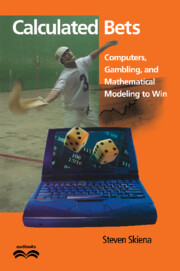
Calculated Bets
This is a book about a gambling system that works. It tells the story of how the author used computer simulations and mathematical modeling techniques to predict the outcome of jai-alai matches and bet on them successfully - increasing his initial stake by over 500% in one year! His results can work for anyone: at the end of the book he tells the best way to watch jai-alai, and how to bet on it. With humour and enthusiasm, Skiena details a life-long fascination with computer predictions and sporting events. Along the way, he discusses other gambling systems, both successful and unsuccessful, for such games as lotto, roulette, blackjack, and the stock market. Indeed, he shows how his jai-alai system functions just like a miniature stock trading system. Do you want to learn about program trading systems, the future of Internet gambling, and the real reason brokerage houses don't offer mutual funds that invest at racetracks and frontons? How mathematical models are used in political polling? The difference between correlation and causation? If you are curious about gambling and mathematics, odds are this book is for you!
eBook