
Catalogue Search | MBRL


Are you sure you want to remove the book from the shelf?

{{itemTitle}}
185
result(s) for
"Gangsta rap"
Sort by:

The history of gangster rap : from Schoolly D to Kendrick Lamar : the rise of a great American art form
The History of Gangster Rap is a deep dive into one of the most fascinating subgenres of any music category to date. Sixteen detailed chapters, organized chronologically, examine the evolution of gangster rap, its main players, and the culture that created this revolutionary music. From still-swirling conspiracy theories about the murders of Biggie and Tupac to the release of the 2015 film Straight Outta Compton, the era of gangster rap is one that fascinates music junkies and remains at the forefront of pop culture. Filled with interviews with key players such as Snoop Dogg, Ice-T, and dozens more, as well as sidebars, breakout bios of notorious characters, lists, charts, and more, The History of Gangster Rap is the be-all-end-all book that contextualizes the importance of gangster rap as a cultural phenomenon.-- Amazon.
Book

The Mark of Criminality
Illustrates the ways that the “war on crime”
became conjoined—aesthetically, politically, and
rhetorically—with the emergence of gangsta rap as a
lucrative and deeply controversial subgenre of
hip-hop In
The Mark of Criminality: Rhetoric, Race, and Gangsta Rap in
the War-on-Crime Era , Bryan J. McCann argues that gangsta
rap should be viewed as more than a damaging reinforcement of an
era’s worst racial stereotypes. Rather, he positions the
works of key gangsta rap artists, as well as the controversies
their work produced, squarely within the law-and-order politics
and popular culture of the 1980s and 1990s to reveal a profoundly
complex period in American history when the meanings of crime and
criminality were incredibly unstable. At the center of this
era—when politicians sought to prove their
“tough-on-crime” credentials—was the mark of
criminality, a set of discourses that labeled members of
predominantly poor, urban, and minority communities as threats to
the social order. Through their use of the mark of criminality,
public figures implemented extremely harsh penal polices that
have helped make the United States the world’s leading
jailer of its adult population. At the same time when politicians
like Ronald Reagan, George H. W. Bush, and Bill Clinton and
television shows such as
COPS and
America’s Most Wanted perpetuated images of gang
and drug-filled ghettos, gangsta rap burst out of the hip-hop
nation, emanating mainly from the predominantly black
neighborhoods of South Central Los Angeles. Groups like NWA and
solo artists (including Dr. Dre, Snoop Dogg, and Tupac Shakur)
became millionaires by marketing the very discourses political
and cultural leaders used to justify their war on crime. For
these artists, the mark of criminality was a source of power,
credibility, and revenue. By understanding gangsta rap as a
potent, if deeply imperfect, enactment of the mark of
criminality, we can better understand how crime is always a site
of struggle over meaning. Furthermore, by underscoring the nimble
rhetorical character of criminality, we can learn lessons that
may inform efforts to challenge our nation’s failed
policies of mass incarceration.
eBook


Chicago Hustle and Flow
On September 4, 2012, Joseph Coleman, an eighteen-year-old aspiring gangsta rapper, was gunned down in the Englewood neighborhood of Chicago. Police immediately began investigating the connections between Coleman's murder and an online war of words and music he was having with another Chicago rapper in a rival gang. InChicago Hustle and Flow, Geoff Harkness points out how common this type of incident can be when rap groups form as extensions of gangs. Gangs and rap music, he argues, can be a deadly combination.
Set in one of the largest underground music scenes in the nation, this book takes readers into the heart of gangsta rap culture in Chicago. From the electric buzz of nightclubs to the sights and sounds of bedroom recording studios, Harkness presents gripping accounts of the lives, beliefs, and ambitions of the gang members and rappers with whom he spent six years. A music genre obsessed with authenticity, gangsta rap promised those from crime-infested neighborhoods a ticket out of poverty. But while firsthand experiences with gangs and crime gave rappers a leg up, it also meant carrying weapons and traveling collectively for protection.
Street gangs serve as a fan base and provide protection to rappers who bring in income and help to recruit for the gang. In examining this symbiotic relationship,Chicago Hustle and Flowultimately illustrates how class stratification creates and maintains inequalities, even at the level of a local rap-music scene.
eBook


Nuthin' but a \G\ thang : the culture and commerce of gangsta rap
In the late 1980s, gangsta rap music emerged in urban America, giving voice to—and making money for—a social group widely considered to be in crisis: young, poor, black men. From its local origins, gangsta rap went on to flood the mainstream, generating enormous popularity and profits. Yet the highly charged lyrics, public battles, and hard, fast lifestyles that characterize the genre have incited the anger of many public figures and proponents of \"family values.\" Constantly engaging questions of black identity and race relations, poverty and wealth, gangsta rap represents one of the most profound influences on pop culture in the last thirty years. Focusing on the artists Ice Cube, Dr. Dre, the Geto Boys, Snoop Dogg, and Tupac Shakur, Quinn explores the origins, development, and immense appeal of gangsta rap. Including detailed readings in urban geography, neoconservative politics, subcultural formations, black cultural debates, and music industry conditions, this book explains how and why this music genre emerged. In Nuthin' but a \"G\" Thang, Quinn argues that gangsta rap both reflected and reinforced the decline in black protest culture and the great rise in individualist and entrepreneurial thinking that took place in the U.S. after the 1970s. Uncovering gangsta rap’s deep roots in black working-class expressive culture, she stresses the music’s aesthetic pleasures and complexities that have often been ignored in critical accounts.
eBook

24 Bars to Kill
The most clearly identifiable and popular form of Japanese
hip-hop, \"ghetto\" or \"gangsta\" music has much in common with its
corresponding American subgenres, including its portrayal of life
on the margins, confrontational style, and aspirational
\"rags-to-riches\" narratives. Contrary to depictions of an
ethnically and economically homogeneous Japan, gangsta J-hop gives
voice to the suffering, deprivation, and social exclusion
experienced by many modern Japanese. 24 Bars to Kill
offers a fascinating ethnographic account of this music as well as
the subculture around it, showing how gangsta hip-hop arises from
widespread dissatisfaction and malaise.
eBook
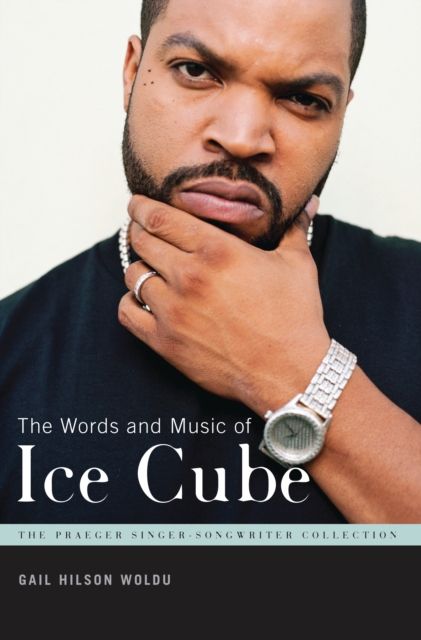
The Words and Music of Ice Cube
Ice Cube is one of the most influential figures in the history of rap and hip-hop. Best known for the vitriol of his angry black man recordings of the late 1980s and mid 1990s, Ice Cube epitomizes the genre often referred to as gangsta rap. Much of his music from these years is focused on the disturbing realities of life in black urban ghettos, and as a result it chronicles such complex and controversial issues as racial stereotypes, street gangs, racial profiling, black on black crime, teen pregnancy, absentee fathers, and male-female relationships. His recordings with NWA are noteworthy for their sardonic humor in discussing dire issues. The group's landmark CD Straight Outta Compton (1988) is a palette of urban woes recounted in aggressive and hostile street vernacular, while Ice Cube's recordings of the 1990s now represent paradigms of the gangsta style. The first three chapters of The Words and Music of Ice Cube explore Ice Cube's recordings between 1988 and 1996 and situate Ice Cube in the context of other rappers of this period-most notably Public Enemy, Ice-T, Tupac, Biggie, and Snoop Dogg-whose music also chronicled explosive issues in urban ghettos. The fourth chapter considers Ice Cube's career in film, beginning with a discussion of his performance in Boyz n the Hood and ending with a look at his most recent films, Barber Shop, Barber Shop II, Are We There Yet? And Are We Done Yet? The fifth and final chapter looks back over all of Ice Cube's work to date and considers his impact and his legacy in music and popular culture at large..
eBook

Crime as Pop: Gangsta Rap as Popular Staging of Norm Violations
Crime is quantified extensively, mostly in order to prevent it, therefore assuming it as something purely negative. With the concept “Crime as Pop” we argue that such a view is one-sided, since crime is often staged as something that can be attractive and that can be used constructively for different purposes. We investigate this perspective by studying gangsta rap, which we consider a pop-cultural phenomenon that young people relate to in the context of interactive practices of identity construction. The stories told in gangsta rap are used by the youth recipients in a situation- and location-specific manner to present themselves in a certain way. Young people reproduce motifs of success that often characterize gangsta rap. They portray themselves as agentive and stage forms of resistance against people and institutions to which they might otherwise appear passive and powerless. Young people’s engagement with gangsta rap thus shows how the pop-cultural phenomena can be appropriated in many different ways. “Crime as Pop” illustrates the contingent connections of cultural phenomena and their appropriation that require detailed empirical reconstruction.
Journal Article

Gangstas, Thugs, and Hustlas: Identity and the Code of the Street in Rap Music
Recent research on identity, culture, and violence in inner-city communities describes a black youth culture, or street code, that influences adolescent behavior, particularly violent behavior. I build upon such literature through analysis of gangsta rap music, exploring how the street code is present not only in “the street,” but also in rap music. I first consider how structural conditions in inner-city communities have given rise to cultural adaptations embodied in a street code. These adaptations help to create an interpretive environment where violence is accountable, if not normative. I then examine the complex, reflexive relationship between the street code, rap music, and social identity. These issues are examined through content analysis of 403 songs on rap albums from 1992 to 2000. Portrayals of violence in the lyrics serve many functions including establishing social identity and reputation and exerting social control: these are the central topics of the analysis.
Journal Article