
Catalogue Search | MBRL


Are you sure you want to remove the book from the shelf?

{{itemTitle}}
2,790
result(s) for
"Gardens in literature"
Sort by:

Chinese garden pleasures : an appreciation
Celebrating the pleasures of garden living enjoyed by the elite of late imperial China, this book brings together poetry, prose, paintings and prints from imperial China to show the many facets of life and leisure in the Chinese garden.
Book

Literature and the Renaissance Garden from Elizabeth I to Charles II
Spanning the period from Elizabeth I's reign to Charles II's restoration, this study argues the garden is a primary site evincing a progressive narrative of change, a narrative that looks to the Edenic as obtainable ideal in court politics, economic prosperity and national identity in early modern England. The book offers an original take on gardens by including medical and colonial discourse and by considering the perspective of ecocriticism.
eBook


Colonizing Nature
With its control of sugar plantations in the Caribbean and tea, cotton, and indigo production in India, Britain in the eighteenth and nineteenth centuries dominated the global economy of tropical agriculture. InColonizing Nature, Beth Fowkes Tobin shows how dominion over \"the tropics\" as both a region and an idea became central to the way in which Britons imagined their role in the world.
Tobin examines georgic poetry, landscape portraiture, natural history writing, and botanical prints produced by Britons in the Caribbean, the South Pacific, and India to uncover how each played a crucial role in developing the belief that the tropics were simultaneously paradisiacal and in need of British intervention and management. Her study examines how slave garden portraits denied the horticultural expertise of the slaves, how the East India Company hired such artists as William Hodges to paint and thereby Anglicize the landscape and gardens of British-controlled India, and how writers from Captain James Cook to Sir James E. Smith depicted tropical lands and plants.
Just as mastery of tropical nature, and especially its potential for agricultural productivity, became key concepts in the formation of British imperial identity,Colonizing Naturesuggests that intellectual and visual mastery of the tropics-through the creation of art and literature-accompanied material appropriations of land, labor, and natural resources. Tobin convincingly argues that the depictions of tropical plants, gardens, and landscapes that circulated in the British imagination provide a key to understanding the forces that shaped the British Empire.
eBook

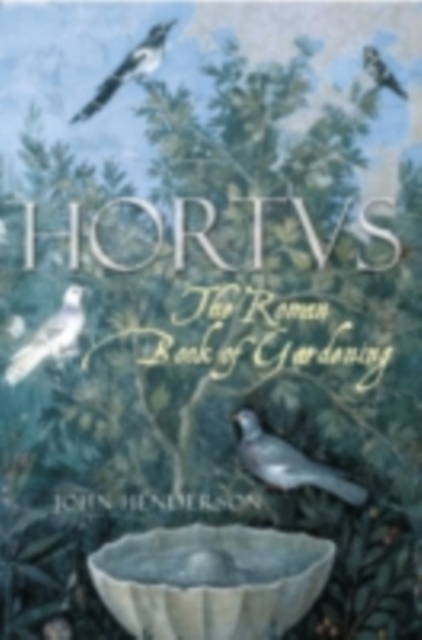
Roman book of gardening
The first book to look at this particular subject, The Roman Book of Gardening brings together an extraordinarily varied selection of texts on Roman horticulture, celebrating herb and vegetable gardening in verse and prose spanning five centuries.
In vivid new translations by John Henderson, Virgil's Georgics stand alongside neglected works by Columella, Pliny and Palladius, bringing to life the techniques and obstacles, delights and exasperations of the Roman gardener. We also hear of the digging, hoeing, planting and weeding which then, as now, went into creating the perfect garden.
This is a timely and valuable contribution to our understanding of gardening history, Roman culture and Latin literature.
eBook

Follow this thread : a maze book to get lost in
\"Are you ready to step inside? Labyrinths are as old as humanity, the proving grounds of heroes, the paths of pilgrims, symbols of spiritual rebirth, and pleasure gardens for pure entertainment. In Follow this thread, Henry Eliot leads us on a twisting journey through the world of mazes, real and imagined, drawing upon mythology, history, philosophy, psychology, pop culture, and more along the way. From Kafka to Kubrick, from the myth of the Minotaur to the quest to find the legendary Maze King, this ingenious book unravels our ancient, abiding relationship with mazes and labyrinths and explores why they continue to fascinate us today\"--Page [4] of cover.
Book

Converging the artificial and the natural: Katherine mansfield's actual and imagined botanical gardens
Gardens, whether as locations of interest or literary tropes, featured prominently in the life and works of Katherine Mansfield. The Botanical Gardens off Tinakori Road was one of Mansfield's favourite spots in Wellington. An early black-and-white photo of the gardens shows a geometrical landscape design with regular walking paths cutting through patches of grass decorated with local cabbage trees.1 The mechanical design did not escape Mansfield's attention as she remarked on the traditional 'carpet bedding' near the gardens' entrance. Artificial regularity did have its appeal to Mansfield, for she compared a green hedge to 'a stave', and the ' long row of cabbage trees […] now high, now low' to 'an arrangement of notes - a curious, pattering, native melody' ('Fiction' 1, 84). Yet as soon as her gaze moved beyond the borders of choreographed beauty, the bush captivated her. The young writer felt that she was transformed into someone ancient yet powerful; she was also instantly transported to 'the Lotus Land' where all previous memory of beauty and order was erased (1, 85). While other visitors admired the carpet bedding with an at times almost religious awe, Mansfield savoured the bush in the shadows of her mind (1, 84). The gardens became where domesticated nature and the wilderness competed and converged. To Mansfield, the Wellington botanical gardens were 'such a subtle combination of the artificial and the natural - that is, partly, the secret of their charm' (1, 84). Bearing in mind Mansfield’s description of this ‘combination’, I wish to discuss her gardens in the sense of both the places she visited - the Wellington and London botanical gardens - as well as the imagined, or rather, re-imagined gardens in some of her stories, reviews, and letters. By doing so, I will explore the delicate balance between 'the artificial and the natural', the tame and the wild, and how these two opposing forces or elements contend, negotiate and settle in the creative space of her writing.
Journal Article

The quest for Shakespeare's garden
This book traces the origins of garden history and the Elizabethan garden, as well as telling the story of the Bard's own garden in Stratford-upon-Avon. Beautifully presented, the text is accompanied by quotations from Shakespeare's works and lush illustrations of his gardens, past and present, plucked from a multitude of sources including embroidered Elizabethan clothing and Victorian gardening books, as well as various gardens around the world. Roy Strong's detailed account is inspired by Shakespeare s works and supplemented by Francis Bacon's 1625 essay 'Of Gardens' which provides Elizabethan-era advice to garden enthusiasts on such topics as topiary, seasonal gardens, scents, aviaries, and more.
Book

The Formal and the Foreign
Kaye Wierzbicki, “The Formal and the Foreign: Sarah Orne Jewett’s Garden Fences and the Meaning of Enclosure” (pp. 56-91)
This essay argues that Sarah Orne Jewett theorizes garden design—particularly the question of whether or not a garden should be fenced—in order to theorize the aesthetic and social implications of her local color genre. Specifically, Jewett’s polemical defense of the garden fence is central to her ability to incorporate foreignness into her fictional landscapes. By placing Jewett’s garden-centric writing into the context of American garden history, this essay counters the prevailing notion that garden fences are transhistorical symbols of rigid protectionism and cultural exclusivity. Instead, Jewett’s garden fences should also be read as theoretically loaded and historically specific sites in the late-nineteenth-century debate between the fence-dismantling garden naturalists and the Colonial Revivalists who sought to preserve or re-erect these fences. As Jewett’s participation in this debate reveals, a garden fence can become a mechanism for defining “the local” as a formal practice that embraces foreignness, in contrast to competing definitions of “the local” that privilege native plants and native persons. Ultimately, Jewett uncovers new theoretical possibilities in the fenced, formal, Colonial Revivalist garden in order to make a case for the cultural expansiveness permitted by local color writing.
Journal Article