
Catalogue Search | MBRL


Are you sure you want to remove the book from the shelf?

{{itemTitle}}
22
result(s) for
"Gartenkunst."
Sort by:

Kyoto gardens : masterworks of the Japanese gardener's art
Kyoto Gardens is a labor of love from master photographer Ben Simmons and Kyoto-based writer Judith Clancy. Simmons' photographs present a fresh and contemporary look at Kyoto's most important gardens. Their beauty is enhanced and humanized by gardeners tending the grounds using the tools of their art. Clancy's graceful text provides historic, aesthetic and cultural context to the gardens. Combining wonder and rigor, she describes how Kyoto's most beloved gardens remain faithful to their founders' creative spirit and conception. Journey to Kyoto's thirty gardens with just a turn of a page, or use the handy maps to plan your trip. -- Source other than Library of Congress.
Book

Follies in America
Follies in America examines
historicized garden buildings, known as \"follies,\" from the
nation's founding through the American centennial celebration in
1876. In a period of increasing nationalism, follies-such
as temples, summerhouses, towers, and ruins-brought a range of
European architectural styles to the United States. By imprinting
the land with symbols of European culture, landscape gardeners
brought their idea of civilization to the American wilderness.
Kerry Dean Carso's interdisciplinary approach in Follies in
America examines both buildings and their counterparts in
literature and art, demonstrating that follies provide a window
into major themes in nineteenth-century American culture, including
tensions between Jeffersonian agrarianism and urban life, the
ascendancy of middle-class tourism, and gentility and social class
aspirations.
eBook

The South Carolina State House Grounds
The South Carolina State House grounds are a work in progress-a
cultural landscape of human-built and natural components connected
physically, conceptually, and aesthetically. As public property,
the grounds should represent and welcome everyone in the state.
While it is a beautiful space, it is not neutral. Over the past two
centuries, various groups have jostled for political and cultural
power, and the winners have used the grounds to assert their
authority and broadcast political positions on the state's most
visible stage. These struggles have resulted in a perpetually
evolving space.
In The South Carolina State House Grounds, the first
comprehensive narrative of this important site at the heart of the
Palmetto State, Lydia Mattice Brandt details the history of the
state capitol and its setting-including the national, state, and
local histories enshrined in its monuments-from 1787 to the
present. Brandt argues that generations of private citizens and
elected officials, who recognized the power of erecting public
monuments and buildings that recall certain versions of history,
have consciously shaped this highly charged, visible, and public
place to assert authority over both the past and present. By
recounting the intentions behind each element in the landscape,
this guidebook considers how South Carolinians have used this place
as a site of storytelling and mythmaking.
The South Carolina State House Grounds, a chronological history
of the state's grandest public space, includes more than sixty
illustrations that track the site's transformation over more than
two centuries. Brandt chronicles the events that occurred in and
around its buildings, the stories of the people memorialized in the
grounds' monuments, and the histories of the monuments
themselves.
eBook

Gardens of Renaissance Europe and the Islamic empires : encounters and confluences
The cross-cultural exchange of ideas that flourished in the Mediterranean during the sixteenth and seventeenth centuries profoundly affected European and Islamic society. Gardens of Renaissance Europe and the Islamic Empires considers the role and place of gardens and landscapes in the broader context of the information sharing that took place among Europeans and Islamic empires in Turkey, Persia, and India. In illustrating commonalities in the design, development, and people's perceptions of gardens and nature in both regions, this volume substantiates important parallels in the revolutionary advancements in landscape architecture that took place during the era. The contributors explain how the exchange of gardeners as well as horticultural and irrigation techniques influenced design traditions in the two cultures; examine concurrent shifts in garden and urban landscape design, such as the move toward more public functionality; and explore the mutually influential effects of politics, economics, and culture on composed outdoor space. In doing so, they shed light on the complexity of cultures and politics during the Renaissance. A thoughtfully composed look at the effects of cross-cultural exchange on garden design during a pivotal time in world history, this thought-provoking book points to new areas in inquiry about the influences, confluences, and connections between European and Islamic garden traditions. In addition to the editor, the contributors include Cristina Castel-Branco, Paula Henderson, Simone M. Kaiser, Ebba Koch, Christopher Pastore, Laurent Paya, D. Fairchild Ruggles, Jill Sinclair, and Anatole Tchikine.
eBook

Literature and the Renaissance Garden from Elizabeth I to Charles II
Spanning the period from Elizabeth I's reign to Charles II's restoration, this study argues the garden is a primary site evincing a progressive narrative of change, a narrative that looks to the Edenic as obtainable ideal in court politics, economic prosperity and national identity in early modern England. The book offers an original take on gardens by including medical and colonial discourse and by considering the perspective of ecocriticism.
eBook

Islamic Gardens and Landscapes
\"In the course of my research,\" writes D. Fairchild Ruggles, \"I devoured Arabic agricultural manuals from the tenth through the fourteenth centuries. I love gardening, and in these texts I was able to enter the minds of agriculturalists and botanists of a thousand years ago who likewise believed it was important and interesting to record all the known ways of propagating olive trees, the various uses of rosemary, and how best to fertilize a garden bed.\" Western admirers have long seen the Islamic garden as an earthly reflection of the paradise said to await the faithful. However, such simplification, Ruggles contends, denies the sophistication and diversity of the art form.Islamic Gardens and Landscapesimmerses the reader in the world of the architects of the great gardens of the Islamic world, from medieval Morocco to contemporary India. Just as Islamic culture is historically dense, sophisticated, and complex, so too is the history of its built landscapes. Islamic gardens began from the practical need to organize the surrounding space of human civilization, tame nature, enhance the earth's yield, and create a legible map on which to distribute natural resources. Ruggles follows the evolution of these early farming efforts to their aristocratic apex in famous formal gardens of the Alhambra in Spain and the Taj Mahal in Agra. Whether in a humble city home or a royal courtyard, the garden has several defining characteristics, which Ruggles discusses. Most notable is an enclosed space divided into four equal parts surrounding a central design element. The traditional Islamic garden is inwardly focused, usually surrounded by buildings or in the form of a courtyard. Water provides a counterpoint to the portioned green sections. Ranging across poetry, court documents, agronomy manuals, and early garden representations, and richly illustrated with pictures and site plans,Islamic Gardens and Landscapesis a book of impressive scope sure to interest scholars and enthusiasts alike.
eBook

The making of place
Gardening is rich in tradition, and many gardens are explicitly designed to refer to or honour the past. But garden design is also rich in innovation, and in The Making of Place John Dixon Hunt explores the wide varieties of approaches, aesthetics and achievements in garden design throughout the world today. From imposing sculptures discovered in woodlands or on hilly trails to community gardens, and along disused rail tracks to ones made on inhospitable seashores, this book offers insights into the history and makeup of contemporary gardens, whether they reflect the priorities of modern society, bring new ideas and materials into the world, or seek the reinvention of ancient cultures. The modern botanical gardens, sculpture parks, campuses, memorial gardens and vernacular gardens examined showcase the differences between cultures and countries around the world, including the United Kingdom, France, Germany, the United States, China and Australia. The Making of Place offers an accessible tour of modern garden landscapes that gives non-designers as well as specialists a new view of the created outdoor world around them. Richly illustrated, it is sure to enchant and inspire even the most modest of home gardeners.
eBook
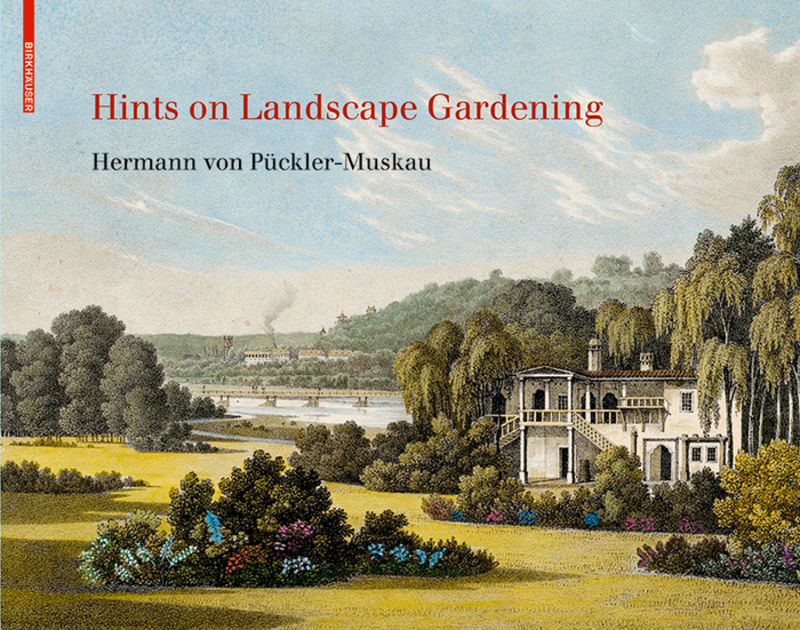
Hints on Landscape Gardening
Park Muskau, Prince Pückler's extraordinary nineteenth-century creation on both sides of the River Neisse, together with Hints on Landscape Gardening (Andeutungen über Landschaftsgärtnerei), his instructive 1834 treatise based on the park's design, are as important to American landscape architects as the work and writings of Frederick Law Olmsted.
eBook

Zen landscapes
The essential elements of the dry Japanese garden are few: rocks, gravel, moss. Simultaneously a sensual matrix, a symbolic form and a mythic domain, these gardens exhibit precise craftsmanship and exquisite miniaturization. However, their apparent minimalism belies a profound complexity, which must be approached according to the play of scale, surroundings and seasons, and especially in relation to the other arts, thus allowing us to experience them as living landscapes rather than as merely abstracted design. These gardens partake of the Zen aesthetics of the tea ceremony, which also permeates Japanese poetry, painting, calligraphy, architecture, cuisine and ceramics, all of which entail different modes of representation. Japanese art favours suggestion and allusion, the indistinct over the literal: the moment when objects emerge or disappear, and the border between figuration and abstraction, are particularly valued. This is an art of the incipient and the potential, inspired by the intimation of continual transformation. This book shows how ceramics – seen as the very sublimation of the earth – plays a crucial role related at once to the site-specificity of gardens, to the ritualized codes of the tea ceremony and to the everyday gestures of the culinary table. Zen Landscapes is the first in-depth study in the West to examine the correspondences between gardens and ceramics, suggesting new implications for theories of representation, arguing for the rightful place of ceramics among the fine arts and above all revealing original ways of seeing. This unique study will appeal to readers interested in landscape design, ceramic appreciation and the customs, craftsmanship and culture of Japan.
eBook