
Catalogue Search | MBRL


Are you sure you want to remove the book from the shelf?

{{itemTitle}}
1,817
result(s) for
"Gauls."
Sort by:

Asterix on the warpath : pop-up!
Chaos erupts in the camp as Gaul turns on Gaul. Asterix and Obelix take on pirates on the perilous open seas. And the heroes come head-to-head with the troublesome Romans in an epic 3D battle. Fantastically funny with high-quality paper-engineering throughout, this is the perfect addition to any Asterix collection.
BOOK

Southern Gaul and the Mediterranean
The interactions of the Celtic-speaking communities of Southern Gaul with the Mediterranean world have intrigued commentators since antiquity. This book combines sociolinguistics and archaeology to bring to life the multilingualism and multiple identities of the region from the foundation of the Greek colony of Massalia in 600 BC to the final phases of Roman Imperial power. It builds on the interest generated by the application of modern bilingualism theory to ancient evidence by modelling language contact and community dynamics and adopting an innovative interdisciplinary approach. This produces insights into the entanglements and evolving configurations of a dynamic zone of cultural contact. Key foci of contact-induced change are exposed and new interpretations of cultural phenomena highlight complex origins and influences from the entire Mediterranean koine. Southern Gaul reveals itself to be fertile ground for considering the major themes of multilingualism, ethnolinguistic vitality, multiple identities, colonialism and Mediterraneanization.
eBook
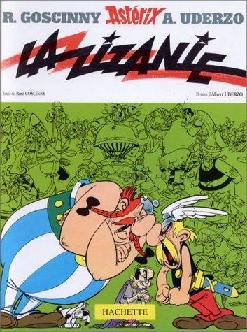
La zizanie
Asterix, Obelix, and Getafix attempt to outwit the greedy Tortuous Convolvulus who is trying to make the Gauls suspect each other of treachery.
BOOK

Archaeologies of Colonialism
This book presents a theoretically informed, up-to-date study of interactions between indigenous peoples of Mediterranean France and Etruscan, Greek, and Roman colonists during the first millennium BC. Analyzing archaeological data and ancient texts, Michael Dietler explores these colonial encounters over six centuries, focusing on material culture, urban landscapes, economic practices, and forms of violence. He shows how selective consumption linked native societies and colonists and created transformative relationships for each. Archaeologies of Colonialism also examines the role these ancient encounters played in the formation of modern European identity, colonial ideology, and practices, enumerating the problems for archaeologists attempting to re-examine these past societies.
eBook

Asterix and the Picts
\"When Asterix and Obelix rescue a mysterious Pict named MacAroon, they must journey to Caledonia, now Scotland, to return him to his lady love, Camomilla, the adopted daughter of the old king. However, the treacherous chieftain, MacCabaeus, plans to marry her and claim the throne, with the help of the Romans! What with caber-tossing, bagpipes, malted water and an enormous otter in the loch, can the Gauls reunited MacAroon and Camomilla and enjoy some Roman-bashing along the way?\"-- page [4] of cover.
Book

Bishops and the Politics of Patronage in Merovingian Gaul
Following the dissolution of the Western Roman Empire, local Christian leaders were confronted with the problem of how to conceptualize and administer their regional churches. As Gregory Halfond shows, the bishops of post-Roman Gaul oversaw a transformation in the relationship between church and state. He shows that by constituting themselves as a corporate body, the Gallic episcopate was able to wield significant political influence on local, regional, and kingdom-wide scales.
Gallo-Frankish bishops were conscious of their corporate membership in an exclusive order, the rights and responsibilities of which were consistently being redefined and subsequently expressed through liturgy, dress, physical space, preaching, and association with cults of sanctity. But as Halfond demonstrates, individual bishops, motivated by the promise of royal patronage to provide various forms of service to the court, often struggled, sometimes unsuccessfully, to balance their competing loyalties. However, even the resulting conflicts between individual bishops did not, he shows, fundamentally undermine the Gallo-Frankish episcopate's corporate identity or integrity. Ultimately, Halfond provides a far more subtle and sophisticated understanding of church-state relations across the early medieval period.
eBook

L'anniversaire d'Astérix et Obélix : le livre d'or
In 1 A.D., 50 years after the action of the previous books, we meet Astérix and Obelix and their friends surrounded by their children and grandchildren. Astérix and Obelix are remembering the celebration 50 years ago of their birthday (which happens to be on the same day) and how all their friends (and enemies) wrote them or visited bearing gifts.
Book

Cemeteries and Society in Merovingian Gaul
This volume collects seven of Guy Halsall's most important essays on the social interpretation Merovingian cemetery archaeology, alongside two rewritten pieces and two wholly new articles. These are accompanied by five 'commentaries' on the debates to which these chapters contributed.
eBook

Julius Caesar’s Battle for Gaul
Between 58 and 51 BC Julius Caesar conquered Gaul. He campaigned across much of present day France and the Low Countries, crossed the Rhine to Germany, and sailed the Channel to invade Britain. In doing this he achieved immense personal wealth and glory and the loyalty of a battle-hardened army of veterans. Caesar’s eventual return to Rome began with the crossing of the Rubicon which started a bloody civil war from which he emerged victorious and as dictator.Roman historians have little to say on the consequences of the war on the Iron Age communities of north-west Europe. Their story is told instead by archaeology and numismatics. Huge numbers were involved in the war, at a vast cost in people and wealth. In the aftermath, leaders sympathetic to Rome were installed and sometimes whole peoples were resettled. The diplomatic relations created at this time directly affected the eventual incorporation of these peoples into the Roman Empire.This book presents the latest archaeological research on the Battle for Gaul and its aftermath. Based on an acclaimed 2017 conference, it is the first Europe-wide overview and much of the research is published here in English for the first time. After an introduction to recent trends in historical studies, thematic studies and regional surveys analyse the archaeological and numismatic evidence from across north-west Europe. Comparative evidence for the Roman conquest of Spain is also examined, along with the fundamental role that the study of the Battle for Gaul played in shaping the development of Iron Age archaeology. Written by leading international experts, this book will be of interest to archaeologists, numismatists, ancient historians and military historians.
eBook