
Catalogue Search | MBRL


Are you sure you want to remove the book from the shelf?

{{itemTitle}}
23
result(s) for
"Gaza War, 2008-2009"
Sort by:

The mourning news : reporting violent death in a global age
\"A conventional wisdom in media studies is that 'when it bleeds it leads'. The media loves violence and from the newsroom perspective, negative news is good news. Violent death often makes it to the headlines, and mass violent death events often become media events that receive immediate continuous attention worldwide. However, reporting violent death is not only about sending information, but also about the maintenance of society. News about violent death function as media rituals which elicit grief and inform a sense of care and belonging. Accordingly, this book takes a broader sociological and anthropological approach to considering the role of death and the media in organizing social life in a global age. Based on literature on solidarity and social cohesion, death rituals, media rituals, and journalism studies, this book examines whether and how the performance of the media at the occurrence of mass violent death events informs solidarity and interconnectedness on a cosmopolitan level. The book develops the analytics of grievability as an analytical framework that unpacks the ways in which news about death construct grievable death and articulates relational ties between spectators and sufferers. The book employs the analytics of grievability in a comparative manner and analyses the coverage of three different case studies (terror attack, war and natural disaster) by two transnational news networks (BBC World News and Al-Jazeera English). This comparative analysis showcases the centrality of news media in selectively cultivating a sense of cosmopolitan solidarity in a global age\"-- Provided by publisher.
Book

Gaza
The Israeli offensive in Gaza was described by Amnesty international as '22 days of death and destruction'. Sharyn Lock's eyewitness account brings home the horror of life in Gaza beneath the bombs. Sharyn went to the Gaza strip with the Free Gaza Movement, thinking the greatest danger she faced was making it past the Israeli sea blockade in a fishing boat, but soon after her arrival Israel attacked Gaza's 1.5 million inhabitants by land, air and sea. With others from the International Solidarity Movement, Sharyn volunteered with Palestinian ambulances, assisting them as they faced overwhelming civilian casualties. Her candid and dramatic blogs from Gaza gave the world an insight into the conflict that the mainstream media - unable to enter Gaza - couldn't provide. Gaza: Beneath the Bombs provides a view of Gaza difficult to glimpse from outside - of a people who face their oppression not only with courage but with humour.
eBook

Hard Fighting
Like Israel in 2006, the United States today is likely ill prepared for hybrid warfare. To identify lessons that the U.S. military might learn from the Israeli experience in Lebanon, the author examines the state of the Israeli military before the Second Lebanon War, the lessons it learned during that conflict, the reforms it undertook to address its deficiencies, and how it fared during Operation Cast Lead three years later.
eBook
Can Donald Trump Force A Ceasefire In Gaza?, in Economist Video
Can Donald Trump force a ceasefire in Gaza? With Israel’s prime minister, Binyamin Netanyahu, heading to the White House, Mr Trump is hoping to announce an end to the war. Our deputy editor, Ed Carr, explains why it will depend on three factors.
Streaming Video
Economist video. Who will rebuild Gaza?
Who will rebuild Gaza? Since the ceasefire in Gaza was announced, nothing has been done to rebuild the devastated territory. Our Middle East editor, Josie Delap, looks at how much reconstruction could cost, and who might foot the bill.
Streaming Video
Who Will Rebuild Gaza?, in Economist Video
Who will rebuild Gaza? Since the ceasefire in Gaza was announced, nothing has been done to rebuild the devastated territory. Our Middle East editor, Josie Delap, looks at how much reconstruction could cost, and who might foot the bill.
Streaming Video

Gaza
Gaza is among the most densely populated places in the world. Two-thirds of its inhabitants are refugees, and more than half the population is under eighteen years of age. Since Israel occupied Gaza in 1967, it has systematically de-developed the economy. After Hamas won democratic elections in 2006, Israel intensified its blockade of Gaza, and after Hamas consolidated its control of the territory in 2007, Israel tightened its illegal siege another notch. In the meantime, Israel has launched no less than eight military operations against Gaza--culminating in Operation Cast Lead in 2008-9 and Operation Protective Edge in 2014--that left behind over three million tons of rubble. Recent UN reports predict that Gaza will be unlivable by 2020. Norman G. Finkelstein presents a meticulously researched and devastating inquest into Israel's actions of the last decade. He argues that although Israel justified its blockade and violent assaults in the name of self-defense, in fact these actions were cynical exercises of brutal power against an essentially defenseless civilian population. Based on hundreds of human rights reports, the book scrutinizes multifarious violations of international law Israel committed both during its operations and in the course of its decade-long siege of Gaza. It is a monument to Gaza's martyrs and a scorching accusation against their tormenters
eBook

Correspondence: Just War Theory and the 2008–09 Gaza Invasion
Jerome Slater's normative treatment of Israel in the 2008-09 Gaza War spotlights an often misunderstood domain of the security studies field: just war theory. This is a largely understudied area, given its normative framework of analysis in a field that historically is largely devoid of norms. My sense is that this journal may be becoming a forum for the reintroduction of this framework to the field, thanks to Slater's article and Robert Pape's call for a revised standard for humanitarian intervention.2 As a student of the ethics of war, I welcome this development. But precisely because just war theory is understudied, it is still highly prone to oversimplification and abuse. Slater regrettably engages in both in his attempt to apply it to the conduct of Israel in the Gaza War.
Journal Article
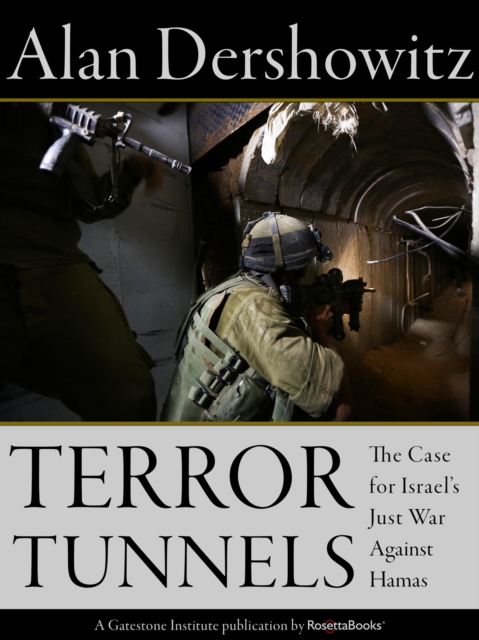
Terror Tunnels
The New York Times–bestselling author \"has focused his internationally recognized expertise and clarity of vision on . . . this evolving terrorist tactic\" (Benjamin Netanyahu).
At a time when Israel is under persistent attack—on the battlefield, by international organizations, and in the court of public opinion—Alan Dershowitz presents a powerful case for Israel's just war against terrorism.
In the spirit of his international bestseller, The Case for Israel, Dershowitz shows why Israel's struggle against Hamas is a fight not only to protect its own citizens, but for all democracies. The nation-state of the Jewish people is providing a model for all who are threatened by terrorist groups—such as ISIS, al-Qaeda, and Boko Haram. Having himself been in one of the Hamas terror tunnels, Dershowitz explains why Israel had no choice but to send in ground troops to protect its civilians against Hamas death squads.
Dershowitz wrote this book to warn the world that unless Hamas's strategy of building terror tunnels and firing rockets from behind human shields is denounced and stopped—by the international community, the media, the academy, and good people of all religions, ethnicities, and nationalities—it will be coming soon \"to a theater near you.\"
Covering all the hot-button issues—from the BDS movement, to the rise of anti-Semitism, to the charge of war crimes, to the prospects of peace— Terror Tunnels: The Case for Israel's Just War Against Hamas is a must-read for all who care about Israel, peace in the Mideast, human rights, and fairness.
eBook