
Catalogue Search | MBRL


Are you sure you want to remove the book from the shelf?

{{itemTitle}}
23
result(s) for
"Gender identity -- England -- History -- 16th century"
Sort by:
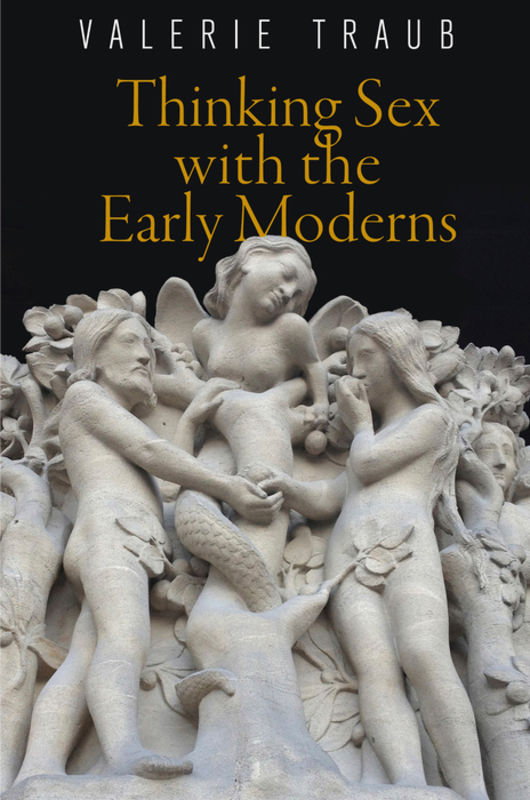
Thinking Sex with the Early Moderns
What do we know about early modern sex? And how do we know it? How, when, and why does sex become history? InThinking Sex with the Early Moderns, Valerie Traub addresses these questions and, in doing so, reorients the ways in which historians and literary critics, feminists and queer theorists approach sexuality and its history. Her answers offer interdisciplinary strategies for confronting the difficulties of making sexual knowledge.
Based on the premise that producing sexual knowledge is difficult because sex itself is often inscrutable,Thinking Sex with the Early Modernsleverages the notions of opacity and impasse to explore barriers to knowledge about sex in the past. Traub argues that the obstacles in making sexual history can illuminate the difficulty of knowing sexuality. She also argues that these impediments themselves can be adopted as a guiding principle of historiography: sex may be good to think with, not because it permits us access but because it doesn't.
eBook

Blood, Bodies and Families
This collection of essays contains a wealth of information on the nature of the family in the early modern period. This is a core topic within economic and social history courses which is taught at most universities. This text gives readers an overview of how feminist historians have been interpreting the history of the family, ever since Laurence Stone's seminal work FAMILY, SEX AND MARRIAGE IN ENGLAND 1500-1800 was published in 1977.The text is divided into three coherent parts on the following themes: bodies and reproduction; maternity from a feminist perspective; and family relationships. Each part is prefaced by a short introduction commenting on new work in the area.This book will appeal to a wide variety of students because of its sociological, historical and economic foci.
eBook

Bible Readers and Lay Writers in Early Modern England
Bible Readers and Lay Writers in Early Modern England studies how immersion in the Bible among layfolk gave rise to a non-professional writing culture, one of the first instances of ordinary people taking up the pen as part of their daily lives. Kate Narveson examines the development of the culture, looking at the close connection between reading and writing practices, the influence of gender, and the habit of applying Scripture to personal experience. She explores too the tensions that arose between lay and clergy as layfolk embraced not just the chance to read Scripture but the opportunity to create a written record of their ideas and experiences, acquiring a new control over their spiritual self-definition and a new mode of gaining status in domestic and communal circles. Based on a study of print and manuscript sources from 1580 to 1660, this book begins by analyzing how lay people were taught to read Scripture both through explicit clerical instruction in techniques such as note-taking and collation, and through indirect means such as exposure to sermons, and then how they adapted those techniques to create their own devotional writing. The first part of the book concludes with case studies of three ordinary lay people, Anne Venn, Nehemiah Wallington, and Richard Willis. The second half of the study turns to the question of how gender registers in this lay scripturalist writing, offering extended attention to the little-studied meditations of Grace, Lady Mildmay. Narveson concludes by arguing that by mid-century, despite clerical anxiety, writing was central to lay engagement with Scripture and had moved the center of religious experience beyond the church walls.
eBook

Women, beauty and power in early modern England : a feminist literary history
Divided into three sections on cosmetics, clothes and hairstyling, this book explores how early modern women regarded beauty culture and in what ways skin, clothes and hair could be used to represent racial, class and gender identities, and to convey political, religious and philosophical ideals.
eBook

Gender, Sexuality, and Material Objects in English Renaissance Verse
An important contribution to recent critical discussions about gender, sexuality, and material culture in Renaissance England, this study analyzes female- and male-authored lyrics to illuminate how gender and sexuality inflected sixteenth- and seventeenth-century poets' conceptualization of relations among people and things, human and non-human subjects and objects. Pamela S. Hammons examines lyrics from both manuscript and print collections”including the verse of authors ranging from Robert Herrick, John Donne, and Ben Jonson to Margaret Cavendish, Lucy Hutchinson, and Aemilia Lanyer”and situates them in relation to legal theories, autobiographies, biographies, plays, and epics. Her approach fills a crucial gap in the conversation, which has focused upon drama and male-authored works, by foregrounding the significance of the lyric and women's writing. Hammons exposes the poetic strategies sixteenth- and seventeenth-century English women used to assert themselves as subjects of property and economic agents”in relation to material items ranging from personal property to real estate”despite the dominant patriarchal ideology insisting they were ideally temporary, passive vehicles for men's wealth. The study details how women imagined their multiple, complex interactions with the material world:the author shows that how a woman poet represents herself in relation to material objects is a flexible fiction she can mobilize for diverse purposes. Because this book analyzes men's and women's poems together, it isolates important gendered differences in how the poets envision human subjects' use, control, possession, and ownership of things and the influences, effects, and power of things over humans. It also adds to the increasing evidence for the pervasiveness of patriarchal anxieties associated with female economic agency in a culture in which women were often treated as objects.
Pamela S. Hammons is an associate professor of English at the University of Miami, USA.
Contents: Introduction: his and hers; Part I Love Tokens: Robert Herrick's gift trouble; Women's poetic portraits of love tokens in heteroerotic courtship; Women's poetic portraits of love tokens in same-sex and divine relationships. Part II Houses and Land: The gendered imagination of real property in Renaissance England; Margaret Cavendish's disguised possession; Lucy Hutchinson's polluted palaces and ekphrastic empire; Conclusion; Bibliography; Index.
eBook

As She Likes It
As She Likes It is the first attempt to tackle head on the enduring question of how to perform those unruly women at the centre of Shakespeare's comedies. Unique amongst both Shakespearian and feminist studies, As She Likes It asks how gender politics affects the production to the comedies, and how gender is represented, both in the text and on the stage. Penny Gay takes a fascinating look at the way Twelfth Night, The Taming of the Shrew, Much Ado About Nothing, As You Like It and Measure for Measure have been staged over the last half a century, when perceptions of gender roles have undergone massive changes. She also interrogates, rigorously but thoughtfully, the relationship between a male theatrical establishment and a burgeoning feminist approach to performance. As illuminating for practitioners as it will be enjoyable and useful for students, As She Likes It will be critical reading for anyone interested in women's experience of theatre.
eBook

The Routledge Handbook of Shakespeare and Animals
Shakespeare’s plays have a long and varied performance history. The relevance of his plays in literary studies cannot be understated, but only recently have scholars been looking into the presence and significance of animals within the canon. Readers will quickly find—without having to do extensive research—that the plays are teeming with animals! In this Handbook, Karen Raber and Holly Dugan delve deep into Shakespeare’s World to illuminate and understand the use of animals in his span of work. This volume supplies a valuable resource, offering a broad and thorough grounding in the many ways animal references and the appearance of actual animals in the plays can be interpreted. It provides a thorough overview; demonstrates rigorous, original research; and charts new frontiers in the field through a broad variety of contributions from an international group of well-known and respected scholars.
eBook

Engendering a Nation
Engendering a Nation adopts a sophisticated feminist analysis to examine the place of gender in contesting representations of nationhood in early modern England. Plays featured include:
* King John * Henry VI, Part I * Henry VI, Part II * Henry, Part III * Richard III * Richard II * Henry V.
It will be a must for students and scholars interested in the cultural and social implications of Shakespeare today.
eBook

Constructions of female homoeroticism in early modern drama
This book explores representations of love and desire between female characters in nearly seventy plays written between 1580 and 1660. The work argues that playwrights of late sixteenth- and early seventeenth-century England recognized and constructed richly diverse tropes of female homoerotic desire. Writers place female characters in erotic situations with other female characters in playful scenarios of mistaken identity, in anxious moments of amorous intrigue, in predatory situations and in enthusiastic, utopian representations of romantic love. These plays indicate an awareness of female homoeroticism in early modern England and belie statements that literary evidence of homosexuality was concerned primarily with men.
eBook