
Catalogue Search | MBRL


Are you sure you want to remove the book from the shelf?

{{itemTitle}}
203
result(s) for
"Generals Germany Biography."
Sort by:

Lossberg's war : the World War I memoirs of a German Chief of Staff
\"General Fritz von Lossberg (1868-1942) directed virtually all the major German defensive battles on the Western Front during the First World War. Hailed as \"the Lion of the Defensive,\" he was an extremely influential military tactician and, unlike many other operations officers of his era, was quick to grasp the changes wrought by technology. Now available for the first time in English, Lossberg's memoir explains how he developed, tested, and implemented his central principles--flexibility, decentralized control, and counterattack--which were based on a need to adapt to shifting conditions on the battlefield. Lossberg first put his theory of elastic defense combined with defense-in-depth into practice during the Battle of Arras (April-May 1917), where it succeeded. At the Battle of Passchendaele (June-November 1917), his achievements on the field proved the feasibility of his strategy of employing a thinly manned front line that minimized the number of soldiers exposed to artillery fire. Lossberg's tactical modernizations have become essential components of army doctrine, and Lossberg's War: The World War I Memoirs of A German Chief of Staff will take readers inside the mind of one of the most significant military innovators of the twentieth century.\"--Provided by publisher.
Book

Dragonslayer
In this fascinating biography of the infamous ideologue Erich Ludendorff, Jay Lockenour complicates the classic depiction of this German World War I hero. Erich Ludendorff created for himself a persona that secured his place as one of the most prominent (and despicable) Germans of the twentieth century. With boundless energy and an obsession with detail, Ludendorff ascended to power and solidified a stable, public position among Germany's most influential. Between 1914 and his death in 1937, he was a war hero, a dictator, a right-wing activist, a failed putschist, a presidential candidate, a publisher, and a would-be prophet. He guided Germany's effort in the Great War between 1916 and 1918 and, importantly, set the tone for a politics of victimhood and revenge in the postwar era. Dragonslayer explores Ludendorff's life after 1918, arguing that the strange or unhinged personal traits most historians attribute to mental collapse were, in fact, integral to Ludendorff's political strategy. Lockenour asserts that Ludendorff patterned himself, sometimes consciously and sometimes unconsciously, on the dragonslayer of Germanic mythology, Siegfried—hero of the epic poem The Niebelungenlied and much admired by German nationalists. The symbolic power of this myth allowed Ludendorff to embody many Germans' fantasies of revenge after their defeat in 1918, keeping him relevant to political discourse despite his failure to hold high office or cultivate a mass following after World War I. Lockenour reveals the influence that Ludendorff's postwar career had on Germany's political culture and radical right during this tumultuous era. Dragonslayer is a tale as fabulist as fiction.
eBook

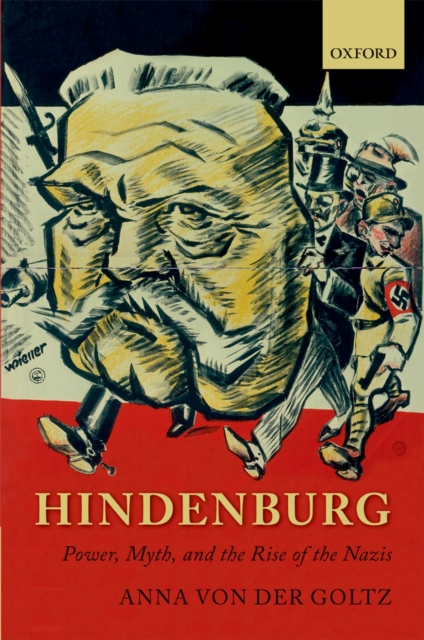
Hindenburg : power, myth, and the rise of the Nazis
Hindenburg: Power, Myth, and the Rise of the Nazis investigates the various political and cultural manifestations of the myth surrounding German Chief of Staff and Reich President Paul von Hindenburg, from the Battle of Tannenberg in 1914 to his death in the ‘Third Reich’ and beyond. How this little-known General, whose career to normal retirement age had provided no real foretaste of his heroic status, became a national icon and living myth, and what this phenomenon tells us about one of the most crucial periods in German history, is the subject of this book. The book charts the origins of the Hindenburg myth during the First World War, looks at how it survived the revolution, and explains why Hindenburg's name on the ballot mesmerized voters in the presidential elections of 1925 and 1932. The only two times in German history that the people could elect their head of state directly and secretly, they chose this national icon; Hindenburg even managed to defeat Hitler in 1932, making him the Nazi leader's ultimate arbiter. The book examines the complex role of the Hindenburg myth in fashioning the Führer cult, while also emphasizing its more wide-ranging appeal prior to 1933. The Hindenburg myth, in fact, caught the imagination of an exceptionally broad social and political coalition of Germans, turning it into one of the most potent forces in German politics in a period otherwise characterised by rupture and fragmentation. Crucially, it managed to survive military failures and political disappointments. As the author shows, the mythical narrative was constantly evolving, but the belief in Hindenburg's mythical qualities was more enduring than a narrow application of Weber's model of ‘charismatic authority’ — which defines projection as key — would suggest.
eBook


Marie von Clausewitz : the woman behind the making of On War
For generations, among those who revere the work of Carl von Clausewitz, the role of his beloved wife, nee Marie von Bruhl, in shaping his seminal work on military theory has been a subject of intense speculation. It seems certain that without her On War would never have been published. But as historian and Clausewitz scholar Vanya Eftimova Bellinger establishes in this ground-breaking biography of the \"other\" Clausewitz, Marie was far more than merely a supportive wife who facilitated her husband's legacy. Marie's 1810 marriage to von Clausewitz did not make sense by most accounts (least of all to her mother). She was a wealthy, cultured, and politically engaged young woman; he was a minor Prussian officer. But the bond between Marie and Claus was forged by love, a deep sense of trust, and a meeting of the minds over common interests. A newly discovered archive of correspondence reveals the extent of Marie's influence on her husband, beginning with the very early days of the courtship and lasting until his premature death. The two came to a \"collaborative opinion\" on many topics, from the moral implications of war to the emotional constitution of true leadership. Marie's involvement, too, adds insight about the role of class and gender relations in a time when women were excluded from politics-the perspective of a spouse and caretaker on the home-front, observing the physical and emotional effects of combat. The issues that Marie von Clausewitz raised about the hardships of war - such as the social isolation and treatment of veterans, and the use of violence to achieve political and economic rights - still resonate today. This biography sheds light on an extraordinary life and mind, offering the first comprehensive and compelling look at the woman behind the composition of On War.
eBook
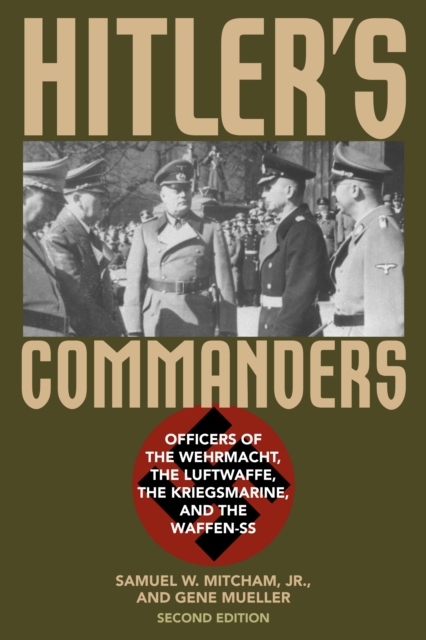
Hitler's Commanders
Now in an expanded edition that includes biographies of the generals of Stalingrad and a new chapter on the panzer commanders, this book offers rare insight into the men who ran Nazi Germany's war machine. Going beyond common stereotypes, Samuel W. Mitcham and Gene Mueller recount the compelling lives of a varied group of army, navy, Luftwaffe, and SS men. Weaving in dramatic stories of tank commanders, fighter pilots in aerial combat, and U-Boat aces, the authors bring the battlefields of World War II to life.
eBook

Friedrich Freiherr Kreß Von Kressenstein
Blick ins Buch Die Quellenedition versammelt Schriften einer schillernden Gestalt der deutschen Militärgeschichte: Friedrich Freiherr Kreß von Kressenstein (1870-1946) war bayerischer General und ging 1913 zur deutschen Militärmission nach Konstantinopel.
eBook
