
Catalogue Search | MBRL


Are you sure you want to remove the book from the shelf?

{{itemTitle}}
692
result(s) for
"Generals Rome History."
Sort by:

Julius Caesar : the boy who conquered an empire
A biography of Julius Caesar, who is famous for conquering Gaul and making himself ruler of the Roman world.
Book

Constantine and the Cities
Over the course of the fourth century, Christianity rose from a religion actively persecuted by the authority of the Roman empire to become the religion of state-a feat largely credited to Constantine the Great. Constantine succeeded in propelling this minority religion to imperial status using the traditional tools of governance, yet his proclamation of his new religious orientation was by no means unambiguous. His coins and inscriptions, public monuments, and pronouncements sent unmistakable signals to his non-Christian subjects that he was willing not only to accept their beliefs about the nature of the divine but also to incorporate traditional forms of religious expression into his own self-presentation. InConstantine and the Cities, Noel Lenski attempts to reconcile these apparent contradictions by examining the dialogic nature of Constantine's power and how his rule was built in the space between his ambitions for the empire and his subjects' efforts to further their own understandings of religious truth.
Focusing on cities and the texts and images produced by their citizens for and about the emperor,Constantine and the Citiesuncovers the interplay of signals between ruler and subject, mapping out the terrain within which Constantine nudged his subjects in the direction of conversion. Reading inscriptions, coins, legal texts, letters, orations, and histories, Lenski demonstrates how Constantine and his subjects used the instruments of government in a struggle for authority over the religion of the empire.
eBook


People under Power
This volume presents a batch of incisive new essays on the relationship between Roman imperial power and ideology and Christian and Jewish life and thought within the empire. Employing diverse methodologies that include historical criticism, rhetorical criticism, postcolonial criticism, and social historical studies, the contributors offer fresh perspectives on a question that is crucial for our understanding not only of the late Roman Empire, but also of the growth and change of Christianity and Judaism in the imperial period.
eBook


Urban Developments in Late Antique and Medieval Rome
A narrative of decline punctuated by periods of renewal has long structured perceptions of Rome's late antique and medieval history. In their probing contributions to this volume, a multi-disciplinary group of scholars provides alternative approaches to understanding the period. Addressing developments in governance, ceremony, literature, art, music, clerical education and the construction of the city's identity, the essays examine how a variety of actors, from poets to popes, productively addressed the intermittent crises and shifting dynamics of these centuries in ways that bolstered the city's resilience. Without denying that the past (both pre-Christian and Christian) consistently remained a powerful touchstone, the studies in this volume offer rich new insights into the myriad ways that Romans, between the fifth and the eleventh centuries, creatively assimilated the past as they shaped their future.
eBook

Who was Julius Caesar?
\"Julius Caesar was a force to be reckoned with as a savvy politician, an impressive orator, and a brave soldier. Born in Rome in 100 BC, he quickly climbed the ladder of Roman politics, making allies--and enemies--along the way. His victories in battle awarded him the support of the people, but flush from power, he named himself dictator for life. The good times, however, would not last much longer. On the Ides of March, Caesar was brutally assassinated by a group of senators determined to end his tyranny, bringing his reign to an end\"-- Provided by publisher.
Book
Constantine
Drawing on recent scholarly advances and new evidence, Timothy Barnes offers a fresh and exciting study of Constantine and his life.First study of Constantine to make use of Kevin Wilkinson's re-dating of the poet Palladas to the reign of Constantine, disproving the predominant scholarly belief that Constantine remained tolerant in matters of.
eBook

Julius Caesar : dictator for life
An introduction of Julius Caesar, who \"rose from chaos to bring order to Rome. After gaining power, he attacked his allies and won a brutal civil war. Then he declared himself dictator and ruled Rome from a golden throne\"--Amazon.com.
Book
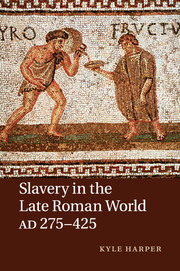
Slavery in the Late Roman World, AD 275–425
Capitalizing on the rich historical record of late antiquity, and employing sophisticated methodologies from social and economic history, this book reinterprets the end of Roman slavery. Kyle Harper challenges traditional interpretations of a transition from antiquity to the Middle Ages, arguing instead that a deep divide runs through 'late antiquity', separating the Roman slave system from its early medieval successors. In the process, he covers the economic, social and institutional dimensions of ancient slavery and presents the most comprehensive analytical treatment of a pre-modern slave system now available. By scouring the late antique record, he has uncovered a wealth of new material, providing fresh insights into the ancient slave system, including slavery's role in agriculture and textile production, its relation to sexual exploitation, and the dynamics of social honor. By demonstrating the vitality of slavery into the later Roman empire, the author shows that Christianity triumphed amidst a genuine slave society.
eBook