
Catalogue Search | MBRL


Are you sure you want to remove the book from the shelf?

{{itemTitle}}
46
result(s) for
"Geography Kuwait"
Sort by:

Urban green areas and their impact on land surface temperature in semi-arid environments: a case study in Kuwait
Urban green areas are considered significant contributors to environmental quality as they have been shown to reduce temperature and noise levels and improve air quality. Consequently, several studies have analyzed the relationship of surface temperature, vegetation cover, and building density using remote sensing indices. However, existing studies have limitations as they either do not explore this relationship in the context of semi-arid urban regions or do not monitor change over multiple years. To address these issues, this study analyzes the relationships among those indices and their changes over a five-year span (in both winter and summer) in the semi-arid urban region of Kuwait. Results showed that 9% of Kuwait's urban area became vegetated from 2013 to 2019, despite the increase in surface temperature, and 4% went the other way. Both surface temperature and vegetation density were correlated with building density. Yet, both were weakly anticorrelated with each other in the summer and uncorrelated in the winter, perhaps due to the lack of densely vegetated spaces in the study area and Kuwait’s arid climate. Nonetheless, selected areas with high vegetation cover showed a significant reduction in surface temperature in the summer, while in the winter there was no to very weak impact on temperature.
Journal Article
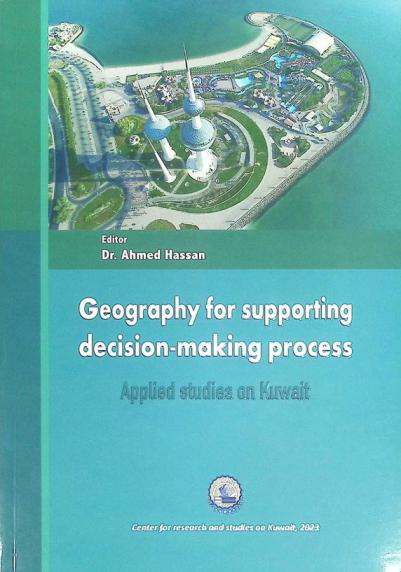
Geography for supporting decision-making process : applied studies on Kuwait
This academic publication explores the vital role of modern geographical sciences in shaping and supporting public policy and strategic planning in the State of Kuwait. Edited by Dr. Ahmed Mohamed Elsayed Hassan Elkasaby, the book presents a collection of empirical studies that demonstrate how spatial analysis, Geographic Information Systems (GIS), and remote sensing can address complex national challenges. The research covers a diverse range of applications, including urban land-use planning, the optimization of transportation networks, environmental risk assessment, and the management of natural resources. By providing data-driven geographical insights, the book aims to bridge the gap between academic research and the practical needs of decision-makers in Kuwaiti governmental and private sectors. It serves as a specialized reference for geographers, urban planners, and policy analysts interested in the intersection of spatial science and sustainable development in the Arabian Gulf.
BOOK

Decreasing trend of imported malaria cases but increasing influx of mixed P. falciparum and P. vivax infections in malaria-free Kuwait
Malaria still continues to be the most important parasitic disease worldwide, affecting 228 million people and causing 405,000 deaths each year. In this retrospective study during 2013 to 2018, we documented the incidence of imported malaria infection and evaluated the impact of malaria preventive measures in Kuwait, a non-endemic country. The epidemiologic and demographic data of all malaria cases was collected from the Infectious Diseases Hospital, Kuwait where all suspected cases of malaria are referred for confirmation and therapeutic intervention. The diagnosis of malaria infection was done by microscopy of Giemsa stained blood films. Selected samples were retested with BinaxNOW ® Malaria rapid test and molecular assay to reconfirm the Plasmodium spp. or mixed infection. Overall, 1913 (25.9%) malaria cases were detected, 81.5% of which were among male subjects. Male subjects had higher incidence of P . vivax malaria (113; 91.1%) and mixed infection with P . falciparum and P . vivax (1245; 90.0%) compared to females who had higher rate of P . falciparum infection (52.4%). An overwhelming majority of malaria cases (1895; 99.1%) were detected among expatriates from malaria-endemic countries; India (1012; 52.9%), Pakistan (390; 20.4%), Afghanistan (94; 4.9%) and African countries (313; 16.3%). Only 18 cases involved Kuwaiti nationals, all with a history of travel to African countries. The majority of malaria cases were detected during the summer and fall months (May-October). Our data showed that the incidence rate of imported malaria cases was stable during 2013 to 2018, however, the incidence of total malaria cases showed a declining trend over the years. This study confirms that the preventive program has been successful in reducing the incidence of imported malaria infections in Kuwait. The most striking finding of this study was high incidence of mixed infection with P . falciparum and P . vivax , with almost all (97%) cases among workers from India.
Journal Article
Relationship between faculty characteristics and their entrepreneurial orientation in higher education institutions in Kuwait
Considering intrapreneurship theory, this study aims to examine the extent to which the entrepreneurial orientation of faculty employed at Kuwaiti higher education institutions differ across their individual-level attributes. Faculty entrepreneurial orientation will be assessed at three levels, i.e., innovativeness, risk-taking, and proactivity. For this purpose, we surveyed a sample of 291 faculty from Kuwaiti colleges and universities. The core constructs were operationalized using scales validated in previous studies. The hypothesized relationships were tested using the structural equation modeling method. Our findings indicate that while female faculty are more proactive than men, males are innovative and risk-takers to some extent. Moreover, Ph.D. holders are more proactive and innovative than Master’s degree holders. The relationship between specialization and both innovativeness and risk-taking is significant only for business, but not for engineering. Teaching experience is more positively correlated with faculty proactivity. The number of scientific publications is negatively associated with faculty risk-taking propensity. Additionally, faculty who cumulated significant industry experience are proactive in identifying long-term opportunities and threats for their institutions. Having earned professional certifications is positively related to some aspects of innovativeness and proactivity. Finally, faculty who received their latest degree from a non-accredited institution are more active in realizing ideas at work.
Journal Article

Applying GIS and Text Mining Methods to Twitter Data to Explore the Spatiotemporal Patterns of Topics of Interest in Kuwait
Researchers have developed various approaches for exploring the spatial information, temporal patterns, and Twitter content in topics of interest in order to generate a better understanding of human behavior; however, few investigations have integrated these three dimensions simultaneously. This study analyzes the content of tweets in order to conduct a spatiotemporal exploration of the main topics of interest in Kuwait in order to provide a deeper understanding of the topics people think about, when they think about them, and where they tweet about them. To this end, we collect, process, and analyze tweets from nearly 120 areas in Kuwait over a 10-month period. The study’s results indicate that religion, emotions, education, and public policy are the most popular topics of interest in Kuwait. Regarding the spatiotemporal analysis, people post more tweets regarding religion on Fridays, a holy day for Muslims in Kuwait. Moreover, people are more likely to tweet about policy and education on weekdays rather than weekends. In contrast, people tweet about emotional expressions more often on weekends. From the spatial perspectives, spatial clustering in topics occurs across the days of the week. The findings are applicable to further topic analysis and similar research in other countries.
Journal Article

Attitudes of Drivers towards Electric Vehicles in Kuwait
Although researchers have started to examine the landscape of electric vehicles (EVs) around the world, very little research has examined this phenomenon in Kuwait. In addition, limited research has explored it among drivers. Kuwait constitutes a very promising market for EVs because there is a need to lower GHG emissions and improve the air quality in Kuwait. This study therefore explored the attitudes of conventional car internal combustion engine (ICE) drivers towards EVs in Kuwait, particularly identifying attributes, features, enablers, and barriers of EVs that are considered important by potential consumers in Kuwait. This study utilized a mixed method approach in terms of quantitative data and qualitative data from a sample of 472 drivers to accomplish the main objectives of this study. The study showed that more than half of participants would buy an EV within the next 3 years, and they would buy if several conditions were met. That includes a cheaper purchase price with the assistance of policies controlled by the government along with the availability of suitable infrastructure for EVs relating to charging stations, fast lanes, and free parking spaces. More than 40% of participants would also seriously start thinking about buying an EV if the gas/fuel prices increased by between 50 and 199%. More than 40% of participants thought that EVs are safe in relation to fire and car crashes. Furthermore, approximately half of participants would pay 6–20% more for an EV that is both environmentally friendly and much quicker than gasoline cars. In addition, participants would also prefer EVs over gasoline cars in the future for their environmental, economic, and technological values. More importantly, the study yielded many significant findings, such as the demanded and preferred features of EVs and reflections on the readiness of the Kuwaiti market.
Journal Article

Assessing Public Perceptions and Technical Potential of Waste-to-Energy in Kuwait’s Residential Sector
Kuwait faces mounting challenges in municipal solid waste (MSW) management alongside continued dependence on fossil-fuel-based electricity generation. Per capita waste generation in Kuwait is approximately 1.7 kg/person/day, exceeding the global average of 0.74 kg/person/day, indicating substantial potential for resource recovery and energy conversion. This study evaluates public perceptions of waste-to-energy (WtE) in Kuwait’s residential sector and estimates the potential electricity that could be generated from household waste. A structured online household survey (n = 470) was administered to assess socio-demographic characteristics and key perception constructs, including awareness, perceived risks, perceived benefits, and overall attitudes toward WtE. In parallel, a quantitative estimation was undertaken using literature-based parameters for monthly per capita waste generation and electricity consumption to derive household-level waste quantities, corresponding energy potential, and generated-to-consumed energy ratios. Survey findings indicate generally favourable attitudes toward WtE and recognition of its potential to reduce landfill dependence and contribute to electricity supply, although respondents showed stronger support for locating WtE facilities away from residential neighbourhoods. Perceived risks—particularly related to health and environmental impacts—remained salient, while perceived benefits associated with waste reduction and local economic value were also acknowledged. The technical assessment indicates that higher waste generation increases theoretical energy recovery potential; however, high residential electricity demand reduces the relative contribution of WtE, with a generated-to-consumed energy ratio of approximately 2, compared with a global benchmark ratio of 4.1. This study highlights the need for targeted public engagement, improved source segregation, and more detailed Kuwait-specific technical and economic evaluations to support evidence-based WtE policy and investment decisions.
Journal Article

Wellbeing Matters in Kuwait
Wellbeing is predictive of improved learning outcomes, better mental health, prosocial and civic behavior, higher work productivity, and enhanced life satisfaction. Given that literature in support of wellbeing is robust, it is incumbent on local communities to put this research into practice and develop culturally-competent programs that promote the skills to increase it. In collaboration with Alnowair, a non-profit organization committed to increasing wellbeing in Kuwait, a semester-long positive psychology program, called Bareec, was designed to generate positive emotions and increase levels of flourishing in university and secondary school students. The Bareec program consisted of 15-min weekly instructions in positive psychology and positive psychology interventions. To test the program’s efficacy, Bareec was implemented in the national public university and in 10 secondary schools (total N = 977). Relative to control groups, Bareec university participants showed greater levels of flourishing (eudaimonic wellbeing; d = .32), while secondary school participants showed enhanced positive affect (hedonic wellbeing; d = .27) in addition to a small improvement in flourishing (d = .15).
Journal Article

GIS-based Spatial Analysis of Population Density in Kuwait, 1957 to 2020
Population density is among the most insightful demographical metrics for urban planners, land developers and researchers in the geography sector. In this article, a Geographical Information System (GIS) framework is designed to study the spatial and temporal population density trends and investigate whether any notable patterns may be attributed to the socioeconomic factors prevalent in each period. The methodology involves collecting spatial population data over time and using GIS to overlay the population density changes against various socioeconomic parameters in Kuwait. The results indicate that the population density is strongly correlated to the national and international economic and political conditions of each respective period. Furthermore, the population tended to form high density clusters. The findings suggest that future development shall aim to address the impacts of high population density, and the effects of the pandemic and global energy and economic turbulence on Kuwait's labor market and lifestyle over 2020-2022.
Journal Article