
Catalogue Search | MBRL


Are you sure you want to remove the book from the shelf?

{{itemTitle}}
21,950
result(s) for
"Geography Maps"
Sort by:

National Geographic family reference atlas of the world
Maps have been around in some form or other since humans first understood the need to record their physical space, and for the past hundred years, the National Geographic Society has been at the forefront of mapmaking. This Fourth Edition of our popularFamily Reference Atlas of the World brings you the world and its marvels -- through maps.Using the latest technological advances, satellite data has been compiled to create some 1,400 images -- maps, diagrams, graphs, and tables, as well as National Geographic's signature color photographs -- to allow you to examine the most remote corners of the globe. In an era when political, health, climatic, and environmental crises anywhere on the globe can affect our daily lives, maps provide a time-honored way to navigate the realities we face. With this atlas, you hold a powerful yet accessible tool to understanding the interplay of global forces at work in the fast-changing but always miraculous planet that is our home.
Book

Portraying the Land
The book presents and discusses a large corpus of Jewish maps of the Holy Land that were drawn by Jewish scholars from the 11th to the 20th century, and thus fills a significant lacuna both in the history of cartography and in Jewish studies. The maps depict the biblical borders of the Holy Land, the allotments of the tribes, and the forty years of wanderings in the desert. Most of these maps are in Hebrew although there are several in Yiddish, Ladino and in European languages. The book focuses on four aspects: it presents an up-to-date corpus of known maps of various types and genres; it suggests a classification of these maps according to their source, shape and content; it presents and analyses the main topics that were depicted in the maps; and it puts the maps in their historical and cultural contexts, both within the Jewish world and the sphere of European cartography of their time. The book is an innovative contribution to the fields of history of cartography and Jewish studies. It is written for both professional readers and the general public. The Hebrew edition (2014), won the Izhak Ben-Zvi Prize.
eBook

The atlas of the real world : mapping the way we live
In this definitive reference, sophisticated software combines with comprehensive analysis of every aspect of life to represent the world as it really is. Digitally modified maps or cartograms depict the areas and countries of the world not by their physical size, but by their demographic importance on a vast range of subjects, from basic data on population, health, and occupation to how many toys we import and who is eating the most vegetables.
Book

The Routledge Atlas of Central Eurasian Affairs
Providing concisely written entries on the most important current issues in Central Asia and Eurasia, this atlas offers relevant background information on the region's place in the contemporary political and economic world.
Features include:
Profiles of the constituent countries of Central Asia, namely Kazakhstan, Kyrgyzstan, Tajikistan, Turkmenistan, and Uzbekistan
Profiles of Mongolia, western China, Tibet, and the three Caucasus states of Armenia, Azerbaijan, and Georgia
Timely and significant original maps and data for each entry
A comprehensive glossary, places index and subject index of major concepts, terms and regional issues
Bibliography and useful websites section
Designed for use in teaching undergraduate and graduate classes and seminars in geography, history, economics, anthropology, international relations, political science and the environment as well as regional courses on the Former Soviet Union, Central Asia, and Eurasia, this atlas is also a comprehensive reference source for libraries and scholars interested in these fields.
eBook

Historical atlas of the ancient world
This new atlas of the ancient world illustrates the political, economic, social and cultural developments in the ancient Near East, the Mediterranean world, the Byzantine Empire, the Islamic world and the Holy Roman Empire from the 3rd millennium BC until the 15th century AD. The atlas has 170 large color maps that document the main historical developments. Each map is accompanied by a text that outlines the main historical developments. These texts include bibliographies and 65 additional maps, tables, and stemmata that provide further elucidation.
Book

Historical atlas of northeast Asia, 1590-2010
Four hundred years ago, indigenous peoples occupied the vast region that today encompasses Korea, Manchuria, the Mongolian Plateau, and Eastern Siberia. Over time, these populations struggled to maintain autonomy as Russia, China, and Japan sought hegemony over the region. Especially from the turn of the twentieth century onward, indigenous peoples pursued self-determination in a number of ways, and new states, many of them now largely forgotten, rose and fell as great power imperialism, indigenous nationalism, and modern ideologies competed for dominance. This atlas tracks the political configuration of Northeast Asia in ten-year segments from 1590 to 1890, in five-year segments from 1890 to 1960, and in ten-year segments from 1960 to 2010, delineating the distinct history and importance of the region. The text follows the rise and fall of the Qing dynasty in China, founded by the semi-nomadic Manchus; the Russian colonization of Siberia; the growth of Japanese influence; the movements of peoples, armies, and borders; and political, social, and economic developments—reflecting the turbulence of the land that was once the world's \"cradle of conflict.\" Compiled from detailed research in English, Chinese, Japanese, French, Dutch, German, Mongolian, and Russian sources, the Historical Atlas of Northeast Asia incorporates information made public with the fall of the Soviet Union and includes fifty-five specially drawn maps, as well as twenty historical maps contrasting local and outsider perspectives. Four introductory maps survey the region's diverse topography, climate, vegetation, and ethnicity.
eBook

Historical atlas of the British Isles
\"Illustrated with 150 full-colour maps and plans that range many topics, such as agricultural, political and industrial revolutions\"--The publisher.
Book

The Routledge Atlas of the Arab-Israeli Conflict
The Routledge Atlas of the Arab-Israeli Conflict traces not only the tangled and bitter history of the Arab-Jewish struggle from the early twentieth century to the present, including the death of Yasser Arafat and recent proposals for compromise and co-operation, it also illustrates the current moves towards finding peace, and the efforts to bring the horrors of the fighting to an end through negotiation and agreed boundaries. In 227 maps, the complete history of the conflict is revealed, including: The Prelude and Background to the Conflict - from the presence of Jews in Palestine before the Arab conquest to the attitude of Britain to the Arabs and Jews since 1915 The Jewish National Home - from the early Jewish settlement and the Zionist plan for Palestine in 1919 to the involvement of the Arab world from 1945 to the present day The Intensification of the Conflict - from the Arab response to the United Nations partition plan of November 1947 to the declaration of Israeli independence in May 1948 The State of Israel - from the Israeli War of Independence and the Suez and Six Day Wars to the October War (the Yom Kippur War), the first and second intifadas, the suicide-bomb campaign, the Israel-Hezbollah War of 2006, Operation Cast lead against the Gaza Strip in 2009, the Gaza Flotilla of 2012 and Nakba Day 2011 The Moves to find Peace - from the first and second Camp David talks and the death of Arafat, to the continuing search for peace, including the Annapolis Conference, 2007, the work of the Quartet Emissary, Tony Blair 2007-2011, and the ongoing Palestinian search for statehood.
eBook

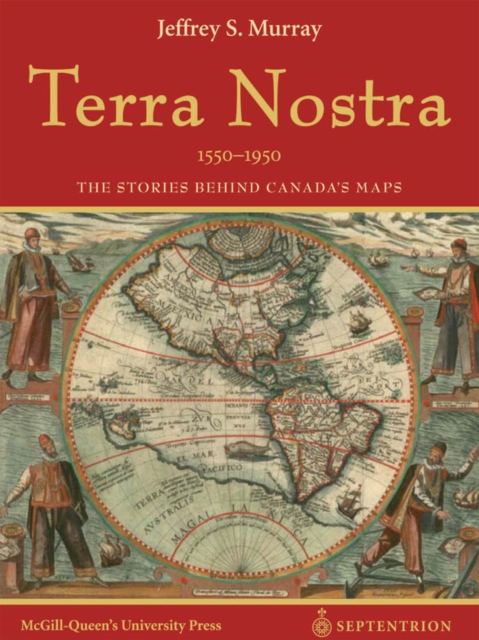
Terra Nostra, 1550-1950: The Stories Behind Canada's Maps
A celebration of four centuries of cartographic history
eBook