
Catalogue Search | MBRL


Are you sure you want to remove the book from the shelf?

{{itemTitle}}
402
result(s) for
"Geopolitics Asia, Central."
Sort by:

The new Central Asia : the regional impact of international actors
This book focuses on Central Asia's place in world affairs and how international politics of state-building has affected the Asian region, thus filling the gaps in ongoing discussions on the rise of Asia in global governance. It also attempts to generalize and contextualize the \"Central Asian experience\" and re-evaluate its comparative relevance, by explaining the complex dynamics of Central Asian politics through a detailed analysis of the effects of major international actors -- both international organizations as well as current and rising great powers.--Publisher's description.
Book
Central Asia at the End of the Transition
For better or worse, the former Soviet republics of Central Asia have largely completed their post-independence transitions. Over more than a decade, they have established themselves as independent states whose internal regimes and external relations have characteristic patterns and vulnerabilities both individually and as a group. The purpose of this volume is to assess both what has been accomplished and the trends of development in the region, especially its leading states. How sound are the foundations of this \"bulwark against the spread of terrorism\" in Eurasia?
eBook

Afghanistan and Its Neighbors after the NATO Withdrawal
The planned reductions in NATO troop numbers in Afghanistan through 2015 and a final withdrawal at the end of 2016 brings up numerous pressing questions about the security and national interests of not just Afghanistan, but of the broader region itself.
eBook

Securing the Indian Frontier in Central Asia
The three decades between 1865 and 1895 marked a particularly contentious period in the relationship between Britain and Russia in Central Asia, which more than once brought them to the verge of war. Moderates tried to settle the problem by the negotiation of ‘neutral zones’, or firm boundaries, but the issue was complicated by misreading of intentions, much internal confusion and dispute, and considerable ignorance of the geographical and geopolitical factors involved.
This careful and detailed analysis examines the strategic thinking and diplomatic discourse which underlay the whole period, and in particular of the succession of efforts to establish a frontier, which eventually brought the period to a close without a major confrontation being provoked. Based on relevant records in the PRO and the British Library, as well as private papers, press comment, parliamentary debates and other contemporary accounts, Sir Martin Ewans provides a ‘history of thought' of this crucial period in Central Asia. He provides an insight into the manner in which issues of war and peace were handled in the 19 th Century and a fascinating case study of a great power relationship prior to the First World War. An important contribution to the study of Asian history, Tsarist Russia, imperial history and the history of British India, this book will also be of interest in India and Pakistan as a study of the events that led to the definition and consolidation of their northern frontiers.
Introduction 1. Prelude 2. Russia and the Central Asian Khanates 3. The British Debate 4. Anglo-Russian Negotiations, 1865-1873 5. The Agreement of 1873 6. Kashgar 7. The Revival of the ‘Forward Policy’ 8. The ‘Forward Policy’ Enforced 9. War with Afghanistan 10. The Seizure of Merv 11. The Pandjeh Crisis 12. The Settlement of the Western Frontier 13. The Erosion of the 1873 Agreement 14. Confrontation in the Pamirs 15. The Consolidation of Dardistan 16. The Pamirs Settlement 17. Epilogue Appendix 1: The Gorchakov Memorandum of 1864 Appendix 2: The Anglo-Russian Agreement of 1973 Appendix 3: The Gorchakov Memorandum of 1875 Appendix 4: The Western Frontier: Protocol of 1885 Appendix 5: Col. Ridgeway’s Report on the Western Frontier, 1887 Appendix 6: The ‘Durand Agreement’ of 1893 Appendix 7: The Pamirs Agreement of 1895
'Ewans’s book is an important contribution to cartographic history. Its significance lies not just in the 11 maps that bring to the forefront the complexities of terrain and political boundaries, nor in the details of the negotiations in the series of appendices that indicates how the lines were finally agreed upon, but in the fact that the author portrays very clearly the ambiguities that plagued the negotiations on both sides, ambiguities that resulted from a limited knowledge of the topography, ethnography and spheres of influence that existed in the region.' - Anita Sengupta, Maulana Abul Kalam Azad Institute of Asian Studies, Kolkata; Central Asian Survey, Vol. 30, No. 1, March 2011
'[Martin Ewans's] book, based on thorough research, is a welcome addition to the literature on the subject... no serious student of boundary-making can afford to ignore this very instructive work.\" - A.G. Noorani; Frontline, Volume 29 - Issue 01 : Jan. 14-27, 2012
Sir Martin Ewans is a former diplomat, who in the course of his career was closely concerned with Central Asian and South Asian affairs, including postings in India, Pakistan and Afghanistan. Since retiring, he has written a number of books, including two on Afghanistan.
eBook

The European Union's influence in Central Asia
Unknown yet highly strategic, Central Asia attracts the interest of major global powers due to its vast energy resources and crucial geographic position. Russia, China, and the European Union view this region as an indispensable springboard to enhance their political and economic influence on the Eurasian landmass. Thus, facing strong competition and working on low budget, the EU is attempting to establish itself as a relevant and influential actor in an environment in which its leadership role is far from certain. Unlike in other post-communist regions, the EU is not able to rely on the attractiveness of its political models, and risks being marginalized by other global powers. The crucial question then is: How does the EU exert influence in such a challenging geopolitical context? Which strategies does the EU apply to be an actor who counts? Through an analysis of the EU’s discourse, instruments, and the reception of its policies in Central Asia, this study argues that the EU consciously takes the position of a second-tier actor who acts as a “consultant” and projects a picture of itself as an honest broker with no geopolitical agenda. The EU’s influence is confined to niche domains in the security sphere that are nevertheless important for the regional security. The EU is not a great power in the region nor is it willing to become one. It does, however, have comparative advantages in being perceived as inoffensive and for occupying areas that are neglected by the other actors, such as governance and water security.
eBook

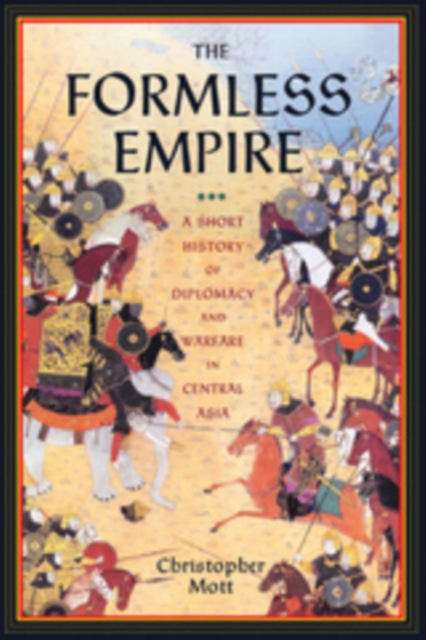
The Formless Empire
The Role of Nomadic Culture in the Evolution of Non-Western Power Politics Central Asia, a vast region extending from eastern Russia and across Kazakhstan, Uzbekistan, Turkmenistan, Afghanistan, Tajikistan, Kyrgystan, Mongolia, and western China, has its own tradition of foreign policy rooted in the ancient nomadic culture of many of its peoples.
eBook