
Catalogue Search | MBRL


Are you sure you want to remove the book from the shelf?

{{itemTitle}}
2,141
result(s) for
"Georgia History."
Sort by:

Middle Georgia and the approach of modernity : essays on race, culture and daily life, 1885/1945
\"This collection of new essays describes the lives of the common people of the day. A grisly mass murder underscored issues of race, class and poverty. African Americans struggled for self-betterment against the rise of Jim Crow. Women striving to overcome gender barriers found a hero in a pioneering Georgian female pilot.\"-- Provided by publisher.
Book

The Culture of Property
This history of the idea of \"neighborhood\" in a major American city examines the transition of Atlanta, Georgia, from a place little concerned with residential segregation, tasteful surroundings, and property control to one marked by extreme concentrations of poverty and racial and class exclusion. Using Atlanta as a lens to view the wider nation, LeeAnn Lands shows how assumptions about race and class have coalesced with attitudes toward residential landscape aesthetics and home ownership to shape public policies that promote and protect white privilege. Lands studies the diffusion of property ideologies on two separate but related levels: within academic, professional, and bureaucratic circles and within circles comprising civic elites and rank-and-file residents. By the 1920s, following the establishment of park neighborhoods such as Druid Hills and Ansley Park, white home owners approached housing and neighborhoods with a particular collection of desires and sensibilities: architectural and landscape continuity, a narrow range of housing values, orderliness, and separation from undesirable land uses-and undesirable people. By the 1950s, these desires and sensibilities had been codified in federal, state, and local standards, practices, and laws. Today, Lands argues, far more is at stake than issues of access to particular neighborhoods, because housing location is tied to the allocation of a broad range of resources, including school funding, infrastructure, and law enforcement. Long after racial segregation has been outlawed, white privilege remains embedded in our culture of home ownership.
eBook

Cultivating success in the South : farm households in the postbellum era
\"This book explores changes in rural households of the Georgia Piedmont through the material culture of farmers as they transitioned from self-sufficiency to market dependence. The period between 1880 and 1910 was a time of dynamic change when Southern farmers struggled to reinvent their lives and livelihoods. Relying on primary documents, including probate inventories, tax lists, state and federal census data, and estate sale results, this study seeks to understand the variables that prompted farm households to assume greater risk in hopes of success as well as those factors that stood in the way of progress. While there are few projects of this type for the late nineteenth century, and fewer still for the New South, the findings challenge the notion of farmers as overly conservative consumers and call into question traditional views of conspicuous consumption as a key indicator of wealth and status\"-- Provided by publisher.
Book

The Struggle for the Georgia Coast
In 1733, General James Edward Oglethorpe officially
established the colony of Georgia, and within three years had
fortified the coast southward toward St. Augustine. Although
this region, originally known as the provinces of Guale and
Mocama, had previously been under Spanish control for more than
a century, territorial fighting had emptied the region of
Spanish missionaries, soldiers, and their Indian allies.
Spanish officials maintained that the long history of Spanish
authority over the territory guaranteed Spain the right to defy
and repel the English intruders. By 1739, with diplomatic
negotiations failing and the potential for war imminent, King
Philip V requested that Don Manuel de Montiano, Governor of
Spanish Florida, provide him with every document from both
governmental and ecclesiastical sources that would demonstrate
prior Spanish presence and control over the region. Original
documents and translations were delivered within the year and
safely filed for future use--then forgotten. With the outbreak
of open war six months earlier, the diplomatic utility of the
documents had passed. For over 250 years, the documents
languished safely in the Archive of the Indies in Seville until
recognized, recovered, translated, and published by John Worth.
Within this volume, Worth brings to light the history of the
documents, provides complete translations and full explanations
of their contents and a narrative exposition of the Spanish
presence along the Atlantic coast never before fully
understood. David Hurst Thomas provides an introduction that
places Worth's translations and his historical overview into
the context of ongoing archaeological excavations on the
Georgia coast. With the publication of this volume, one of the
least known chapters of Georgia history is finally examined in
detail.
eBook


Criminal Injustice
Criminal Injustice: Slaves and Free Blacks in Georgia's Criminal Justice System is the most comprehensive study of the criminal justice system of a slave state to date. McNair traces the evolution of Georgia's legal culture by examining its use of slave codes and slave patrols, as well as presenting data on crimes prosecuted, trial procedures and practices, conviction rates, the appellate process, and punishment. Based on more than four hundred capital cases, McNair's study deploys both narrative and quantitative analysis to get at both the theory and the reality of the criminal procedure for slaves in the century leading up to the Civil War. He shows how whites moved from the utopian innocence of the colony's original Trustees, who envisioned a society free of slavery and the depravity it inculcated in masters, to one where slaveholders became the enforcers of laws and informal rules, the severity of which was limited only by the increasing economic value of their slaves as property. The slaves themselves, regarded under the law both as moveable property and--for the purposes of punishment--as moral agents, had, inevitably, a radically different view of Georgia's slave criminal justice system. Although the rules and procedures were largely the same for both races, the state charged and convicted blacks more frequently and punished them more severely than whites for the same crimes. Courts were also more punitive in their judgment and punishment of black defendants when their victims were white, a pattern of disparate treatment based on race that persists to this day. Informal systems of control in urban households and on rural plantations and farms complemented the formal system and enhanced the power of slaveowners. Criminal Injustice shows how the prerogatives of slavery and white racial domination trumped any hope for legal justice for blacks.
eBook


Discordant Neighbours
Drawing heavily on Georgian sources, the author offers readers a unique opportunity to appreciate why the Abkhazians and South Ossetians have seen no alternative to resisting the threats emanating from Tbilisi by refusing to join an independent Georgia.
eBook

The weeping time : memory and the largest slave auction in American history
\"In 1859, at the largest recorded slave auction in American history, over 400 men, women, and children were sold by the Butler Plantation estates. This book is one of the first to analyze the operation of this auction and trace the lives of slaves before, during, and after their sale. Immersing herself in the personal papers of the Butlers, accounts from journalists that witnessed the auction, genealogical records, and oral histories, Anne C. Bailey weaves together a narrative that brings the auction to life. Demonstrating the resilience of African American families, she includes interviews from the living descendants of slaves sold on the auction block, showing how the memories of slavery have shaped people's lives today. Using the auction as the focal point, The Weeping Time is a compelling and nuanced narrative of one of the most pivotal eras in American history, and how its legacy persists today\"--Publisher.
Book
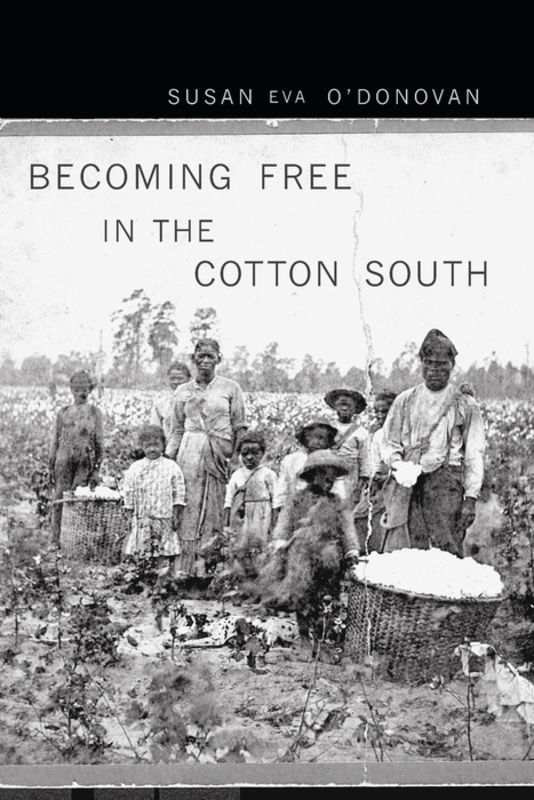
Becoming Free in the Cotton South
This book challenges our most basic ideas about slavery and freedom in America. Instead of seeing emancipation as the beginning or the ending of the story, as most histories do, O'Donovan explores the perilous transition between these two conditions, offering a unique vision of both the enormous changes and the profound continuities in black life before and after the Civil War.
eBook